


Cambridge Acceleration Zone Poses a Growing Concern
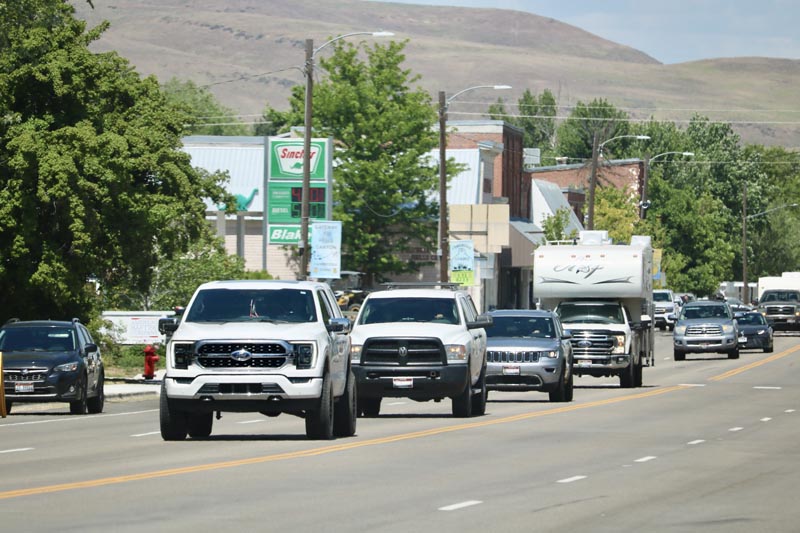
When the city fathers platted the townsite of Cambridge around 1900, they apparently had something pretty grandiose in mind when they allowed for a wide Superior Street, the eventual thoroughfare for U.S. Highway 95. They had no idea that one day their plan for the future would create a dangerous situation.
If you’ve ever wondered who would win a drag race between a Dodge pickup with a 22-foot camper and a Chevy pickup loaded with camping gear and pulling an 18-foot boat, maybe you should visit the business district in Cambridge on any summer weekend.
Since 1962 when U.S. Highway 95 through town was expanded from two to four lanes, the new design has created a dangerous passing lane that continues to threaten the lives of pedestrians and other traffic entering Superior Street from Highway 71 and side streets.
Southbound travelers entering the city limits near the fairgrounds, after following slower vehicles for several miles, often find their first opportunity to pass after rounding the corner in front of the Williamson building and straightening out for the stretch to the other end of town. This has created an acceleration zone where many impatient drivers block out any semblance of regard for anyone or anything that might hold them back.
The established, but mostly ignored speed limit within the city limits is posted at 25 mph. More often than not, if you’re obeying that speed limit, you will be passed regardless of what lane you are in.
As the Treasure Valley population continues to grow, so does the threat to local citizens, as well as to travelers. Recreation traffic to McCall and Valley County that has for years clogged Highway 55, now spills over to Highway 95. More and more fun-seekers are now finding respite from the growing valley mayhem by frequenting Washington and Adams Counties. The majority of plates indicate those passing through here are from Ada and Canyon Counties.
Add to all this the increased daily truck traffic on Idaho’s only unrestricted north-south highway, and you will soon see the folly in trying to pass anyone. Many times if you do get around slower traffic on the way to Weiser, you may be waiting at the first traffic light when they pull up next to you. Some folks endanger their lives and those of others for the sake of netting an extra thirty to sixty seconds, but it happens every day.
Is there a solution to the situation? Let’s explore some possibilities.
Council, our good neighbor to the north, faced a similar situation several years ago. Highway 95 similarly passed through the downtown corridor in much the same way as that in Cambridge. The passage posed similar dangers, but Council had only two narrow lanes to go with two sharp curves. It was almost impossible to parallel park on the street and be able to open your door while cars and trucks were passing a scant few feet away. Their main issue wasn’t speed.
Council’s traffic problem was solved with a nice bypass, but at the expense of any local downtown business that relied on transient traffic. I have no data to support it, but it appears that the community has suffered to a degree because of the shift. Small towns all over the country have suffered the same plight as evidenced by empty storefronts and closed businesses. Is a bypass somewhere in the future for Cambridge?
Would a redesign of the corridor in Cambridge be the answer? In a recent off-the-record conversation, Mayor Mark Loveland suggested that a reduction from two lanes to one with the addition of a center turnout lane with maybe even bike lanes may solve the problem. That suggestion certainly has merit and would eliminate the passing lane.
Would increased law enforcement presence be a remedy? Cambridge relies on our Washington County Sheriff’s office for traffic control, and while they do a great job and there is a significant noticeable difference in behavior when they’re patrolling the street, they are severely limited on the number of hours they can be present. Is a permanent traffic control officer somewhere in the city’s future?
Perhaps increased signage would help alleviate the problem. The city already has digital speed tracking signs, but they appear to be ignored nearly as much as the static speed limit signs. There are no signs that warn through traffic of others entering from Highway 71. Perhaps a traffic light at this intersection, similar to the one installed on Highway 55 where the Banks-Lowman Highway enters is in order.
Once again, the possibility of an Emmett to Mesa Highway has resurfaced. With the increased population and commerce in the Treasure Valley, this option looms once again in spite of the massive cost. The new freeway interchange from I-84 to Emmett would be a perfect connection for a new north-south highway, bypassing several small towns along 95 and 55.
At least for now, the simplest, least expensive, and most logical solution to the problem is for people to just obey and respect our current traffic laws. Just how that can be accomplished in a society where many federal and local laws are seemingly ignored without consequence remains to be seen.
Meanwhile, the bulk of the responsibility for your personal safety remains with each of us as individuals. Situational awareness may protect you to a degree. Put away or your cell phone, check your mirrors before you step out of your car, use the crosswalks, and keep an eye on your own speed. Drive and walk defensively.
Until a permanent solution is implemented, you are on your own!