

Extension Office Hosts Drone Workshop in Cambridge
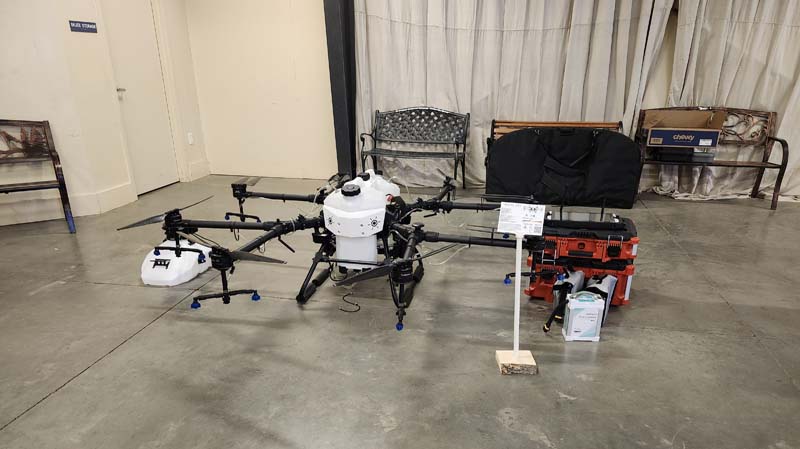
The Washington County Extension Office hosted, “The Introduction to Drones,” in Cambridge at the exhibit hall on Wednesday, April 23, 2025. The guest speakers were Dr. Jason Karl and Dr. Tim Prather. The topics discussed were drone uses, drone regulations, demonstration, and hands on learning: flying a drone.
If you have always wanted a drone and are interested in knowing more about them, the workshop was a great learning opportunity. This workshop was also helpful to farmers or ranchers who may have seen or heard about drones being used to spray or seed fields and were curious about practical applications for their own farms and ranches.
Dr. Karl runs the Drone Lab for the University of Idaho. He discussed the uses of drones in agriculture and natural resources. One use of drones in agriculture is weed control. This application can be used in fields at any time, whereas tractors or 4-wheelers are limited to times when fields are dry. Drones can be used on hills and other areas that would be inaccessible or too dangerous for tractors or 4-wheelers. The drones are capable of reaching areas that would be too difficult on foot.
Seeding of crops is another important capability of drones. Drones give farmers the ability to seed in places that are hard to get to with traditional seeding methods. For example, drones could be helpful for reseeding after fires, like we’ve had in the area over the last several years. Using drones on locations with steep and dangerous hillsides, would be safer and also less time consuming than other methods.
The payload that a drone is capable of carrying is important when determining the use of a drone for an agriculture application. There are drones that have a very limited payload of 6 to 10 kilograms. These types of drones are good for mapping an area or data collection. Drones that are capable of carrying a payload of 110 pounds can be used for spraying or seeding.
The price range of drones varies from about $279.00 to $50,000, depending on the usage and need. There are also more expensive ones. If a farmer or rancher was looking for a spray drone, the price of those typically run between $30,000 and $50,000.
There are many laws to be aware of when flying a drone. Drones cannot be flown in national parks, wilderness areas, or in other restricted airspace. Do not fly your drone under the influence of alcohol or drugs. Make sure that you can see your drone at all times when flying. Do not fly over people. These are just a few of the laws to be aware of, but it’s also important to be aware of when you need a drone license. An online search will help you to know what laws you need to be aware of if you are going to fly a drone in Idaho.
Dr. Tim Prather discussed weed control and the considerations for herbicide applications. The discussion included helicopter, airplane and drone application. He also talked about finding the best herbicide droplet coverage when spraying, in order to achieve the best outcomes.
Tyler O’Donnell, Extension Educator, talked about the ways that drones and drone cameras can be helpful to farmers and ranchers. He said that the quality of the newer drone cameras is so good that cow tags can even be read with clarity, where that was not the case a few years ago. The drones can be used for checking on calving, counting or tracking cattle. Other options include pasture monitoring, checking on fences and water, and even the possibility of herding cows with drones. General monitoring is also made easier with a drone. For example, assessing trees, seeing what’s over the hill, monitoring flooding, checking for predators and wildlife, and seeing if the top of the barn needs repaired, can all be done from the ground with a drone.
Royce Schwenkfelder, Mark Moura and Wyatt Moura were available to talk about their drone and the trailer that they built to use with their drone. They use their drone for spraying and seeding. The discussion went over the things that they have learned since purchasing their drone, including cost, licensure, and other things that go into owning and using a drone. One of the benefits of having their own drone is that they can plan things on their own schedule and not be waiting for a commercial sprayer to get them on their calendar.
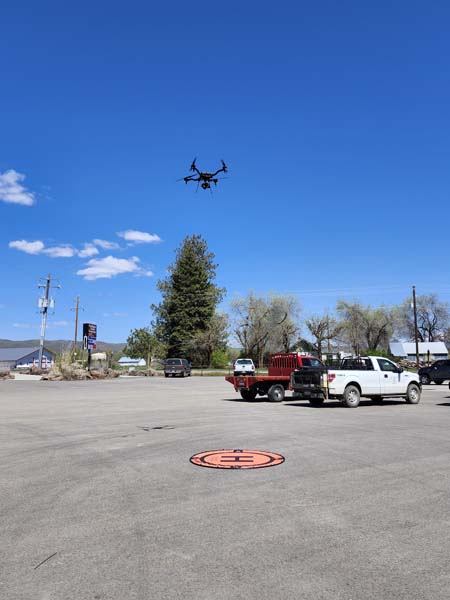
To conclude the workshop, Dr. Karl gave a drone demonstration. Everyone was given the chance to do some hands-on learning and fly a small drone, but most declined. Dr. Karl flew a larger drone that he uses for mapping. As this drone flew, he explained how it worked to create maps. The drone workshop was interesting and a great opportunity to learn more about drones, pricing, capabilities, licensure and laws related to flying a drone.