

Lower Weiser River CWMA’s First 2025 Spray Day
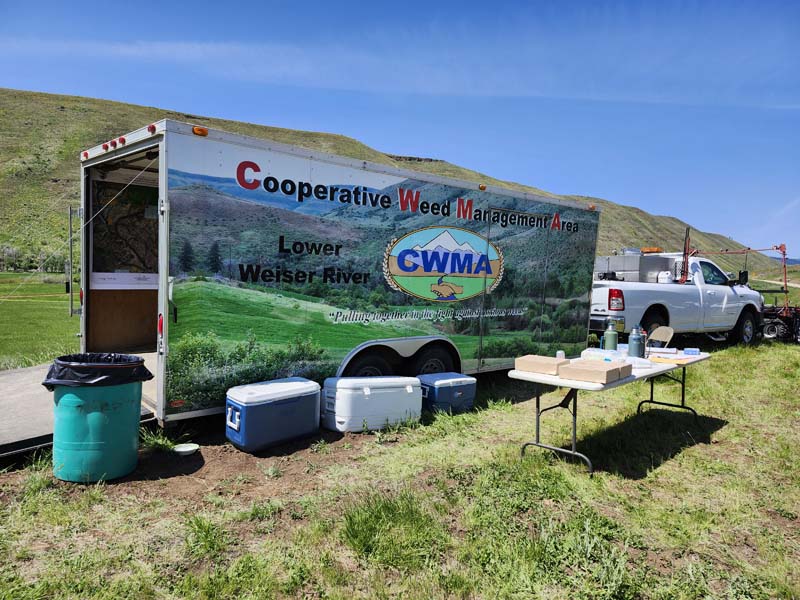
If you have lived in Washington County for a while, you may have heard about “Spray Day.” In a years’ time, there will be 21 spray days, split between spring and fall, throughout the county. This years’ first spray day was on May 1, 2025, outside of Cambridge, on Highway 71. Spray days are the days when the landowners, mainly farmers and ranchers, get together with the county to spray noxious weeds.
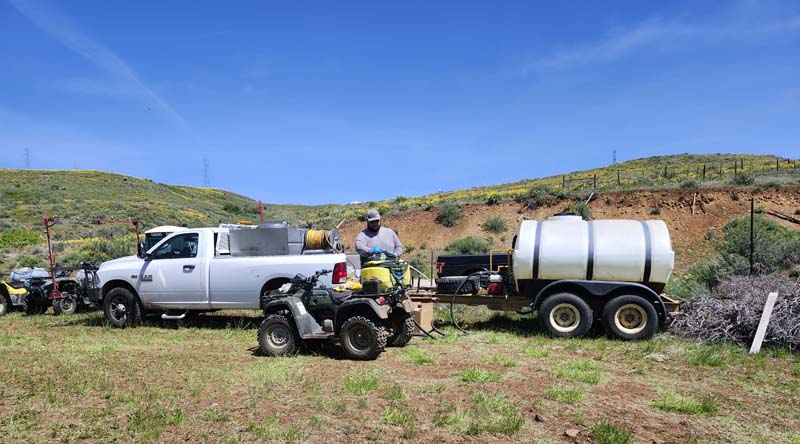
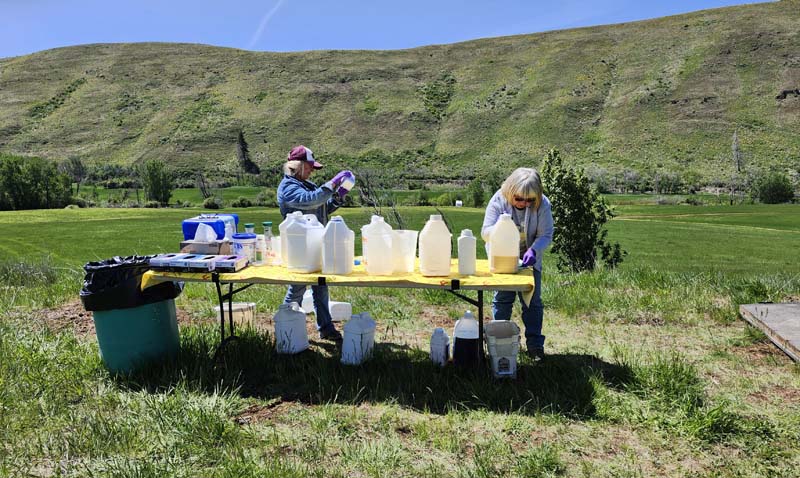
For this first spray day, the LWRCWMA (Lower Weiser River Cooperative Weed Management Area) set-up on the Roy and Linda Mink ranch. The Mink’s offer a corner of their ranch, with easy access to the highway, to be used by the county. Everybody shows up with their own sprayer set-up, which are typically 4-wheelers, side-by-sides, and tractors with spray tanks. There is also an occasional backpack sprayer. Bonnie Davis, County Weed Superintendent, Deb DeHaven, Professional Applicator, and Dakota Taylor, Professional Applicator, arrive on site pulling the CWMA trailer and a water tank. They calculate and measure herbicides, fill spray tanks, and do other jobs throughout the day to assist the sprayers. All projects have coordinators. Justin Mink was the coordinator for this spray day.
Bonnie visited with me about the LWRCWMA. The LWRCWMA basically takes in all of Washington County. She discussed the basic idea behind the LWRCWMA, “It is all about blurring the boundaries, neighbors cooperating with neighbors and bringing some of those old ideas back like the barn raisings, building camaraderie and letting people know that they aren’t fighting this alone.” When talking about weed law, Bonnie stated, “Weed law is a well written law, but if you enforced the law to its full extent, it would bankrupt the county, and it would bankrupt the State. You have to be reasonable, and we all have weeds, so the best way to go about it is to fight it together.” Today, Idaho has over 30 CWMAs covering 87 percent of the state.
Washington County hasn’t always had a CWMA. The county had a commissioner years back that worked closely with the Weed Department. There was also an individual at the State at the time who worked as the Noxious Weed Coordinator. This person talked a lot about CWMAs, blurring the boundaries, and everyone working towards the same goal. The thought of CWMAs really hit home with this particular Washington County Commissioner. He wanted to see a CWMA through and he hand-picked a board of people that were tax paying citizens, mainly agriculture people, and asked them if they wanted to sign-on to help develop this CWMA. Board members were the ones who voted at the meetings. Agency people were welcomed at the meetings but they were only technical advisors and did not vote. Washington County is unique in this way.
The board first met in November of 2000, and by the spring of 2001, the Weed Department went to the field with two or three projects. They didn’t get bogged down with red tape, got the commissioners blessing, and went for it. There were some bumps in the road, but they wanted to show people that it could work. One of the projects that started in 2001, is still going today.
Then the neighborhood project idea came along, with the idea again of blurring the boundaries, and neighbors working together. At that time there was grant funding available through the State. Many people don’t like the idea of grants, but it was nice to be able to tell landowners, all tax paying citizens, that some of their tax dollars were being brought back. One year, Washington County was awarded $100,000 for things like the goat grazing project and funding neighborhood projects. These neighborhood projects were set-up to get the landowner over the hump, and get them to where their weeds were manageable. They weren’t a lifetime funding mechanism.
Later on, people wanted to keep the weed control project going. So, the board took a lot of time figuring out a way to make it work. This CWMA began in 2008. The first three years the chemical is fully funded. For the next three years, 50 percent is funded by the landowner and 50 percent is funded by the county. At year seven, the landowner is 100 percent responsible for the chemical. This year, all of the projects are self-funded and still going on their own. Bonnie noted there is an exception for new people who are moving into project areas, who have never had a chance to participate in the CWMA. They are given two years of full funding and after those two years they are on their own.
Bonnie explained that “It’s good to be able to use all of the tools in the tool box. The bio, which are the insects, grazing, chemical and mechanical, whether you are farming, rehabbing, or fallowing it.”
Bonnie talked about where the LWRCWMA is at this time, “The farmers and ranchers have a vested interest. They see what has been done, and it’s not perfect and we know that, but what if we didn’t? People want to make spray day. They want to be there. It has mended fences with neighbors. It has done some pretty wonderful things over the years and they have sprayed a lot of weeds. We have a sense of pride in what the landowners have accomplished. People ask me around the State, in various meetings, how do you keep this going? How do you get this participation? I tell them, it’s our people, it’s our board and their vision, and our landowners; they care and want to be a part of this.”