

Q&A on Proposed Council Valley Amb. Permanent Special Levy
Quick Facts:
Who: Council Valley Ambulance
What: $226,309 Permanent Special Levy
When: May 19 Election
Where: Council Valley Ambulance District-Adam’s County
Why: Inadequate budget/increased level of care
Editor’s Note: Camille Collings put these questions to Council EMS Director, Cody Murphy. These are the answers he provided.
What dollar amount is the levy for? How many years? What will this cost property owners?
The proposed Special Levy is for $226,309 per year. Per Resolution 2026-08, this is a permanent increase to the Council Valley Ambulance District’s base budget. To pass, Idaho law requires a “supermajority” of 66 2/3% (two-thirds) of the votes cast on May 19, 2026. The estimated cost is $19.73 per $100,000 of taxable assessed value per year. For a home valued at $300,000, this is approximately $59.19 annually, or less than $5.00 per month.
What are the boundaries of the ambulance district, how many residents will this financially impact?
The District serves the residents of Council, Glendale/Fruitvale, Mesa, Indian Valley, and Cuprum. This levy ensures emergency coverage specifically for these areas within southern and western Adams County.
What are the current sources of revenue for the ambulance and how are they determined? Why are they insufficient?
Current revenue comes from property taxes and service billing.
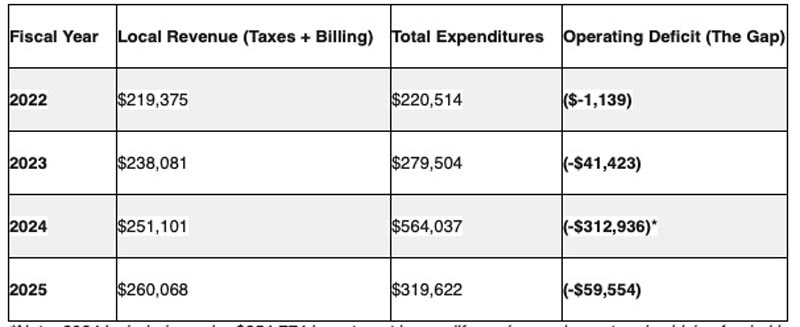
The Structural Deficit: From 2022 to 2025, our local revenue was consistently $34,000 to $60,000 short of our basic operating expenses every year.
The Survival Timeline: We have survived this gap by winning over $600,000 in competitive grants since 2022. However, grants are one-time awards and are never guaranteed. If our grant funding were to cease, Council Valley would only have operational funding for approximately 18 to 24 months before facing total insolvency.
What is the primary purpose of this proposed levy? What specific needs will this levy address that the current budget cannot?
The levy allows us to move from a Basic Life Support (BLS) agency to a Paramedic-led Advanced Life Support (ALS) agency.
Staffing Increase: We currently only have guaranteed in-station staffing for 30 hours a week (Mon–Fri, 0800–1400). This levy moves us to 12-hour in-station staffing, 7 days a week (84 hours/week).
Total Care: This brings “ER-level” care—including advanced cardiac medications, manual defibrillation, and airway management—to Council Valley for the first time in our history.
What is the current ambulance budget? What are the projected needs for this year?
The 2025 operating budget was $319,622. However, our 2026 data shows that costs are rising faster than inflation. We have already spent $113,000 in payroll within the first six months of the 2026 fiscal year just to maintain our current part-time model. This proves that we have hit the “ceiling” of our current budget.
If passed, will this levy fill the budget gap?
Yes. This levy bridges that structural deficit, moving Council Valley toward self-reliance so we are funded by the community we protect rather than outside agencies.
Is the ambulance currently being paid/reimbursed adequately for rides? How did that impact the decision to run this levy?
Reimbursement Realities. Medicare and Medicaid reimbursements often fail to cover the actual cost of an ambulance response. This “under-funding” makes local levy support the only stable pillar for rural EMS.
If there has been a past budget shortfall, how has the ambulance been getting by until now?
Council Valley has been “subsidized” by outside state and federal grants to keep our doors open. We cannot gamble the safety of our residents on the hope that we win a “grant lottery” every year.
Have you explored cost-cutting or alternative funding sources before proposing this levy?
We have recently overhauled our pay structure to a result-based “paid-per-call” system. We have exhausted all alternative funding; the levy is the final step toward long-term stability.
In reports to the Adams County Commissioners, you have stated you are improving efficiencies, reducing personnel costs and reducing costs overall, how do you know you will need this levy?
The District has maintained four consecutive years of perfect audits. We have optimized every internal cost, but efficiency alone cannot provide the $226,309 needed for modern ALS infrastructure.
What is your plan if voters deny the levy?
Council Valley would remain a BLS-only agency with limited 30-hour weekly station staffing. We would remain on a 24-month countdown toward insolvency the moment our grant cycles end.
How will success be measured if the levy is approved? How will the community know the levy is worth the expense to themselves, the taxpayers?
Success will be measured by a fundamental upgrade in the medical safety net provided to Council Valley. Taxpayers will see a direct return on their investment through the following outcomes:
Drastic Reduction in Response Times: By increasing in-house staffing to 12 hours a day, 7 days a week, we ensure EMS providers are already at the station and ready to roll the moment a call comes in, rather than responding from home.
Availability of Advanced Life Support (ALS): Providing hospital-level interventions, including advanced cardiac medications and specialized airway management, during the “Golden Hour” before a patient reaches a hospital.
Local Workforce Development: Hosting Advanced EMT courses locally to build a sustainable, professional, and self-reliant workforce within our own community.
The “Grant Gap” Summary
To illustrate why this levy is critical for survival, the table (below) shows our operating deficit without the “luck” of winning competitive grants.