

Rails Through Upper Country Removed Thirty Years Ago
The lonesome rumble of freight trains along the Weiser River and the blast of locomotive horns in the distance came to an abrupt halt thirty years ago this month when salvage operations of the old P&IN rail line began in earnest.
Construction of the 89-mile line from Weiser to New Meadows commenced in late 1899 and eventually reached it’s terminus in New Meadows by 1911. The Pacific & Idaho Northern operated the combination freight-passenger line until August of 1936 when the financially beleaguered venture was absorbed by Union Pacific.
Union Pacific successfully operated the line for the next 57 years with at least tri-weekly service and actually thrived during the post World War II years and well into the late 1960s. The bulk of the line’s revenue, which at one time depended largely upon general freight and passenger service, along with the USPS mail contract, dwindled extensively after construction of the Weiser Valley Highway in 1939.
Passenger service became almost non-existent when folks could afford an automobile and transport themselves on the new highway to and from the upper country. When the railroad could no longer justify fully-staffed passenger trains, bus-like, motorized cars affectionately known as the “Galloping Goose” were instituted and saved the service until the early 1950s.
Similarly, the new highway system provided cheaper point-to-point freight hauls for the trucking industry, leading to a severe reduction in freight revenue for the railroad.
Farm implements, supplies, fertilizers, grain, cattle, and sheep, once the life-blood of the line were soon replaced by predominately wood products from the abundant forests of north central Idaho. Sawmills at Tamarack, Council, Cambridge, and Emmett were all serviced by a regular schedule of trains, mostly originating in Nampa. Logs, lumber, and chips became the mainstay for over fifty years.
Further enhancing the profit picture for Union Pacific was the building of the Idaho Power dam complex on the Snake River in Hells Canyon for nearly fifteen years, ending with the completion of the Hells Canyon Dam in 1968. Most of the hardware and thousands of tons of concrete were shipped by rail to Cambridge and then trucked to the canyon.
Log trains began to dwindle in the early 1970s after environmental concerns removed thousands of acres of federal timber sales from the market and local sawmills became more dependent on private sales. The Cambridge Sawmill was sold to Boise Cascade and dismantled in 1973, followed several years later with the closure of the mill at Emmett.
Union Pacific tightened their belt to some degree in 1979 when they abandoned and removed the northernmost 5.32 miles of track from Rubicon to New Meadows. A wye was installed just north of the Tamarack mill for turning locomotives for the return south.
By the early 1990s the Class One railroads were divesting themselves of unprofitable branch lines like this one, now referred to as the New Meadows Branch. This branch, along with several others were sold to the Idaho Northern & Pacific in November of 1993.
The INPRR continued to serve two main customers, the Boise Cascade Mill at Council and the Tamarack Mill at Evergreen.
The only other regular customer was Ideal Gas from McCall who received on average, one tank car of propane per month to a facility at Rubicon.
The Boise Cascade Mill at Council announced its closure in March of 1995, and within a month, the short line INPRR filed for abandonment with the Public Utilities Commission. There were no major objections to the abandonment at the hearing and the motion was granted.
While the mill at Tamarack remained a viable customer, and would likely still be today, revenue from that source wasn’t enough to warrant continued operation of the branch.
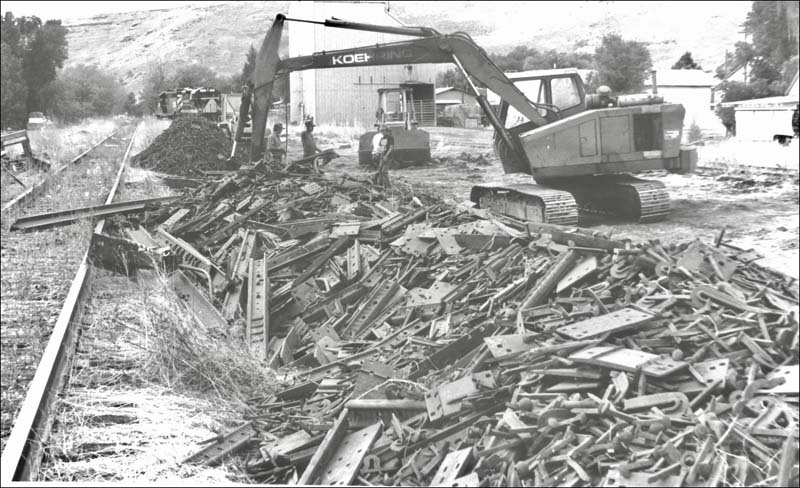
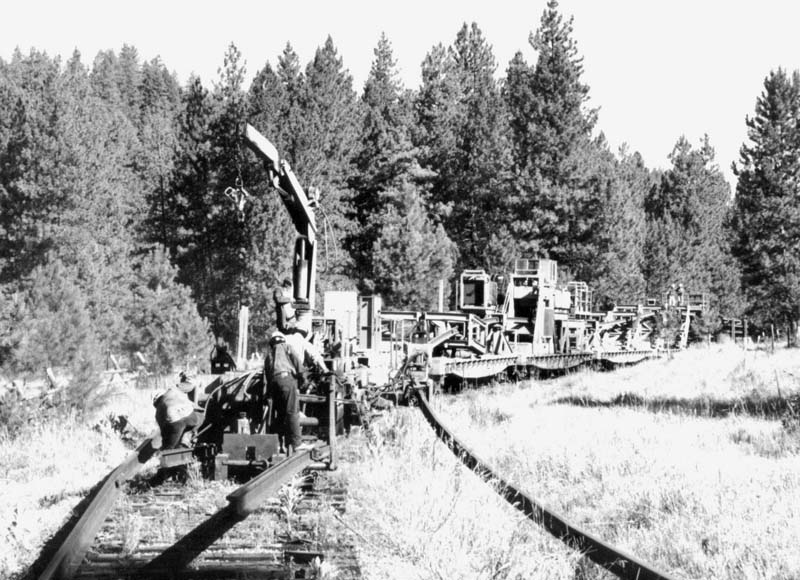
The final revenue train cleared the line on a dreary, foggy day in mid-November of 1995 and the line went dormant until June of 1996 when scrapping began. Mors, Inc., an Iowa firm was contracted for the job, along with Union Pacific Rail Trains capable of hauling ten miles of rails on each pass.
With the exception of some ties and other hardware still on the ground between Cambridge and Midvale, all of the track had been removed from Midvale to Rubicon by the end of December 1996. The great New Year’s Day flood of 1997 washed away hundreds of yards of roadbed and destroyed multiple bridges and trestles all along the line. The damage was so extensive that had the abandonment not spelled doom for the line, the flood would have.
The entire corridor, with the exception of the upper five miles abandoned in 1980, was deeded to Friends of The Weiser River Trail by Union Pacific who had retained possession of the corridor, and serves today as an 83-mile long non-motorized recreational trail.
Under the Federal Rail-Banking Law, the corridor is protected for future utility and/or transportation needs.
For more reading and a complete history of the line, the book “The P&IN” written and published by Dale Fisk and Don Dopf in 1998 is still available. Information on obtaining your copy is available at ddopf427@gmail.com.