


Scotch Thistle, Gothic Nightmare
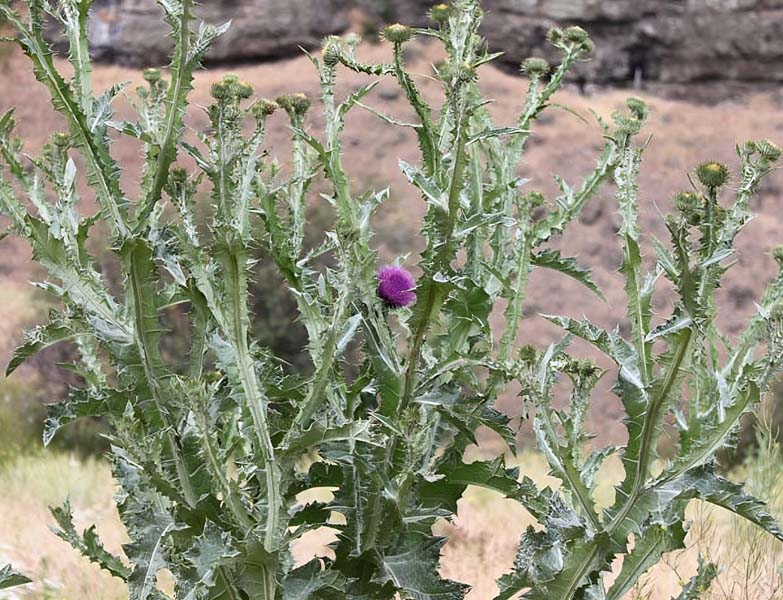
It’s a plant from a gothic nightmare, a spikey, ten foot tall monster with 1/2 inch spines and a stalk three inches thick. Left to itself it crowds and shades out other plants and forms a hedge that could have been Disney’s inspiration for the brambles around the castle in “Sleeping Beauty.” The sad part is that this is an escaped ornamental!
Onopordum acanthium, Scotch thistle, is the only member of its family reported in Idaho, but it has been wildly successful in weed terms, being reported in every one of Idaho’s 44 counties. Idaho has plenty of thistles, both invasive and native, but the others belong to either Carduus or Cirsium. Worldwide, Onopordum boasts 46 species. Like many of our invaders, it hails from Eurasia and the Mediterranean.
Typically, Scotch is a biennial, but it isn’t picky. It can bolt and set seed in a single year or it may persist for a few years as a short lived perennial. Normally, fall rains cause germination and the plant overwinters as a rosette. Often we find these in the spring as the snow leaves, and they range from two tiny leaves the size of a fingernail to robust plants 2 or more feet in diameter. The leaves are lobed and ruffled along their edges, with spines at each lobe point. A covering of fine hair makes them look grey, rather than the deep green of Canada or Bull thistle. The stems have wing-like ridges with spines, again unlike Canada or Bull thistles which have round stems. Scotch is a much bigger plant and tends to branch out more than the others.
The flower is actually a 1”-2” cup (capitulum) covered by spiney bracts. The purple composite flowers can self pollinate, and can produce up to 400 mottled brown seeds. When new, these seeds will have a crown of short, bristly hairs (pappus). These hairs can catch in animal fur, and help disperse seed for very short distances in wind, but generally Scotch seed falls near the parent plant. The seeds contain a water soluble germination inhibitor, and are light sensitive. This means that seeds may lie dormant for as many as 40 years before conditions are right for germination. This makes Scotch thistle control a long term commitment.
With its spines, Scotch isn’t utilized much by any of our wildlife. Bees like it, but that seems a poor trade for a plant so prickly! I suspect the small songbirds spread the stuff. We have no biological controls for this one, partly because we have so many native thistles that could be harmed by an imported bio-control.
The easiest control for Scotch thistle is to cut it a couple inches below the ground with a good shovel. This works great for small patches and young plants. If it gets away from you, chemical controls become more efficient. I like the aminopyralid family of chemicals, they seem to be especially effective against thistles. 2,4-D and other growth regulators work well on smaller plants early in the season. Spray it before it buds!
Mowing can be an effective control, but don’t do it too early, that will only delay flowering, not stop it. Discing or harrowing works, but most of our Scotch is found in rangelands where it is difficult to reach with equipment. Fire isn’t effective. Sheep, goats and horses (not cows) will graze some on young plants and the flowers. Healthy grass stands can generally resist encroachment.
The main enemy of any of these methods, including chemical controls, is the seed bank. In a large patch there could be millions of seeds lying dormant. You have to plan to visit a Scotch site for years, and dedicate yourself to never let a Scotch plant set seed. Otherwise, well, remember Prince Philip from Sleeping Beauty.
Keep those shovels (swords?) sharp!