

Space Rocks in New Meadows
Jeff Riechmann invited kids ten and up to the Meadows Valley Public Library on August 14 to learn about space rocks. Jeff was in the Air Force and got to work directly with astronauts and space shuttles at NASA.
At the library, Jeff had paper planets laid out on the floor. He explained that the asteroid belt is between Mars and Jupiter. Right now, NASA is trying to figure out how to best deflect an asteroid in case a big one ever gets knocked out of orbit and heads toward earth.
Asteroids are mainly made of iron or zinc. When they enter earth’s orbit, they are called meteors. Meteors travel at least 17,000 mph, the same speed as the International Space Station, which takes 90 minutes to circle the earth. Any slower, and they would be pulled in by earth’s gravity. Meteors, the size of a grain of sand, are falling all the time. We see them at night and call them falling stars. They burn up very quickly. The meteors that are too big to burn up, travel all the way to land. Jeff showed a picture of one that fell through someone’s house. Once a meteor hits the ground, it’s then called a meteorite. One the size of a car made a crater nearly a mile wide and 570 feet deep. It’s called Meteor Crater In Arizona.
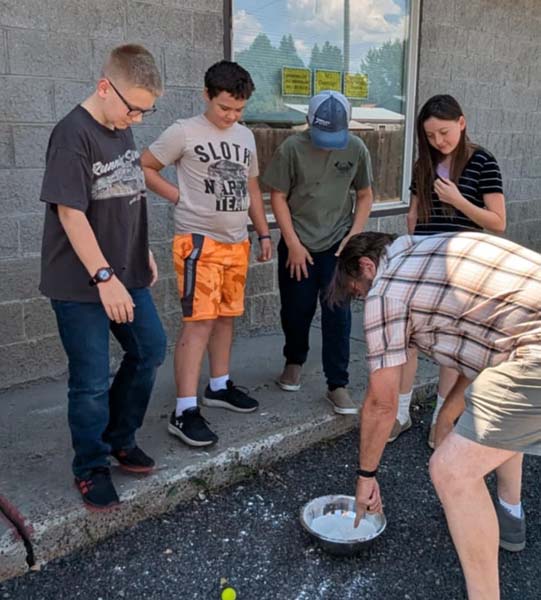
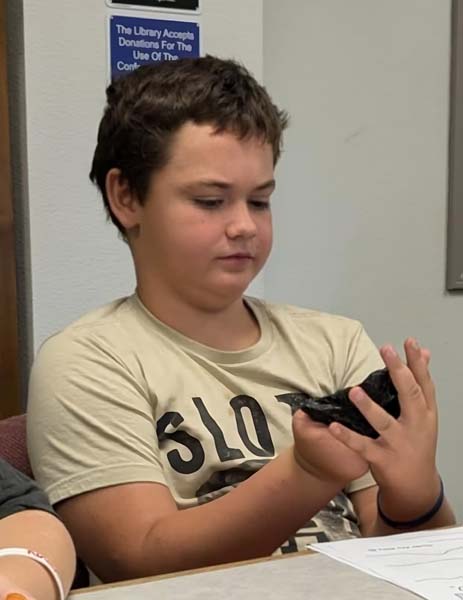
Actual meteorites and pictures were passed around. Hunter Jessee won a drawing and got to take home a meteorite! Outside, Mr. Riechmann, presented a pie pan with white dust in it and asked what the kids thought it was. One said, “Chalk?” Another guessed, “Flour?” Jeff said, “Nope, it’s the moon!” Craters on the moon were formed from asteroids hitting it. Gunner Gerke then dropped a ball in it to demonstrate what happens. Everyone enjoyed space coloring pages, space rock candy and moon pies.
Afterward, Jeff shared some stories. He was part of the Air Force Rescue Team for the Space Shuttles. He worked on emergency procedures and decontaminating astronauts when returning from space. His most memorable moment was at the first space shuttle landing. No one knew how it would go. It was believed that if there was an incident many people would die. He had trained with burning rocket fuel in Florida heat for three days.. Waiting in position for three hours on the day of the landing, he finally heard the rumble of the shuttle. When he looked up, he saw a black dot coming straight toward him. The shuttle landed and went by him, about 150 yards away, with its nose wheel still in the air.
Jeff worked many landings after that with his main job being maintaining the emergency checklists. His “last hoorah” was in 2001 when he organized a space shuttle crash test. A simulated launch and landing in which he had it touch down short and spin 180 degrees, with an unauthorized person taking pictures and someone driving a pickup where they shouldn’t. Hazardous material was blowing into the cockpit, and a firefighter broke his leg. Hospitals were also tested to see if they could get an astronaut out of his suit. One astronaut, while there, went to the children’s ward in his suit and handed out stickers. Jeff went on to train County Firefighters for possible off base crashes.
Then, he was called to develop rescue plans and train people for SpaceShipOne. The only privately-developed spacecraft to carry a pilot to suborbital space, SpaceShipOne made three successful flights in 2004. The last flight carried Jeff’s badge on it.
Now,he shares his learned knowledge with kids everywhere. Mr. Riechmann works with Courageous Kids Climbing, a group of rock climbers that donate their time to teach children with special needs how to climb.