

Who Was Martha Jane Roberts?

In late spring of 1893 Charles Boque and Bert Carrick were riding their horses across a low, grassy knoll about two miles east of present-day Cambridge, Idaho just off what is now Hall Road when they came across an old, weathered wagon end-gate lying on the ground.
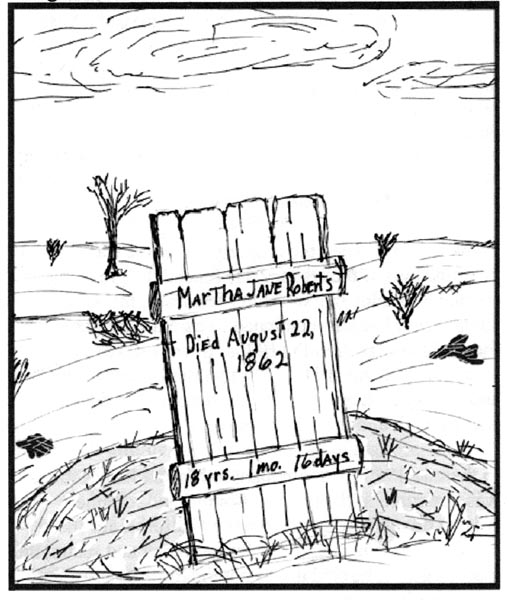
Further investigation revealed that it was a grave marker with crudely-drawn lettering that read: Martha Jane Roberts, Died August 22, 1862, 18 yrs, 1 Month, 16 Days. It was apparent that this young lady must have been buried there by parties who were passing through this entirely unsettled portion of Idaho.
At that time it was mostly unknown who the travelers were or where they were going, and only the decayed headboard remained to tell the sad story of their sorrow at having to leave one of their number by the way. —Salubria Citizen, June 16, 1893.
Much less is known about Martha Jane Roberts than the circumstances that made her somewhat of a famous individual worthy of a monument erected in her name nearly 100 years later.
Early emigrants Harrison Abernathy and Johnny Moore had returned to the valley several years after the girl’s burial in order to settle in the area, recounted what they knew about the event. When the grave was discovered they were able to give the details of that first brief expedition to the valley and explain the presence of the grave. It was a part of their story that this young girl, knowing that she was dying, had chosen this particular spot, a knoll rising slightly above its surroundings, for her last resting place.
The Cambridge News of April 18, 1924 said in part that the Lookout Club of Cambridge and the local Legion post met to act along with The Commercial Club to devise means “to mark and protect the grave of the first white person buried in Salubria Valley” and then goes on to tell of that vagrant wagon train, “under command of Tim Goodale,” that had come into the valley so long ago. The item ends with: “It is perfectly proper that this grave be marked, and a permanent fence be placed around it, as one of the historical spots in our county.”
There was indeed a fenced-in gravesite, a marker, and an elevated arch with the words “Rest in Peace” constructed in 1874 that was maintained by dedicated folks in the Salubria Valley until at least 1921 when most of those people had moved from the valley. Over the years however, the site has fallen victim to the weather, vegetation growth, and other factors to the point that it became no longer distinguishable.
The afore-mentioned, current-day monument is now firmly planted on the corner of Superior Street and Highway 71 next to the Cambridge Museum, mostly unnoticed by those passing. The monument was originally constructed in the mid 1950s by Johnny Adams and others from the Upper Country Grange #251.
It was originally located across Highway 95 from the Washington County Fairgrounds entry next to an Idaho monument commemorating John Cuddy’s Mill. Both monuments were moved to the current museum site in the 1980s under the direction of Dick Pugh and John Mount.
Extensive research concerning Martha’s gravesite and location have been performed over the past 25 years by museum volunteers Thel Pearson, Bo Thorsen, Gary Franklin, Sandra Hansen, and others. The exact location of the gravesite still remains somewhat of a mystery in spite of rigorous and exhaustive efforts that included the use of a K9 trained to find human remains. More than one site was found suspect by the dog, lending to a little speculation even today.
Volunteers’ research has determined that the girl was part of a 75-wagon party of pioneers being led by Timothy Goodale. Goodale is famous for his creation of more than one variant of cutoffs from the Oregon Trail that traversed southern Idaho from Fort Hall near Pocatello to present-day Baker City.
Those variants provided an alternate of sorts from the more perilous southern route plagued by hostile Indians and other concerns. Two variants of his cutoffs came to a confluence just east of the Salubria Valley near the gravesite vicinity and moved west across the valley to Brownlee country and across the Snake River into Oregon. Volumes have been written and published about Goodale and his eventual impact on settlement and development of this area and the State of Idaho.
Just who determined that Martha Jane Roberts was the first white person buried in Washington County remains a mystery to this day. Perhaps it stems from the earlier statement about her being “the first white person buried in the Salubria Valley.”
For what it’s worth, Washington County proper wasn’t established until 1879, some seventeen years after the girl’s passing.