


Would You Winter in a Root Cellar?
When one grows food, it naturally follows that one needs a good place to store it. Traditionally, that place is a root cellar. It was a given that we would have a root cellar on our property, so when our friend dug the hole for the house, we asked him to kindly dig an adjoining hole for the cellar.
Because it is a smaller structure than the house, we decided to start it first. In the back of our minds we knew that, if things went more slowly on the main structure than anticipated, the root cellar would be a warm place to overwinter… and thus it is proving to be.
Our root cellar is massive compared to many, measuring 12x16’ at its finished size. The walls and ceiling are concrete, and below the current plywood and laminate floor is a layer of compacted gravel. The concrete is really farrocement: cement plastered over a reinforcing wire structure. For our farrocement, we mixed Portland cement and sand/gravel (aggregate) at a 1:3 ratio. We were able to separate all the aggregate from the very dirt that had once filled the root cellar, which was a nice feeling.
Cattle, or hog, panels served as the reinforcing wire on the walls. They were stood up against the dirt wall, and Spencer threw concrete mud at them while I caught and smoothed it into place. To strengthen the walls further, we mortared in large rocks, particularly on the back wall where the hole slopes away. We also used repurposed U-channel posts for added support.
Compared to laying the walls, setting the roof was a whole ‘nother beastie. Before arching the panels into place, we zip tied chicken wire to them to add further reinforcement, but also to keep as much of the concrete on the roof as possible. We quickly learned that this was not the two person job the walls had been. One person was needed on the ground to scoop and plop the concrete, another to smooth and squash it onto the roof for a good connection, and a third to use their hands as movable forms to support the mud from underneath. A fourth person was a luxury, passing the shovel up and down from the roof to the ground.
Spencer and I managed by the skin of our teeth to put up two panels by ourselves. Dear friends saved us for the other three, and cut the time it took to put up a roof section in half! Our children delighted in being able to get in on the action; they found being on the roof and playing with mud to be lots of fun!
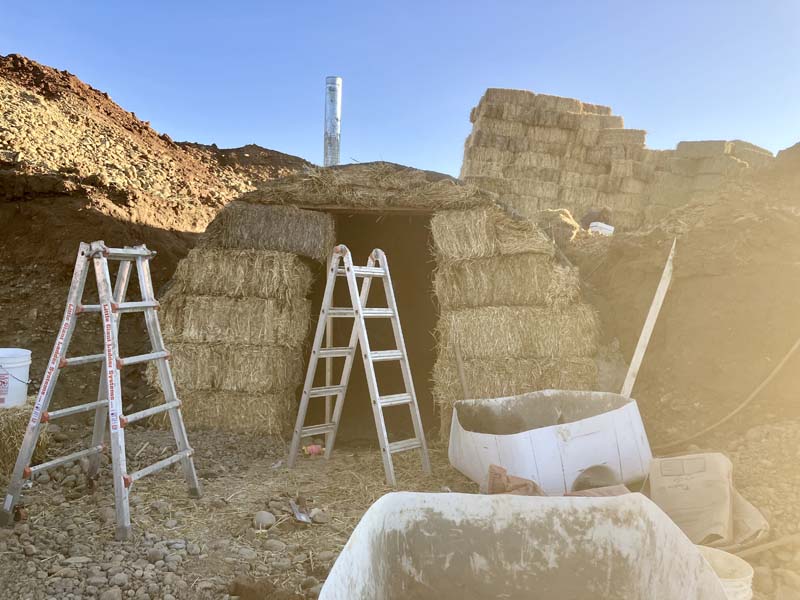
We built the front wall out of straw bales, and used them to cover the roof, then pinched the door from the square yurt. On October 4, after five months in the square yurt, we moved into the root cellar and opened a new chapter of our homesteading journey.