
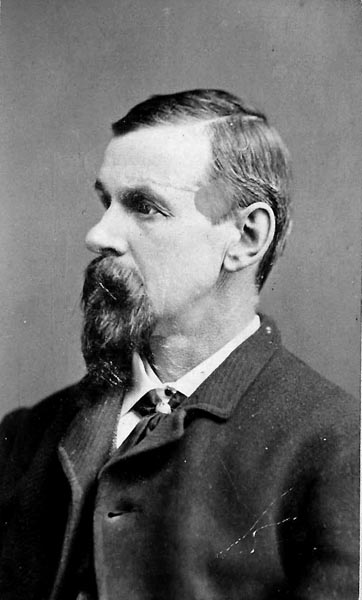
After the surrender of the Wallowa / Non-treaty Nez Perce were beaten into surrendering in Montana in the fall of 1877, settlers along the Weiser and Payette Rivers left their fortifications and returned home. Although it isn’t clear from newspaper reports and other clues, many settlers probably spent little or no time in the forts in late summer, after it was clear the Nez Perce had fled to Montana.
In the spring of 1878 Calvin White took over Solon Hall’s mail contract between Indian Valley and Warren. He would hold that job for the next four years.
In May of 1878 Calvin White staked out a homestead in Meadows Valley (called Salmon Meadows at the time) and planted “a crop of wheat, barley and vegetables.” The Tri-Weekly Statesman said, “With the exception of two nights in the week, he remains alone in the valley.”
Whether White was actually alone can be doubted, since there were two or three bachelors known to be living in the valley at this time. The two nights he was reportedly not alone in the valley might have been when he was on his mail route. Or maybe another mail carrier that he employed stayed at his home those two nights.
White evidently had not moved his family to Meadows Valley yet, but they did join him later that summer.
The very month that White was establishing a home in Meadows Valley (May 1878) a bloody conflict with natives erupted in south central Idaho that spread into Oregon. It became known as the Bannock War. Once again, settlers panicked and retreated into forts. This time settlers in the Council Valley area built their own fort just northwest of present day Council.
On July 18 Calvin White began guiding Colonel William Egbert’s Army unit from the “Upper Weiser” (Council Valley area) to Meadows Valley. The Statesman said Egbert’s command consisted of 135 men, 20 wagons and 100 pack animals. Exactly how this fit into the activities of the U.S. Army during the Bannock War is not clear, but Egbert was one of several subordinate officers under O.O. Howard. Egbert’s role was to intercept raiding parties, protect settlements, or reinforce other columns. The Bannock War was marked by fast-moving engagements and difficult terrain, so officers like Egbert were instrumental in executing Howard’s broader campaign.
The Statesman said the journey took two and a half days and covered a 50-mile route, 40 miles of which had never been traversed with a wagon. The distances may have been exaggerated, and the route taken is not clear. However a later reference might give a clue. A later issue of the Tri-Weekly Statesman said: “The trail most traveled goes over the mountains west of the river, in and out among the gulches and descends to the Weiser again at Fort Price. From there, there is a good natural road into Little Salmon valley.” Fort Price was Tom Price’s mail cabin at Price Valley.
This route sounds like one similar to routes now traced by Forest Service roads on the ridges between the Warm Springs Creek drainage and the Weiser River.
Around this same time, the Statesman mentioned “the old Nez Perce trail through... the Weiser Valley... up the Weiser... down the Little Salmon and over Packer John Mountain to north Idaho and Lolo....”
By August of 1878, the Bannock War had wound down. When the Winkler and Copeland families arrived in the Council Valley on August 6, some settlers here were still spending some time in the fort. When Ida Copeland gave birth in a small log cabin near the fort in September, William Copeland became the first white child to be born in the Council Valley. Edgar Moser was born four months later, in January of 1879. The first white girl born here was Matilda Moser, in 1881.
It is interesting to note that at this time the Council area was often referred to as “Hornet” or “Hornet Creek,” because Hornet Creek entered the Weiser River here.
In late August 1878, four Indian Valley men, who were pursuing Indians who had stolen horses, were ambushed at present-day Cascade, and three of them were killed. The badly-wounded lone survivor, Sylvester “Three Fingers” Smith, managed to struggle to Payette Lake where he was discovered by Calvin White while White was on his mail route. This story is detailed in my Landmarks book, as well as in previous columns. It’s worth noting that Edgar Hall again made a marathon ride to Boise to get medical help and alert the military.
A lesser known story happened in the fall of 1878 – only lesser known because it didn’t result in tragedy. The October 22, 1878 Tri-Weekly Statesman reported that more stock had been stolen from parties in Indian valley, Solon Hall being the principle victim. “The men who followed the trail came to a cliff and a deep gorge between two hills, and almost warm horse tracks leading to the pass. The striking evidences of the death-trap arrested the attention of the men and the long and practical experience and knowledge of the Indian character has impressed their minds with the murdering intent of the Indians. Finding themselves powerless and unequal, they turned back and came home, fully satisfied that the Indians have no intention of soon ending the hostilities.” In other words, they had learned from the disastrous ambush in Long Valley earlier that summer and turned back when they recognized a likely ambush site.
My books covering local history are now for sale at the Baker’s Pantry in Council. I will be giving a major presentation about the Seven Devils Mining District on October 22 at the New Meadows Depot at 7:00 p.m..
100 years ago
October 15, 1925
Graveling of the highway over Midvale Hill is likely to start soon. “Funds have been appropriated and, we understand, are available to complete the work. This is a Federal Aid project and will mean a great deal to all who use the highway, especially during the winter months.”
“There will be around 600 carloads of apples and the like shipped from the Council and Mesa orchards this year. Practically all is shipped to the eastern and foreign markets.”
A boy named Melvin Hartley was born to Mr. and Mrs. B. F. Johnson of Indian Valley.
Sugar beets are being loaded onto railcars at Midvale and Cambridge this week.
75 years ago
October 12, 1950
A boy was born to Mr. and Mrs. Lawrence Page at the Council hospital October 10.
“A box social and dance will be held at the North Crane schoolhouse October 21. Music will be by the Sour Doughs.”
49 years ago
October 14, 1976
“Dr. and Mrs. Ed Quick of San Antonio, Texas have announced that they will be moving to Council where Dr. Quick will open practice in the Council Clinic and the Council Community Hospital with Dr. Monger.”
The First Baptist Church of Cambridge received $50,000 from the estate of T. B. and Tennie Bell Burton. A like sum will also be presented to the Weiser Memorial Hospital.
25 years ago
October 19, 2000
Died: Walter Schnell, 93, of Caldwell, formerly of Midvale.
The Indian Valley Community Hall is celebrating its 50th anniversary.