
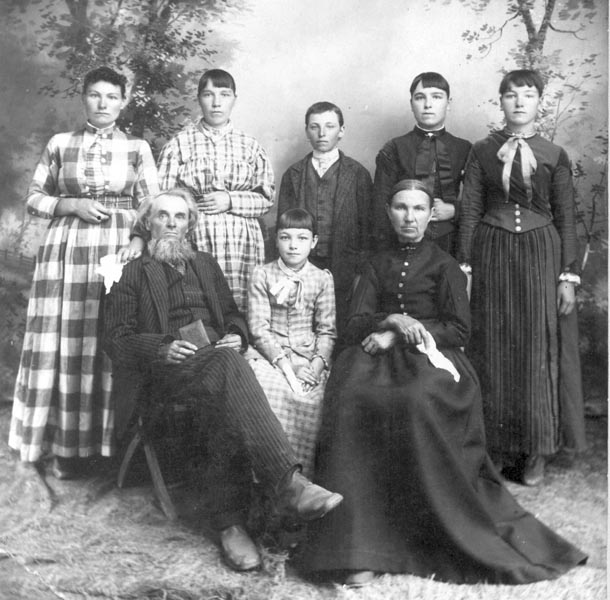
The George and Elizabeth Moser family in 1890 - eight years after George’s bear attack. This picture is a family studio portrait, an image dating to 1890. Matilda is seated between her parents. Standing (from left to right): Emily, Ida, Edgar, Eva, and Sara.
June 22, 1880 Idaho Tri-Weekly Statesman: “Jim Summers and another man, ... became suspicious that there were some Indians near the mouth of Crooked river, where Lieut Calley saw a lot of supposed horse thieves which he took for Indians last summer. Summers raised a small party and went out there, and saw a horse, and went towards him, and when near enough they saw an Indian was picketing the horse; and about the same time they were fired upon by a band of Indians some distance off. One ball hit Summers in the shoulder, and another man was struck or grazed by a bullet near his mouth. Summers party think there were ten or fifteen Indians. At all events, the whites left the Indians as they were too strong for them. All this occurred about three weeks ago.”
The timing of this incident is interesting because, by this time, all the Indian wars in the Northwest were over. The last war was the Sheep Eater conflict in 1879, when the last remnants of the Mountain Shoshoni were rounded up. After that, almost all native people were confined to reservations, except when they were allowed to leave to harvest berries and hunt. After 1879, conflicts with natives were generally more bureaucratic and legal than military, but they reflected deep unrest over land loss and cultural suppression.
The August 31, 1882 Weiser Signal said of Indian Valley: “There are at present 18 settlers, 10 of whom have families. At present we have no school, for want of a suitable teacher, though we have a schoolhouse.”
In the Council Valley Museum there are two bear claws on exhibit. The story that goes with them concerns an item in the November 4, 1882 Weiser City Leader, which reported that George Moser was still recovering from wounds to his leg which he suffered in an attack by “a grizzly bear some time ago.” The report said he was not expected to be able to walk for another month or more.
Hogs were commonly raised by settlers - both for sale and home consumption. The Mosers raised lots of pigs and sometimes drove herds of them to the Boise Basin to sell them to the miners there.
It was quite common during the early settlement of the valleys along the Weiser River for farmers to have problems with bears killing livestock; especially pigs. Bears are very attracted to hogs as good eating, so early settlers had to take precautions.
Ida Hitt of Salubria wrote of her family’s experience: “As the spring advanced the hogs were turned out to forage, but were fed a little wheat in the evening so they would come to their covered log pen. It was the fear of bear that made such a pen necessary. One night a bear came. We heard the pig squeal, but when the men arrived with their guns the bear was gone, taking a nice young shoat along. He had coolly pulled four logs off, seized the pig and was gone. It showed it was a large bear, perhaps a grizzly; his footprint was enormous.”
In 1882 a big bear had been killing pigs in Council Valley. Finally three or four men with guns and dogs went out to track the bear. After the dogs cornered the bear, George Moser stooped under some overhanging branches to get closer to the bear and get a shot at him. He found himself in a dry creek bed where the bear suddenly appeared and lunged down the opposite bank. Before Moser could aim his gun the bear was upon him. From the nature of his wounds (chunks of flesh torn from his legs), one might assume George fell backward and kicked at the bear in a desperate attempt to survive. No one recorded more details of the attack except to say the thick willows in the creek bed offered some protection. Moser’s injuries must have been significant, as it took a long time for him to recover, and the old woulds troubled him the rest of his life.
Whether the bear was actually a grizzly has never been confirmed, but the claws at the museum, which are said to be from the bear that attacked George Moser, appear to be from a grizzly. There probably were a few grizzlies in the Council area. The abundant salmon in the Weiser River would have been an ideal food source for them.
A grizzly was said to have been killing livestock near Alpine in 1874. This animal reportedly weighed over 600 pounds and had a ten inch long track. In 1896, Gilbert Smith, the State Senator from Meadows, killed a bear that reportedly measured 9 1/2 feet from tip of nose to end of its tail.
Reports of coal being found in the Weiser River drainage appear from time to time in old newspapers. One such report in the August 18, 1883 Weiser City Leader said coal had been found at Indian Valley and that local people were burning it.
The next week the Signal said “vacant land is very scarce” in the Council Valley. Settlement continued for decades after this, so the perception of how much unclaimed land was available had to have been relative.
Yester years
100 years ago
October 29, 1925
The blacksmith shop has been leased for an indefinite time to Roy Alderson.
The Morehead hospital at Weiser was mentioned.
“J. A. Galenburg of Baker, Oregon, is hauling out the old machinery in the original mines at Black Lake and shipping it to Baker, according to The Council Leader. The mines have not been operated for years, and the machinery, although so long idle, is said to still be valuable, and it is proposed to salvage, and use elsewhere. Some of the stuff may go to the Cornucopia mines in Baker County and the rest will doubtless be sent elsewhere. Two wagons hitched tandem with 10 horses as motive power came in last week with a load from the mines, and the machinery as it arrives is being loaded onto cars on the P. & I. N. siding.”
75 years ago
October 26, 1950
Died: Mrs. Lavelle Thompson, 33 of McCall, formerly of Cambridge.
Married: Miss Beulah Wiggins, daughter of Mr. and Mrs. Archie Wiggins, to Lee Williams, son of Mr. and Mrs. Paul Williams.
A boy named Stephen Lloyd was born to Mr. and Mrs. Bud Lindenberg at the Weiser hospital.
A girl named Peggy Lee was born October 19 to Mr. and Mrs. Lloyd Woody.
Effective November 1, Donald Duncan will become the publisher of the News Reporter under a lease agreement. Under the new arrangement, Dopfs will continue to operate the commercial printing and of the business.
49 years ago
October 28, 1976
“Clifford Keppinger was taking a truckload of cows to the sale Thursday when a car came out of the side road this side of Weiser and struck the truck, causing the load of cattle to shift and overturned the truck. Neither the cattle nor Clifford were seriously injured.”
25 years ago
November 2, 2000
Died at the Council hospital: Marvin M. Gipe, 79. Burial in the Parma Cemetery.
Died: Iva Evelyn Burgess Ford, 96 of Cambridge.
Died: Helen G. Kincaid, 73 of Cambridge.