National events of 1886: President Grover Cleveland dedicated the Statue of Liberty and became the first president to marry in the White House. A labor demonstration at Chicago’s Haymarket Square turned deadly after a bomb exploded and police fired on protesters. In Seattle, anti-Chinese mobs dragged residents from their Chinatown homes. Coca-Cola went on sale for the first time at an Atlanta pharmacy. In Germany, rival inventors Karl Benz and Gottlieb Daimler filed the first patent applications for gasoline-powered automobiles.
In May of 1886 Weiser City Leader editor William P. Glenn (he was also was Weiser Postmaster at the time) accompanied the Washington County Commissioners on a trip to Council to inspect the site for a new bridge across the Weiser River just west of Council. Apparently they spent the night at the George Winkler place north of Council (now the Gould Ranch), as they noted the roads were terrible all the way there, saying it was “almost a constant mud hole.” The commissioners decided to have the new bridge placed at the “same site of the old bridge,” which was pretty much the same location as today’s bridge.
In November of 1886 it started snowing earlier than usual all over the West. And it just kept snowing. Temperatures also fell to record lows. In Idaho, hundreds of cattle died along the Snake River corridor. Ranchers reported animals frozen stiff, still standing. Stockmen along the Payette and Weiser River Valleys also saw serious losses.
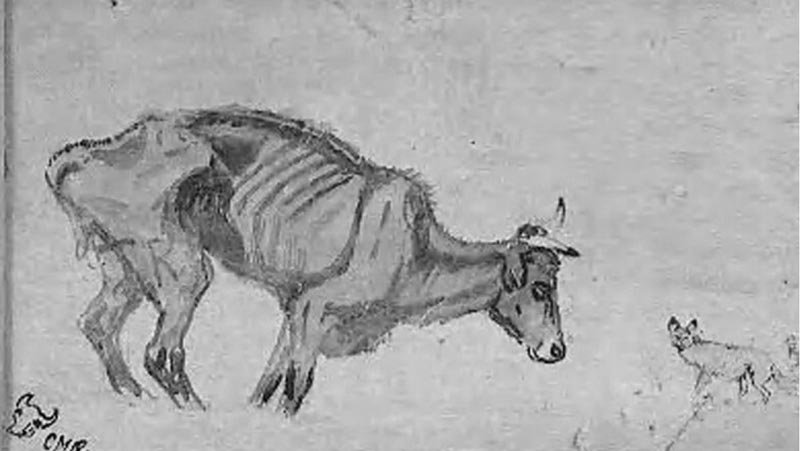
Blizzards and –40°F temperatures across the Great Plains and Montana trapped and froze thousands of cattle. Charlie Russell was working as a cowboy in Montana’s Judith Basin at the time. When his boss asked for a report on how his herd was wintering, Charlie sent a watercolor titled “Waiting for a Chinook,” showing a starving cow stocked by wolves. The image became well-known and marked Russell’s transition from cowboy to “Cowboy Artist.”
Because of this disastrous winter, stock raising practices changed all over the West. Ranchers began storing more hay and abandoning as much reliance on mild winters and open grazing on wild grass.
In early 1887, it was announced that a new town would be laid out in the Seven Devils Mining District. It was to be called “Anna Bristow.” Where this name came from is lost to history. The first plat of the town, with streets and lots neatly drawn, was labeled “The Town of Seven Devils,” but a second plat changed the name to “Helena.” There is little question that the name came from the fact that both Albert Kleinschmidt and Levi Allen were originally from Helena, Montana.
The following appeared in the Portland newspaper, The Morning Oregonian, March 29, 1887 – originally published by the Baker City Democrat:
“The Seven Devils district is situated in the northwest portion of Washington County, Idaho, and about 75 miles from Weiser City, from which it is accessible by roads and trails up the Weiser Valley, or from Baker City by of Sparta, Brownlee’s Ferry, Scot Creek and Bear Creek.
“The principle mines are the Peacock, White Monument, Helena, Blue Jacket, Mountain Queen, Alaska and Decorah. The three first names are owned by Levi Allen of Boise, the discoverer of the camp, Lewis of Wood River, and Governor Hauser of Montana. The Blue Jacket was purchased last fall by *Montana capitalists, who have had men employed all winter developing the property. One of the shafts started is six or 8 feet in solid ore of the highest grade.”
*“Montana capitalists” is an obvious reference to Albert Kleinschmidt and his sons. The article continued:
“During the past winter about 30 miners have been pushing work in the camp, and it is certain a new impetus will be given to this camp this spring and summer. A railroad is an imperative necessity, and there is a good prospect of the Union Pacific Company’s building northward from Weiser City. They have a surveying party of 15 men in the field, under charge of Engineer T. A. Clark. This road is proposed for the purposes of capping the North Idaho country.”
I have a video on youtube.com of my presentation about the Seven Devils Mining District. To find it, type my name into the youtube.com search bar to find all my videos, including my Mesa Orchards presentation and more.
100 years ago
November 26, 1925
Died: Johnnie Mortitz. He was born in Switzerland in 1902.
For 1926, local automobile owners will receive their license plates by applying to the assessor’s office instead of by mail from the State Department. The new plates have black figures on an orange background.
The Ware & Co. store is now “Cambridge Cash Store.”
Midvale – “There has been a sharp turn in the highway between the Than Newman and S. I. Borton places. As this has always been considered a rather dangerous corner especially as it is close to the school house. The city has bought a portion of the corner belonging to Mrs. Potter and are rebuilding the road. This has made it twice as wide as it formerly was, making a diagonal cut across the corner instead of the right angle turn as heretofore.”
75 years ago
November 23, 1950
Married: Donna Williams, daughter of Mr. and Mrs. Paul Williams of Midvale to Nelbert Legg, son of Mr. and Mrs. P. A. Legg of Cambridge.
49 years ago
November 25, 1976
“Governor Cecil D. Andrus has named three fire district commissioners to serve in subdistrict of the Midvale fire protection district created by the Washington County commissioners.”
A girl named Stephanie Diane was born to Mr. and Mrs. Lawrence Denney November 19.
25 years ago
November 30, 2000
For the first time in 20 years Idaho power company is adding to its bulk transmission system with a 52-mile, 230-kilovolt transmission line that will connect Brownlee’s power plant to Ontario, Caldwell and Boise, creating an additional major transmission loop. The line should be complete by late December and energized in January.
Died: Nello Walton Jenkins, 84, of Council. He married Margaret Jane Piper in 1935 at Logan, Utah and they had six children.