
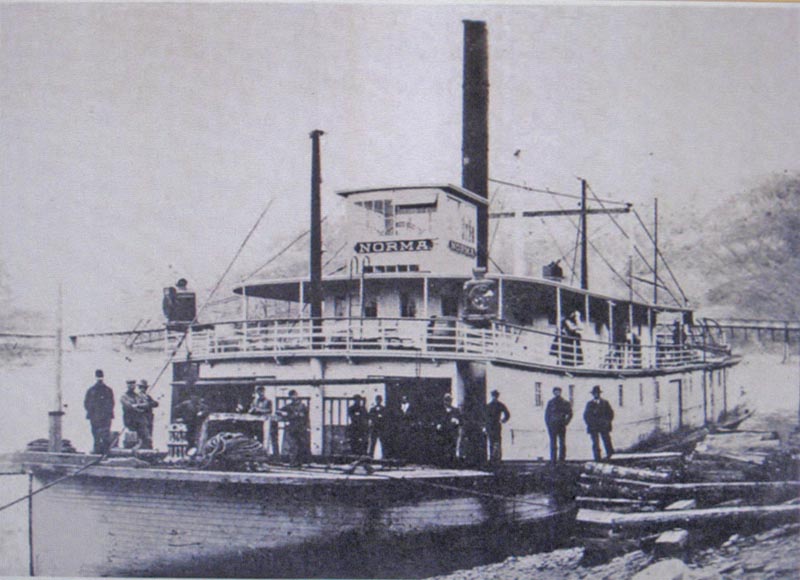
All during the summer of 1890, horse teams pulling Fresnos worked, along with men with picks, shovels and blasting powder, to scratch out a crude wagon road from Helena and the Peacock Mine over the divide to the west side of Indian Creek, then down the timbered mountainsides to the future site of Cuprum and then to Arthur Huntley’s cabin. A short distance past there, road construction started down the steep drop down to the Snake River and Frank Ballard’s ferry.
At the river, Albert Kleinschmidt expected wagon loads of copper ore to be loaded onto a big steamship – the construction of which he had commissioned and named the “Norma” after his daughter. But before the road even reached the Snake, the Norma proved to be a failure. The smokestack was too tall to clear the railroad bridge, and the Snake was too shallow in places for the ship to get through when loaded.
That August, before Kleinschmidt’s road was even completed, the steamship idea was abandoned.
In September, George Gould’s house on Cottonwood Road burned down. By the end of November he had built the house that still stands there today.
Weiser Leader, Sept 12, 1890 – Council: “Our citizens are trying to replace the old school house with a good substantial frame building, in the upper part of the valley. To a stranger stepping into the old log structure, the first impression would be, ‘a hog house, by Jove!’ “
It’s often frustrating trying to reach a conclusion based on bits and pieces of information like the above school information. Fred Lappin (1905 - 1995) told me (if I understood him correctly) that there was a log building that served as the “White School,” which stood near the NE corner of present-day Highway 95 and Lappin Lane. This newspaper mention would seem to refer to that log school. It was replaced by a frame structure at some point – likely soon after this was printed in the Leader.
Another ambiguous clue – this one found in the Sept. 19, 1890 Weiser Leader – refers to a road but doesn’t explain it’s route: “The new road has been completed directly to the mines, thus making a complete wagon road from Weiser to this great copper camp. Mr. Noel Hopper hauled about six hundred pounds of ore out of the Seven Devil mines over the new road. This is the first ore ever hauled directly from the mines in wagons.”
Kleinschmidt’s road was not completed, plus I doubt there was a road along the Snake River from the bottom end of the Kleinschmidt Grade to Weiser at that time. The only other road had to have been between Bear and Kleinschmidt’s road via the Huntley Grade to Arthur Huntley’s ranch. It seems obvious that Kleinschmidt’s road had made it to Huntley’s and this road connected with it.
This road connecting Council with the mines was a major breakthrough for the mining district, as it made transporting ore much easier, although still arduous.
That same Sept. 19 issue of the Weiser Leader announced: “A new a town has been started called Helena, and a post office established.” Before this, mail only came to Dale (today we call that general area “Upper Dale”). About 20 buildings were under construction at Helena, including stores, dwellings and a saloon.
That November of 1890 the Leader had another major announcement: “The road from Helena to Snake river landing, a distance of fifteen miles, is completed.” This was the Kleinschmidt road. It was actually 22 miles long, not 15. Most articles you will see about this road will say it was declared completed on July 31, 1891. I think this is because Winifred Brown Lindsay found a Weiser Signal newspaper with that issue date that said, “Business is dull in the Seven Devils since the completion of the Kleinschmidt wagon road.” From that clue, she wrote: “After two years, Jim Ross, the foreman, declared the road completed on July 31, 1891.” Lindsay’s history of the mining district became one of the primary sources for information about the road, so that date became widely printed as the day the road was completed.
Considering that Kleinschmidt’s road was “completed” in only a few months, one can assume it was little more than a crude wagon trail at first. Even as late as the 1920s, it was a dreadful, narrow path, with rocks sticking up from it’s surface and extremely tight corners. Little attention was probably given to improving or maintaining the section from Huntley’s to the Snake, as it would not have been used much because the steam ship idea had failed. Even so, that route was of great interest to Baker, Oregon businessmen, as they very much wanted the commerce opportunities that a road between Baker and the mines could bring.
By 1890 it had been only 11 years since Indians roamed freely in our area. That year saw wide-spread discontent among native people who were confined to reservations – often with inadequate food, clothing or shelter. They were sometimes allowed to leave the reservations to hunt, fish and gather food plants. A few Indians showed up on the streets in Weiser. This situation made many white settlers uneasy. The ghost dance craze – with Indians believing there would be a revival of their old way of life – spread from the plains tribes to the Fort Hall Reservation in Southern Idaho where ghost dances started being held. On December 29 federal soldiers murdered 250 to 300 Indians at Wounded Knee Creek in South Dakota. I haven’t seen any accounts of violence erupting in our area, but you can bet that tension between the races was strong.
100 years ago
December 24, 1925
Mrs. Herbert Fuller is teaching at the Goodrich school this year.
“The motor bus has been laid up for the winter. It made the last trip Monday and will be left at Weiser until next spring.”
75 years ago
December 21, 1950
Died: Midvale pioneer Alan Goldsmith Hooper, 82. He moved here with his parents in 1910.
A daughter named Verna Christine was born December 17 to Mr. and Mrs. Archie Love of Midvale.
A girl named Susan Margene was born December 18 to Mr. and Mrs. Orvil Larson at the Council hospital.
Died: Philip J. Winder, formerly of Cambridge. He was born in 1882 in Utah and came to Cambridge with his parents in 1901.
49 years ago
December 23, 1976
A daughter named Ronna LeeAnn was born to Mr. and Mrs. Ronnie Smith at the Weiser hospital.
Lynn Reeder, 15, daughter of Mr. and Mrs. William Reeder of Indian Valley was injured in an automobile accident.
Claudia Shelton (Mrs. Leslie Shelton) of Council was injured in a snowmobile accident.
25 years ago
December 21, 2000
Died: Melvin J. Stippich, 80, Cambridge.
This issue contained another installment of “Memories of Old Salubria” by the late Margaret Hannan Peterson.