
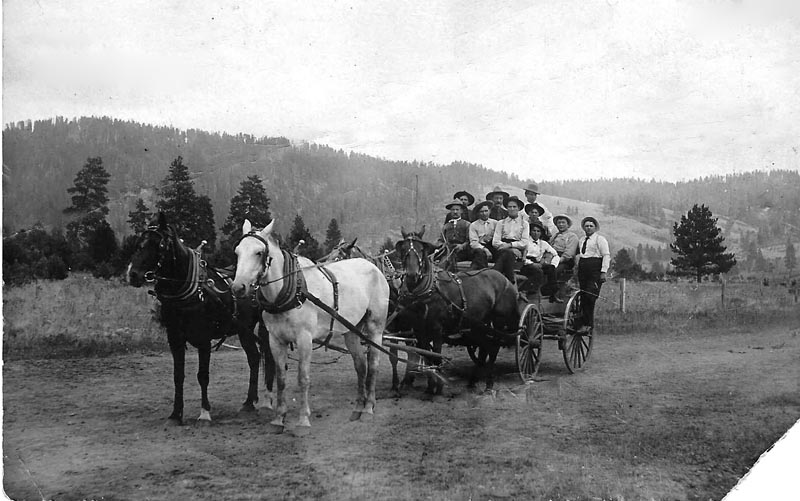
By 1891 settlement of the American continent had reached a point that the U.S. Census Bureau announced that the American frontier no longer existed. (Based on the 1890 census.) What the agency meant by this was that there was no longer a continuous line that could be drawn on a map of the U.S. that separated the settled area from an unsettled frontier. In other words, settlement had broken up the remaining “unsettled” areas into isolated pockets. There was no longer a single, unbroken frontier boundary.
Notable events in 1891: The Dalton Gang committed its first major train robbery near Alila, California. Almon Strowger patented the Strowger switch – the first automatic telephone exchange device. This invention eventually eliminated the need for human operators and transformed telephone systems worldwide. At this time, a phone line from Weiser to Salubria was talked about, but nothing had been done to accomplish that task. And since there was no rail line to the upper Weiser River valleys, there was not even telegraph service beyond Weiser.
Weiser Signal, January 8, 1891: “The Warrens state wagon road will soon be completed to Warren. There are about 100 white men in the camp, and about 2,000 Chinamen, who are working on the old placer mines. The place has two stores, two hotels, two saloons, a butcher shop and blacksmith shop.”
Bill Winkler, who by this time was about 25 years old, was appointed as one of two Washington County Justices of the Peace.
Since the arrival of Albert Kleinschmidt, the Seven Devils Mining District had come to life. In April of 1891 the Owyhee Avalanche newspaper said the American Mining Company had bought the principal claims in the Seven Devils. (I can’t find documentation that a company by that name legally existed that early, but it’s pretty obvious the paper was referring to Kleinschmidt and any partners he had.)
The Avalanche said: “Last summer they built a railroad grade from the camp to the steamboat landing on the Snake River at a cost of $30,000, built a steamboat for $40,000, invested $200,000 in development work on their claims, laid off a town and named it Helena, built a large store and numerous houses, and this summer will build a road from Weiser into the mines.”
Of course the Kleinschmidt road was not a railroad grade, and the dollar figures may have been inaccurate. Plus, the Weiser Leader had already announced, in September of 1890 that a road from Weiser to the mines had already been completed. The tendency for newspapers of the day to exaggerate and print questionable “facts,” sometimes makes researching history frustrating.
Transporting Seven Devils copper ore to a smelter was a crucial issue that would plague mine owners for years to come. Newspapers printed various figures of how much copper, gold and silver the ore contained and what shipping costs were.
The April 23, 1891 Weiser Signal printed a letter from C.E. Walker to Mose Fuchs at Baker City. In part, it read: “Your post office books are here at this office waiting for your disposal. So hurry up and open our Helena office, as it will be needed very bad soon, emmigration sic has begun to start. There was a party come out from Huntley’s Saturday, and the snow is three feet deep on the ridge between Bear creek and Indian creek. It will be about the 1st of May before teams can get to Huntley’s.”
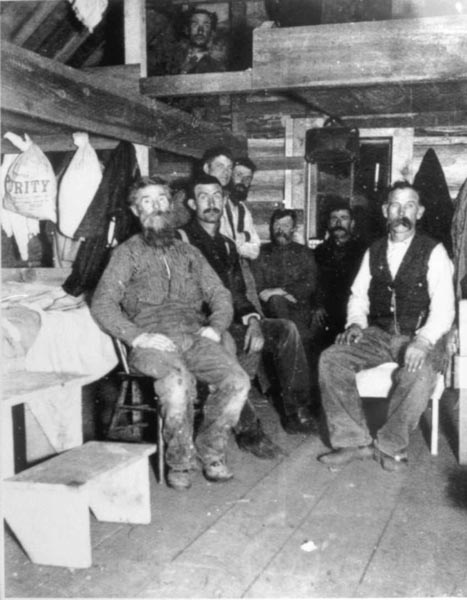
The high elevation of the Seven Devils District made for a short season in which work could take place. Snow remained, in places, until mid-summer. Snow-covered sections of roads were often cleared by men with shovels to enable wagons to reach the mines. Work in and around the mines was often wet and muddy. I think it’s safe to assume that the scent of drying wool clothing was an almost constant presence in living quarters well into the summer or beyond. Of course, in an era when bathing more than once a week was rare and bathing less frequently was common among working men in isolated cabins, other odors also prevailed.
In April of 1891 a dance was being planned at Salubria. While a hall was being prepared for the event, someone knocked over a lamp, causing a fire that spread rapidly out of control. Much of the town burned. By this time, electric lighting only existed in parts of a few major cities. Countless fires were still caused by accidents resulting from lighting with flames, which burned large parts of many towns well into the early 1900s.
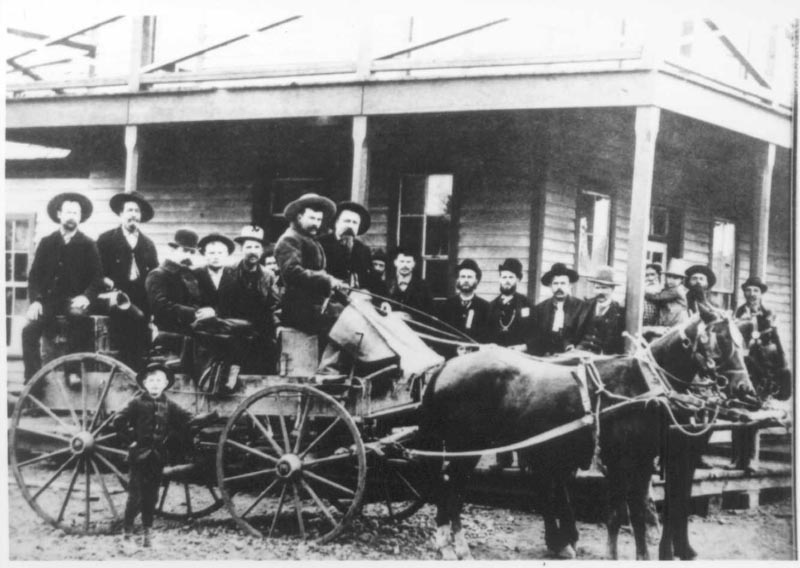
Meanwhile, transportation between Weiser and the upper valleys and beyond was developing rapidly. The roads were primitive, but demand was high. The Weiser & Indian Valley company ran a stage line between Weiser and Indian Valley every day. The Indian Valley & Salmon Meadows stage ran daily from there to Council, and from there the Council & Seven Devils line provided daily transport to and from the mines.
Our impressions from movies leads us to envision a “stage” as a typical Concord-type stagecoach, but early “coaches” were often simply open wagons with seats for passengers.
100 years ago
December 31, 1925
“The snow plow was taken to New Meadows Monday, where it will be held until needed.” (Railroad snowplow.)
“Since the drop in temperature the roads are better in some places while others are so rough they are next to impassable. The highway is good going to Midvale, we are told, and to Mesa, but dangerous and hard going beyond those points, due too deep ruts.”
“The community scales are now completely installed and ready for use.”
Died at Weiser: Mrs. Jesse Blaine, formerly of Midvale. Burial here beside her husband in the Mt. Pleasant Cemetery.
75 years ago
December 28, 1950
Married: Lola Price of Clarkston, Washington and Delbert Wicks, son of Mr. and Mrs. W. F. Wicks of Midvale.
49 years ago
December 30, 1976
Died: Eldon L. “Smokey” Colson, 64, of Boise. He was born at Midvale in 1912, a son of Homer and Edith Helen Shaw Colson, and attended schools in Midvale.
25 years ago
December 28, 2000
This issue contained another installment of “Memories of Old Salubria” by the late Margaret Hannan Peterson.