
The summer of 1891 continued to be a time of mixed success for the Seven Devils Mining District.
One big controversy concerned John Rogers and/or T.J. Fifer issuing bad checks as payment to road workers. Just what roads were under construction or improvement is not clear. Some workers claimed they were not being paid the amount agreed upon.
Idaho Citizen (Salubria newspaper), Aug 21, 1891: “There is bitterness towards John Rodgers and T. J. Fifer the way that they have bilked the road hands.” The Citizen said Rodgers was paying the men only 50¢ on the dollar.
And then checks started bouncing. The very next week, the Citizen contained this: “From various sources comes the information that there is an extremely bitter feeling existing in the Seven Devils towards Capt. John Rogers and T.J. Fifer for the failure to redeem their checks which they paid their hands on the road this season. It seems they issued checks on the Weiser, Boise, Baker City and Portland banks which were not honored by the banks. If this is true Rogers and Fifer can not be too severely censured.”
The issue continued into September, when the Citizen again aired the grievance: “There is skullduggery going on in the Seven Devils. If the men who work are not paid, they may air their opinion in the Citizen.”
Meanwhile, Baker City businessmen had their eyes on profits to be made from Seven Devils customers. In August, the Citizen declared: “It takes 3 days to get to the Seven Devils from Weiser and only 2 now from Baker via the new Kleinschmidt road. As a result, most of the business in the Seven Devils has gone to Oregon merchants.”
Whether it actually took less time to travel between Baker and the mines may or may not have been true. But it was not true that most business was now coming from Baker, and it never would. This exaggeration was inspired by a new road that had just been built from Baker to the Snake River near the oxbow and connected with Frank Ballard’s ferry just downstream, which was near the foot of Kleinschmidt’s road, thereby making a complete road between Baker and the mines. Even so, the hopes of Baker merchants never became a reality. The route to and from Weiser was the one most used, and it would be made even more advantageous after rails reached Council a decade later.
A reporter from the Weiser Signal interviewed George A. Rahm, who lived somewhere in the Seven Devils Mining District and later became an officer in the Hancock Mining Company. The reporter asked Rahm about the new road from Baker. Rahm replied, “Don’t think there is much of a wagon road from Helena to Baker City. I have never heard of but one or two vehicles making the trip, and from them learned that it was incomplete and generally villainous.”
Reporter: “How is the road from Weiser?”
Rahm: “Good. I made the trip up in three days, and came back in the one day, being in somewhat of a hurry on account of sickness in my family. Would you not call a road good on which you could make one hundred or say one hundred and twenty miles per day (24 hours)? Our actual traveling time was seventeen or eighteen hours with only one change of horses. Could have lessened the time from one to two hours.”
The reporter asked what Rahm thought of a mail route from Baker City to Helena.
Rahm: “I think it like all the Oregon jobs; mainly a scheme to steal the Devils away from Idaho because Oregon has no Devils of her own. The proper thing for the Postal Department to do is to establish another office above Dale, say at Bear Creek crossing. I have a petition of thirty-five signers at that point asking for the establishment of an office there to be called Media; and the appointment of Frank Joel Smith as postmaster. This would accommodate the Bear Creek settlement and bring the mail within half a day of Helena (sixteen miles). That being the case...Helena can have a daily mail to and from the outside world in six days. At present it requires three weeks.”
On the positive side, the Signal reported in August: “There are now some 5,000 miners now employed directly in the mines, which are lighted by electricity and use all the latest improved machinery.” And, “Five car loads of copper matte from the Peacock smelter passed through Weiser yesterday enroute to Denver.”
That last bit makes no sense. Copper matte is partially smelted copper ore, and there was no smelter anywhere near the Seven Devils Mining District until a few years later. Sometimes newspapers of the day were fast and loose with facts, which often makes understanding history a challenge.
There was more than one mention in newspapers around this time of a “relapse” in the mining boom. Newspapers were generally overly optimistic and exaggerated the positive side of progress and business, so to even mention a slump in the mining boom, it must have been serious.
Meanwhile the economy of the general Council area was booming. Civil War veteran Frederick Wilkie had settled at the junction of Hornet Creek and Mill Creek just three years prior (1888) and had established a sawmill that now couldn’t keep up with the demand for lumber.
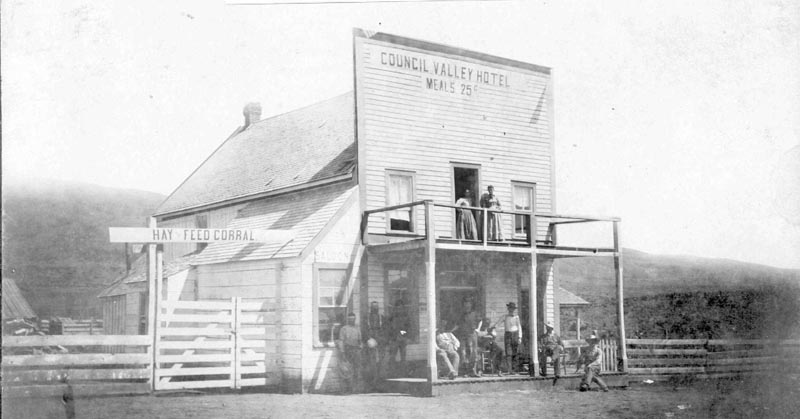
Until now, there was no sign of a town at the present site of Council, with the possible exception of John Peters’ store, but it isn’t clear exactly when Peters built it inside what would become the town. That summer (1891) Milt Wilkerson and John Hancock built what may have been the first business here: a hotel (with a bar) and feed stable.
100 years ago
January 14, 1926
A crew of 12 to 15 men are working at the Peacock Mine. “They are doing preliminary work only, such as building bunk houses, and the like, claiming that mining operations will start in the spring.”
This issue contained the second installment of Arron Parker’s “Forgotten Tragedies of the Indian Warfare in Idaho,” which included more about the Long Valley ambush and details of the beginning of the Sheepeater War.
75 years ago
June 11, 1951
The March of Dimes will start its campaign against polio. There has been an unprecedented number of polio cases reported that in Idaho since 1947.
Died: Mrs. Emma Hanna Week, 81, a resident of Midvale area since 1919, at a Payette nursing home.
“Several visitors were included in the group to attend the Cove square dance club held Saturday evening at the Cove school house. A pleasing variety of round dances were included in the evening’s program.”
49 years ago
January 13, 1977
A boy named Emmett Arlen was born to Mr. and Mrs. Tom Green at the Council hospital.
Kermit Wiggins has purchased the 95 Club building (the old Hudelson Furniture building between the drugstore and the barbershop). He plans to remodel the building and his new business will be the Thread Shed.
Snow depth at Brundage Mountain is at an all-time low for January 1, measuring 10.38 inches of snow, which is 85% below the 12 year average and 76% below the previous recorded low.
25 years ago
January 11, 2001
Died: News-Reporter editor, Stuart Dopf after a 63 year career. He was born in Nebraska in 1913. He purchased the News-Reporter in 1937.
Died: James N. Cole, 87, Weiser, formerly of Indian Valley.