
A lot was happening in 1891, which is why I’ve been spending so much time on it.
The September 3 Weiser Signal announced: “A new post office called Wilburns was recently established over on Crane creek and is kept by Thomas Kimbrough. Now what Crane needs most is a daily mail and we would like awful well to have it go from Salubria.” I’ve never heard of this post office; that doesn’t mean it didn’t exist, at least for a short time.
A week later the Signal quoted Salubria’s Idaho Citizen: “The parties sent out to repair the road between this place and Long valley have returned with the pleasing information that it is now in better condition than ever. This road is considerably above the average mountain road. A ton is considered a good load over it and the distance from Van Wyck to Salubria is exactly forty-one miles. The trip between these places has often been made on horse back in seven hours. A number of teams have passed over it recently and they encountered no difficulty whatever.”
This road is a mystery to me. I suppose it must have gone up the Little Weiser River. This is the only reference to it that I can remember. A decade after this, there was a big deal made of a road up Mill Creek from Council Valley to Long Valley, and it sounded like it was the only such road bridging this side of Council Mountain with Long Valley. Regardless, settlement in Long Valley was still in its early days at this time, and dependable sources of supplies were yet to be established there. Long Valley settlers routinely made an annual journey to Council for supplies in those early years – especially after the railroad arrived in 1901. In 1891 Council stores were just getting off the ground, so Long Valley folks could well have been traveling to Salubria for supplies.
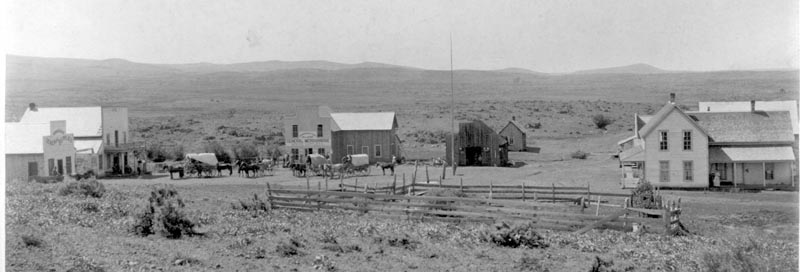
In 1891 an actual town was quickly developing on the spot where Council is today. As I said last week, Wilkerson and Hancock established a hotel / stable in 1891. It was on the east side of a square patch of the Moser’s homestead that George Moser donated to serve as a town square. Evidently Mosers had begun to sell plots of their land, with the goal of creating a town. At the same time as the Wilkerson/Hancock hotel opened, Mosers had a big, two-story hotel building of their own under construction on the west side of that square. It was finished late that fall.
It could be that John Peters had already moved his store to a spot northwest of the northwest corner of that square. It was there at least by 1894 when it burned down. At any rate, after Peters set up shop “in town” a popular jingle made the rounds the describe the fledgling town: “Moser’s Hotel and Peters’ store, Milt’s Saloon and nothing more.”
Meanwhile, conflict continued between the Seven Devils Mining District and Baker City. Weiser Signal, 9-17-1891: “Who Stole the Seven Devils Post Office? Did Baker have a finger in pie? In last week’s Signal was mentioned the report that some one had broken into, the silent post office at Helena. It seems the office was gone, leaving only the building it once occupied. The people of Helena have waited in vain for its return. It don’t return worth a cent. It will also be remembered that the Signal mentioned that Mr. Brackett made a trip to Helena last month with a view to establishing a mail route either from Council valley to Helena or from Baker to Helena. The postal department decided to establish a route from Council to Helena via Dale, and posted notices in all post offices along the route to the effect that sealed bids for carrying the mail would be received on September 12th by the post master at Helena. But about Sept. 1st (so reports say) the post master ordered his assistant to bring the post office furniture and fixtures to Baker city, which was done, leaving Helena without any post office, consequently when the 12th arrived there was not post master at Helena to receive the bids. How and by what manner of means are things thusly? What right has any person to monkey with a government post office and take it out of Idaho into Oregon?”
The October 1 Signal contained a wealth of information. First it said: “The steamboat Norma, built last year, is lying idle at the Union Pacific crossing on the Snake. She made one trip last winter. Going down she did not have an accident, but coming up, a rock was run into at Bay Horse rapids, some eight miles below Huntington. A big hole was punched in the boat’s side and she was with difficulty got back to the landing at the bridge. It would cost about $1,000 to fix her up, and as no one has undertaken it she is in the same condition. When the boat was built it was expected that an appropriation would soon be made by congress toward opening the river. A survey was made last winter, and something will probably be done at the next session.”
“Opening the river” referred to deepening parts of the river’s channel, which was actually done later.
The same issue reported: “Last year copper ore was packed on horses for 100 miles to the town of Weiser on the Union Pacific. But none is being taken out this year.”
Also in that issue was this: “Quite a number of Indians are in the valley trading ponies for cattle.” Exactly what valley is not clear, but had to have been along the Weiser River. By this time, there were not free-roaming natives; they were all confined to reservations. However it was common for Indians to be allowed outside the reservations at least once a year, to gather food and hunt.
100 years ago
January 21, 1926
“Craddock & Son report the sale of an Atwater Kent radio at the O. E. Sutton home, the first of the week. It is a five-tube compact set.”
“Owing to the mild weather, the ice on the river has not frozen very thick so far this winter. A few are storing ice this week, but the clear ice is only about 7 inches in thickness.”
“According to a dispatch in today’s Statesman, a bandit killed at Marysville, California, Monday, is thought to be Hugh Whitney, notoriously known throughout the Northwest. The party who identified the slain man as Whitney refused to divulge his name, so there still remains doubt that it really is Whitney. Hugh Whitney was raised on a ranch of the Upper Country and is well-known as an ex-bandit, by most old-timers of this section.”
This issue featured a continuation of “Forgoten Tragedies of Indian Warfare in Idaho” by Aaron F. Parker. It details murders by Indians at the Rains ranch in 1879, which sparked the Sheepeater War.
75 years ago
January 18, 1951
The 1951 March of Dimes campaign is now underway. Similar campaigns in the past have made possible the hospitalization or other restorative treatment that polio patients, numbering an estimated 500 and Idaho during the past year, have received.
49 years ago
January 20, 1977
A son was born January 14 at the Weiser hospital to Mr. and Mrs. Lynn Heiner.
25 years ago
January 11, 2001
Died: Robert Stewart Dopf, 87, editor and publisher of the Upper-Country News-Reporter in Cambridge for the past 63 years.
A boy named Nathaniel was born to Nate and Nicol Mink at Weiser on December 29. Local grandparents or Roy and Linda Mink.
Died: James N. Cole, 87, Weiser (formerly of Indian Valley).