
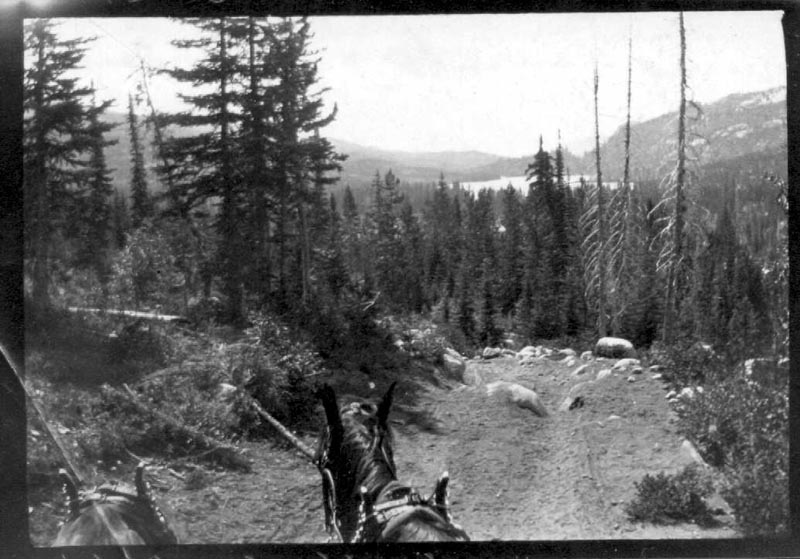
Even though the Weiser Signal had earlier declared that the wagon road to Warren was “soon to be completed,” by July the paper said it would be completed to “Warm springs” in about a month, which was probably also overly optimistic. Burgdorf was known only as Warm Springs at this time. It’s interesting that the community at Warren had existed for almost 30 years but apparently wasn’t yet reachable by wagon. I suppose it could have been that an existing crude trail was being upgraded to an actual road.
1891 was a year of contradictions, at least as far as what newspapers printed. I think it was at least partly an effort to always be a “booster” for progress and development.
At least some people were still clinging to the hope that Kleinschmidts’ steamship, Norma, could still succeed, even though the Weiser Leader had announced it a failure the previous year. The Huntington Democrat newspaper reported the Norma was still navigating a limited section of the Snake River. The editor mused about steamship travel up and down the Snake between near Boise and the foot of Kleinschmidt’s road. But no amount of hype and speculation could compensate for the fact that the Norma could not pass under the Union Pacific bridge below Huntington. In addition, the paper noted: “The putting on of boats by Weiser and Caldwell would necessitate the railroad company changing their bridges, three in number, to ‘draws’ at an enormous expenditure of money.” And even that wouldn’t have addressed the issue of the Snake’s swift rapids and shallow passages.
The previous announcement that a road had been completed from Council to the Seven Devils mines may have been accurate, but “completed” evidently meant barely completed and still needing work.
A report in the July 30 Signal illustrates that point. The paper said the road between Council and the Seven Devils mines “is completed, except one rock point, and it is in a condition to drive a light vehicle over. The people of the Seven Devils have made much calculation on the new route, hoping to transport their ores over this road, but unless it is in a better condition than at present it will be impossible for them to haul even a small load of ore.”
A couple months before that, the Signal editor traveled to the mines and remarked, “A great many teams are now coming in loaded with freight.” It’s a little hard to square such conflicting stories.
There were conflicting reports from Helena early in the season. The Seven Devils Mercantile Company was setting up business in town. The Signal said Helena contained two stores, a restaurant, three saloons, a brewery, and “Two dairies are furnishing the camp with milk and butter.” By the end of June the newspaper said there were two restaurants, three stores, a hotel, six saloons and two assay offices.
On the other hand, a Helena butcher was quoted as saying, “business is dull in the Seven Devils since the completion of the Kleinschmidt wagon road.” Also, in July the Seven Devils Mercantile Company closed it’s store after only a few months in operation.
An item in the May 2 Idaho Statesman said Helena town lots were selling for from $250 - $600 each. In today’s dollars those amounts equal around $9,000 to $22,000.
On May 30 the Signal contained this: “A bigger row occurred about the 19th instant, in the town of Helena over town lots, which came very nearly ending in a tragedy. It seems that by some error of agents selling lots in the town site one lot had been sold to two men separately, each who claimed it. The promoter of the town site was called to account, and owing to the warmth of the discussion determined to adjourn the meeting until some cooler occasion. This did not suit the claimant’s and quite a mob pursued the townsite man toward Baker City via the Snake River, where they arrived an hour behind the fugitive. Much talk is indulged in over the affair, and which hemp, Winchesters, guns is etc., are slung and by way of seasoning with a liberal fusion.”
In early August, the Signal printed the following:
“Parties who have recently came in from the Seven Devils mines report a very unsatisfactory condition of affairs. In fact, nothing to speak of is being done in the mines.
“The failure of the contractors for building the Snake river wagon road has had a demoralizing effect on everyone and has caused financial loss in many instances and is to be regretted. In fact the whole scheme of steamboat, road and everything connected with it has had an uncanny look from the first. And one would suppose that when it was proved that the boat could not run that work on the road would have been abandoned.
“The whole scheme has a wrong look. At the time the boat made the alleged trip there was nothing for her to transport; and the owners of the old Peacock, with its mountains of ore in sight, never have mined a ton. A road constructed as it ought to have been, from Weiser and up Bear creek to the mines, would have given the whole business a legitimate and honest look, and a proper entrance to the country. The present road increases the distance greatly and more than doubles the difficulties.
“News from the Bear creek side is more encouraging and the gold prospects at Placer basin and vicinity are looking better than ever and there is no doubt of the good result n the near future.”
100 years ago
January 7, 1926
“One of the very noticeable things of our recent trip to Boise was the increase in radio aerials. There were probably three times the number along the same route as a year ago.”
Died: Alice Westfall, 72, at Clarkston, Washington. She lived in this area until about nine years ago. She will be buried in the Indian Valley Cemetery beside her husband who died 10 years ago.
Arron F. Parker, pioneer and historian at Grangeville has published a small booklet titled “Forgotten Tragedies of Indian Warfare in Idaho.” Part of its contents were featured in this issue, including the first part of the story of the Long Valley ambush in 1878. He also described how a monument was to be placed at the grave of Private Egan who was killed in the Sheep Eater war of 1879.
An excerpt from Parker’s booklet: “The Cemeterial division of the Q. M. G. has sanctioned the erection over Private Egan’s lonely grave of a five-foot conical monument of boulders laid in cement and surmounted by a marble headstone of the World War design, which will mark not only the grave but the site of the engagement of August 20, 1879, on Big Creek at Soldier Bar. The stone will have to be hauled about 70 miles by wagon and 40 miles by pack mules to reach its destination.”
75 years ago
January 4, 1951
Married: Shirley Westfall, daughter of Mr. and Mrs. George Westfall of Weiser to J. M. Magee of Weiser.
Norman Hansen, who was injured during a football game last season and is recovering nicely from major surgery performed in Boise, recently, returned to school again Wednesday morning.
This issue contained the names of everyone who was born, died or was married in the area in 1950.
49 years ago
January 6, 1977
“Robert Bumgarner, owner of the Cambridge Elevator Company, announced Tuesday the sale of the company to Herman, Roy and Harvey Braun, effective January 1. Bumgarner has been owner of the business for the past five years.”
25 years ago
January 4, 2001
Lawerence Denney of Midvale was elected Assistant Majority Leader in the Idaho House of Representatives.
Married: Shannon Dopf, daughter of Don and Betty Dopf of Cambridge, to Danny Nava.
Died: Francis Langer, 95, at a nursing home in Washington. She owned and operated the Cambridge Café on Main Street for a number of years.
Died: Don C. Scott, 93, of Fruitland, formerly of Cambridge.