
As I said last week, after John Peters’ store burned, he built a new store southwest of the town square. On the night of July 4 the McMahan store at Alpine burned down. Isaac and Lucy McMahan almost immediately moved to Council and went into business with Peters in Peters’ new building.
By late summer, Lewis Winkler was the Road Supervisor in the Council area. The county commissioners routinely hired someone to maintain roads in various parts of the county. In August the Idaho Citizen reported that Winkler was busy building a new bridge across the Weiser River just west of Council. Just how accurate this report was is not clear, as the very next summer local newspapers mentioned several times that a bridge was being built at the same location. It could be that Winkler’s bridge was washed out the following winter or spring, but I find no report of such. Or it could be Winkler was building a bridge, but the Citizen got the location wrong.
That August the Idaho Statesman newspaper gave an account of an unusual ore milling technique being used at the French Ledge gold claim on Bear Creek. At least it was unusual for this area. It was a arrastra, which used technology brought to America by the Spanish, and was more commonly used in the Southwest. An arrastra is a simple, inexpensive to build, ore-crushing mill consisting of a circular, stone-lined pit in which heavy drag stones are pulled around to grind ore. Traditionally powered by animals or water, it was widely used in early Spanish and Western mining districts where stamp mills were impractical.
The Statesman said the arrastra at Bear was “run by a four horsepower under-shot waterwheel. It is 10 feet in diameter and is calculated to crush a ton of rock a day.” The newspaper added: “Twenty-two years ago Arthur David, known as ‘Frenchy,’ and Charles Walker discovered the French Ledge. There were apparently two ledges, 75 feet apart and running north and south toward Bear Creek. And places the quartz, blue stained, rose like a cliff and the ledges could be traced for nearly 1000 feet. ”
The September 7 Idaho Citizen said Annie Wilkerson had bought McMahan’s Alpine store. Since the store had burned in July, it might be that she bought the property and planned to build, or rebuild, a store.
Idaho County Free Press, September 21, 1894: “Leroy Gordon has taken measurements for a cable by which he will run a ferry across the Salmon river at the mouth of Race creek. This will fill a long felt want for the people of Little Salmon as it will be the most convenient way of crossing the river, and will be just above the end of the State road as now contracted for.” Race Creek enters the Salmon River from the west, about a mile north / downstream from Riggins.
The summer of 1894 was the first time that a newspaper mentioned a school at School District 34, which was located at what was later called Fruitvale. Until a school was established there, the children of that area had to travel to the White School at the corner of what is know Lappin Lane and Highway 95, which is over 3 miles from Fruitvale. My impression is that everything north of the White School was called the “Glenn District” because at least a couple Glenn families lived in the Fruitvale area. John Emsley Glenn (born 1878), his sister, Walsa Ellen, and their brothers attended the White School during the three summer months when school was in session.
A story handed down in the Glenn family says that one day while Emsley and the other Glenn kids were making the long walk home from school, several Indians wearing war paint came riding by, going very fast. The warriors paid no attention to the kids, and acted as though they didn’t see them. It was later learned some whites had stolen horses from them, and the warriors were in pursuit. Some time later the Indians came back through with their stolen horses. They had caught the men starting to swim the horses across the Snake River near the mouth of Wildhorse and killed the men.
I find that story nearly impossible to believe because after 1879, all natives in this area were confined to reservations. They were sometimes allowed to leave the reservations to harvest food, but a war party chasing, much less killing, white men would have a major historical event, making headlines in every newspaper in the region.
Dora Black seems to have been the first teacher there, with 22 students, including Cora, Ova Josie and Edna Biggerstaff; Ida and Etta Glenn, Mary, Laura and Albert Robertson and Tom Sevey. The school year was only 3 months, starting in mid June and ending in mid September.
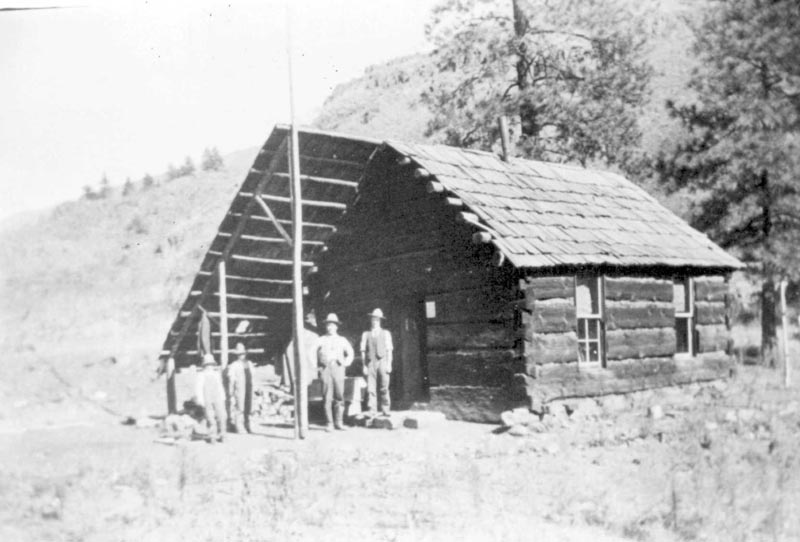
By 1894, schools in the area had proliferated. Schools had been established at Bear, Lick Creek, Cottonwood, Upper Dale and Lower Hornet. It isn’t clear where the Lower Hornet School was located. Several of these early schools were log buildings.
All through the 1890s speculation and rumors about a line to be built to the Seven Devils Mining District came and went. At the end of 1894 the Weiser Signal said that engineer E.H. Mix had issued a detailed report, giving the route, grades, trestles, culverts, cattle guards and more, which would be necessary for construction of the Weiser & Idaho Northern Railway to the Seven Devils Mining District” containing “maps, profile and approximate estimate of cost of road.” This may have been true, but it would be another five years before construction on a similar line would actually become a reality.
100 years ago
March 25, 1926
“Beauty parlor work, such as shingle bobbing, marcelling, done at the Walter Clure home.”
A meeting of the Cambridge Cream Association, was called primarily “to devise some way by which cream could be delivered to the creamery at Weiser in sweet condition. Officials maintained that a large percent of the cream delivered from this section was received in bad condition, due largely to the fact that the passenger train left too early in the day to pick up a large part of the day’s deliveries. Last year they sent trucks to Midvale and Cambridge to pick up those shipments which had come too late for shipment by train.”
Carl Swanstrom was married March 6 at Filer, Idaho to Miss Lillian Buhl who is teaching school there.
“Local members enjoyed a big meeting of the Knights of Pythias at Weiser Monday night.”
75 years ago
March 22, 1951
The Cambridge Commercial Club met to discuss the construction of a new gymnasium or the repairing of the old one.
The Hi-Way Inn Café at Midvale reopened for business Tuesday after being closed for a complete remodeling.
“The Lookout club house is being remodeled again to be used as a club house after being used as a residence for the past few years when living quarters were scarce.”
Married: Pfc. Duane J. Marti, son of Mr. and Mrs. Charles Mart of Cambridge, to Ruby Watson of Illinois.
“Indian Valley school was closed Friday due to bad roads.”
49 years ago
March 24, 1977
With such a light snowpack in the mountains, the irrigation situation in the Indian Valley area and the lower Little Weiser / Salubria area does not look encouraging.
A daughter named Emily Alice was born March 20 to Mr. and Mrs. Jeff Roundtree at the Holy Rosary Hospital in Ontario.
Married: Kay Wiggins, daughter of Mr. and Mrs. Kermit Wiggins to Crist Garcia at Caldwell.
25 years ago
March 15, 2001
Died: Harold Lee Byrd Sr., 69, of Midvale. He was born in 1931 at Cambridge, the son of George and Lucille Dalke Byrd and was raised on a ranch in the Hog Creek area.
The Westpark Plaza in Ontario is celebrating 30 years in business.