
In July the Idaho County Free Press of Grangeville couldn’t resist touting the horrors of the road to the gold camps around Warren from the south instead of from Grangeville. Editor Aaron Parker wrote that a family arrived at Grangeville from Hailey, “having left there May 28 and taking the State wagon road from Meadows by way of Payette lakes and over Secesh summit to Warm Springs (Burgdorf), and thence by way of French creek and Florence to Grangeville.” “The Secesh route is indeed a terror and it was on that part of the road that all their troubles occurred. From the Springs this way it was plain sailing and fine warm weather.”
It’s interesting that he called the summit between Payette Lake and Burgdorf the “Secesh summit.” In the 1870s–1890s, “Secesh” in general meant the Secesh mining district (Warren, Burgdorf, and the Secesh Meadows area). Any summit on the approach to that district could be casually called the “Secesh summit.” Once the Idaho National Forest began producing maps, they needed a single, fixed location for “Secesh Summit.” They placed it at the actual hydrologic divide between Summit Creek and Lake Creek – the high point north of Burgdorf, near Secesh Meadows.
Because the Warren area gold camps were established during the Civil War, the term “secesh” referred to secession from the Union States by the Southern states. The term is still in use; the spelling is informal and phonetic.
All during the summer of 1895 there was bitter conflict between new settlers and cattlemen in Long Valley. Both sides saw the other as infringing on their rights to land. Things reached a head in July when farmers killed 57 head of cattle. Some men were jailed and conflicts continued in court and on the ground.
That summer the Salubria Citizen listed the property on the Washington County tax rolls. Of course the county included what is now Adams County. The records showed: 8 sawmills; 7,747 common cattle + 637 beef cattle + 1274 cows; 3718 hogs; 1621 work horses; 3915 stock horses; 15 musical instruments (valued at $2398 total); 3 water crafts; 537 vehicles; 5 bicycles.
By the end of July, a horse racing track was completed near Meadows (which was still being called Salmon Meadows occasionally). Races were scheduled over a six-day tournament, and drew competitors from near and far.
In 1895 I noticed advertisements for jars for home canning fruit started to show up in area newspapers. Such jars started to be produced in factories in the mid-1880s, but home canning seems to have started to become more widely adopted in the 1890s.
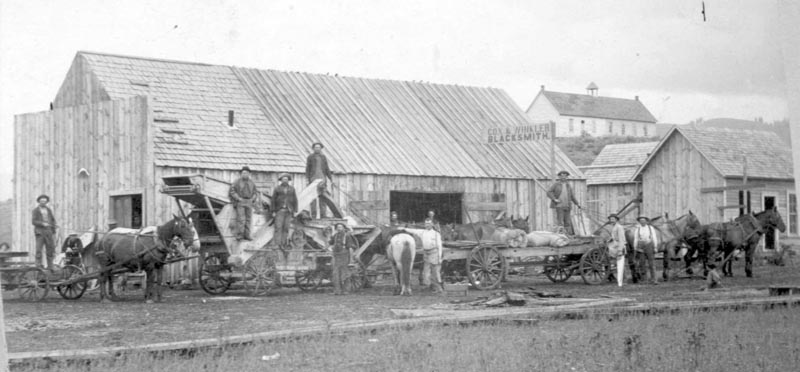
That fall, the Winklers started traveling from farm to farm with their threshing machine. Preston Anderson also had a thresher and offered this service.
A boy named Clarence was born to Mr. and Mrs. George Gould on September 21. Also that month, John Denny purchased the Alpine Store from Mr. and Mrs. John Wilkerson. Mrs. Denney became Alpine postmaster.
In October, Citizen editor Lorton traveled by train to a Press Association meeting at Lewiston. His journey reflected the lack of good roads or rails linking southern Idaho with northern Idaho. He first took a wagon or buggy to Weiser to catch a train, then traveled by rail through Huntington, Baker City, Union, LaGrande, over the Blue Mountains, through Pendleton, Walla Walla, Colfax and finally Pullman. From there he took a stage to Lewiston arriving at 9:00 p.m. the second day after leaving Weiser – a total distance of only 125 miles as the crow flies.
There still was not even a wagon road down the Little Salmon to Pollock. Everything got there via pack animal. Lorton could have traveled the route over Secesh Summit, across the Salmon River and on through Florence and the Camas Prairie, but that would have been even more challenging and time-consuming.
In November, George York was building a new bridge across the Weiser River west of the burgeoning “town” of Council. By this time, there still seemed to be no bridges across Hornet Creek, and the road to Bear crossed the creek several times, which proved to be very dangerous in high water.
100 years ago
April 15, 1926
“Council will have a box factory if present plans are fulfilled.”
Obituary of Nelson Buhl, 68, whose death was announced last week. He was born in 1857 in Denmark, came to the U.S. with his parents when he was five years old, and they arrived to the Salubria Valley in 1869.
75 years ago
April 12, 1951
“Mrs. Elmer Jones completed kemtoning her kitchen this week.”Kem-Tone was a very popular interior wall paint made by Sherwin-Williams.
Married: Arlene Warfield, daughter of Mrs. James Pope of Payette and Laverne Warfield, married Bobby Wininger, son of Mr. and Mrs. Carl Wininger.
Died: Henry Quast, manager of the Cambridge and Council Golden Rule stores. Interment at Caldwell.
A girl named Karen Kathleen was born at the Weiser hospital April 6, to Mr. and Mrs. Elvin Evans of Midvale.
“A plan for splitting reorganized school district No. 432 JB has been prepared and was submitted to the County Board of Education Wednesday.” More details followed about district boundaries and school properties.
49 years ago
April 14, 1977
Died: Loren R. McKee, 60, Cambridge.
Died: Gary Homer Bott, 30, Indian Valley.
Died: Don Morgan, 61, of Weiser. He was born in 1915 at Cambridge and graduated from Cambridge High School in 1934.
25 years ago
April 5, 2001
The State Legislature stipulated that no tax money be used for signs or sign installation marking the Stu Dopf Memorial Highway section south of Cambridge, so the senior center will be responsible for raising $500 which the State Highway Department estimates will be the cost for this signage.
Died: E. Ruth Towell, 87. She married R. Claire Towell in 1934.