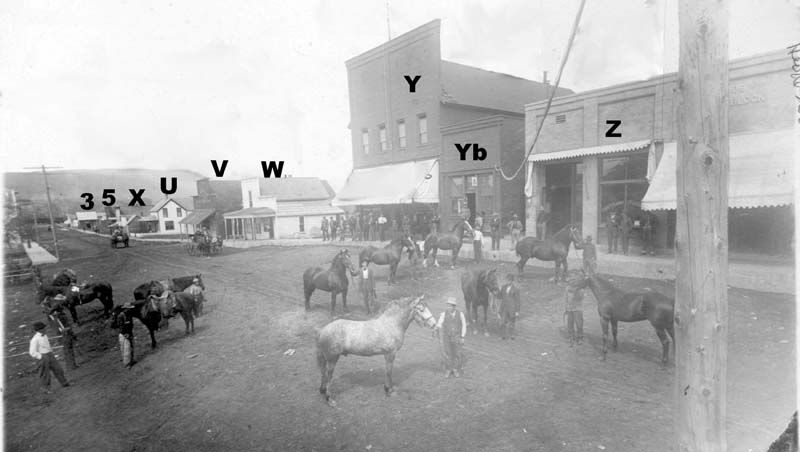
What a unique time in history it was when the western U.S. was being settled. Hundreds of new towns were being created – new towns that needed infrastructure: roads, bridges, stores, blacksmiths, doctors and more. After the very basic elements of infrastructure were more or less in place, more complex systems started to develop. One of those was financial infrastructure – banks.
When things are subject to few, if any, rules, they are often referred to as “like the Wild West.” Of course back in the days of settlement, it actually was the Wild West. Banks did have some rules and regulations, but they were nothing like they are today after decades of learning the hard way.
The U.S. has seen numerous financial ups and downs. One of the worst downward spirals happened in 1893. This was when communities along the Weiser River were just getting on their feet, and banks were few and far between.
During what became known as the “Panic of 1893” nearly 15,000 companies failed, 500 banks went into receivership, and nearly 30 percent of the country’s rail system was financially insolvent at a time when railroads dominated the American economy. European investors pulled their money out of the United States, but it was too late; depression soon gripped the other side of the Atlantic as well.
The September 21, 1893 Weiser Signal announced: “The banking, hardware, and forwarding house of the Idaho Commercial Company, of Weiser, failed to open for business last Saturday, having gone into insolvency.”
I don’t know if there were any banks in Midvale, Cambridge, Council or Meadows at that time. I haven’t seen any evidence of their being any.
There were over 12,000 commercial banks operating in the United States by 1900. Banking was regulated by both federal and state governments, but the regulations were far less stringent compared to today, which made them more susceptible to financial shocks and instability.
Near the end of 1905 the Weiser newspaper announced: “The bank directors have rented half of the first floor of the Council I.O.O.F. hall for six months. They expect to have a building put up by that time. Harry Criss will rent the other half of the room and will move his stock of goods in.” After waiting for the arrival of a safe before it could open, the “First Bank of Council” opened in February of 1906 in the Odd Fellows Hall, which stood where the east half of M&W Market is today.
The names of a couple of the bank directors might be familiar to readers of this column: C.M. Jorgans, J.F. Lowe, Frank Hahn, Isaac McMahan, John Ennis.
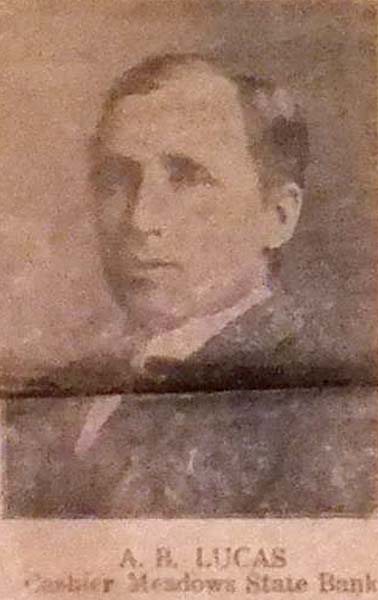
In the spring of 1906 the Meadows State Bank was established at Meadows. A man named Rowell (first and middle initials were either E.C. or F.C.) was president and was credited with creating the bank. F.C. Woodford was Vice President and A.B. Lucas was cashier.
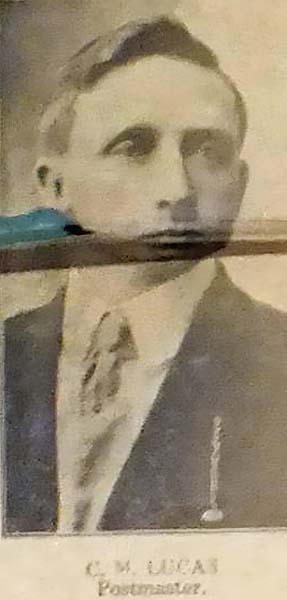
Aaron Briney Lucas, whose first name never appeared in print but was always listed as “A.B. Lucas,” had three sons who were prominent in Meadows Valley:
Carroll Maynes Lucas (evidently known as Maynes or C.M. Lucas) 1884 – 1966 who was Meadows Postmaster about 1911.
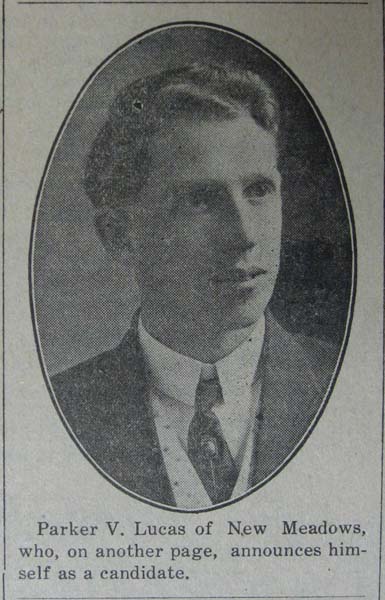
Parker Vincent Lucas 1888 – 1940 who was manager of the Lucas Land Company and was quite politically active. He was also a bank cashier (like his father) at least in 1908, at Roseberry (the town 1 mile east of present-day Donnelly before the railroad killed Roseberry by creating Donnelly).
Aaron Briney Lucas Jr. (1899- 1968) who was only about 5 years old when the Meadows State Bank was established in 1906.
Another economic “panic” hit the U.S. in 1907. Over a three-week period starting in mid-October the New York Stock Exchange fell almost 50% from its peak the previous year. Panic spread throughout the nation, and many state and local banks and businesses entered bankruptcy.
The Snake River and Seven Devils Mines were directly connected to the initial cause of the crisis; it was triggered by a stock manipulation scheme involving the United Copper Company. The panic was short-lived, thanks to the direct intervention by J.P. Morgan injecting large amounts of his own money into the system. There was no central bank or federal agency at the time to regulate the markets, and without Morgan’s help, the crisis would have been much worse.
The First Bank of Council and the Meadows State Bank survived the 1907 panic.
In 1909, a building that is still standing in Council today was built to house a new location for the First Bank of Council. The bank facilities didn’t have far to move, as the new building was right next door, east of its rooms in the Odd Fellows Hall. Sam Criss used the other half of the new building as a general merchandise store.
This was a boom period for Council, and the area was growing quickly. In February of 1910 Council got a second bank. The “Council State Bank” opened in a small, wood-frame building belonging to William Fifer. It was located about where the M&W parking lot is today.
Continued next week.
100 years ago
December 26, 1924
“Stephen Nock, orchard owner at the Mesa, left Monday for Chicago, his home. This is the first time Mr. Nock has been able to leave his business at Mesa for several years.”
“The Upper Country no longer consumes all her hay produced and is shipping much to other parts where the demand is great. Two carloads of baled hay was shipped from Cambridge Tuesday. The baling machine is in operation at the Organ hay yards at the present. Prepared in this manner there is a good market at good prices.”
Low temperatures caused the flume at the Light and Power Company plant on Rush Creek to freeze and forced a shut-down on Friday. The hundreds of patrons have been without the conveniences of electric current since then to this date.
Married: Miss Effie Adams, daughter of Mr. and Mrs. A. Adams of the power plant on Rush Creek, and Mr. Ernest Garrett, son of Mrs. O. E. Garrett of Pocatello.
Died: A. M. Shaw, of Mesa. “An added misfortune visited the Shaw home the same night, when the home at Mesa was burned to the ground.”
75 years ago
December 29, 1949
Died at Walla Walla: Cecil Ader, 34, a lifetime resident of Midvale.
Ira Bledsoe family moved to Weiser Monday to make their home.
49 years ago
December 25, 1975
Died: Milton W. Branch, 67, of Midvale. Burial in the Eastside Cemetery.
Died: Grace M. Sutton of Midvale. Burial in the Eastside Cemetery.
A son named Ryan Douglas was born to Mr. and Mrs. Phil Bonner on December 4.
25 years ago
December 23, 1999
Died: Lorraine L. Yoakum, 78, of New Meadows. Born in 1921 at Indian Valley to Harry and Myrtle Johnson Ludwig. She married Don Yoakum in 1942.
Died: Jack Dale Morris, 70, of Indian Valley.
Died: Camille Joyner. She was born in 1943 in New York, she married Homer Joyner in 1988 and Cambridge.
In 1999 16,781 hunters took 5,458 turkeys in Idaho.