
This is the last of my series featuring some of Chuck Wolfkiel’s memories of growing up on a ranch on the Middle Fork of the Weiser River in the 1940s and ‘50s. My comments are within brackets ‘[]’.
“I remember our occasional drives to Alpine, and since us kids didn’t get an allowance or paid for doing chores, we didn’t have any money. So dad would drive slower than normal so us kids, me mainly, could spot pop or beer bottles in the barrow pit (the ditch on either side of the highway) and when we spotted them, he’d stop the car, and I’d jump out of the car and pick them up. We could then redeem them at the Alpine store for a few cents, the bigger the bottle the more we got, to buy candy or something else. Full size candy bars sold for a nickel apiece, and there was lots of penny candy to choose from. Aluminum cans had not been perfected, and wouldn’t be for several more decades.” My dad did the same thing with us kids. Beer bottles redeemed for 1 cent, pop bottles 2 cents, and big pop bottles brought 5 cents – enough to buy a candy bar!
“I remember the kerosene wick traffic-warning flares that were attached to our truck. They were three of them in a special made holder and used for emergency roadside stopping at night, (this was before the reflective or fuse flares we use now). In the winter when it was severely cold, the oil in the vehicle engines would thicken to the point that the starter couldn’t crank the engine. So dad would light one of the truck flares and place it under the oil pan of the engine the night before we planned to use that vehicle, so the oil would be thin enough for the starter to crank the engine. This was way before the multi-grade and synthetic oils we have today.
The winter of 1948-’49
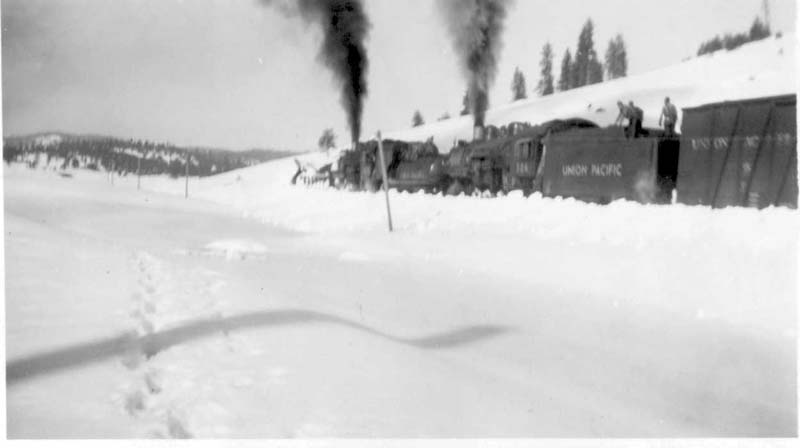
The winter of 1948-’49 stands out in the memories of everyone who experienced it. The amount of snow that fell almost certainly broke any previous area record and has not been matched since. Transportation in the entire region was brought to a standstill. All the roads were impassible for a time, and even trains were stranded.
“The winter of 1948-’49 was a record breaker. We had rain alternating with snow until we had over 5 feet of totally water-saturated snow. Then it turned extremely cold. I remember one night we saw minus 48°F below zero, and the high for the next day was minus 20°F below zero! The snow became one solid block of ice that would support the weight of the cattle and horses! The only way we could keep them from roaming, as the fences were buried, was to give them extra hay.”
“I remember going to the Middle Fork school during the winter of 1948-’49, when the snow was so deep and almost solid ice, of all us kids climbing Fausett’s hill across the road from the school, with our sleds in tow and climbing as high as we could before the recess bell rang, and then we went on a fast sled ride back to class. Since all the boulders, sage/buck brush and fences were covered, all the hills were fair game for long sled rides!”
“We (Dad) had to shovel the snow off the roofs to keep the buildings from collapsing. When we looked out of our house windows, we had to look up because the snow was piled higher than the eves.”
“Must have been the winter of 1948-‘49: Another memory was of flagging down the ‘Galloping Goose,’ a motorized railroad mail car, towing a passenger car. We were snowed in and needed some groceries. So dad rode his horse down to the PIN railroad crossing below our ranch and flagged it down and rode it into Council. The stationmaster told dad the tracks were closed beyond Council and the Galloping Goose would be heading back to Weiser shortly, but they would wait for him to get our groceries, which they did. Dad got our groceries and returned on the Galloping Goose to his horse. Then hanging the sack of groceries on the saddle horn came back home.”
“Later, when the mail contract with the railroad was terminated, dad took us all down to ride the Galloping Goose as it made its final run.” The Galloping Goose made its last run on July 1, 1950.
“We were surprised when the Galloping Goose came to the crossing below the ranch, as it was being towed by a steam engine! They stopped and picked us up, and I and sisters had our first train ride. We went to Council and then rode it back to where we got on. I also remember standing by the steam engine at the station and was so awed that driver wheels on the engine were higher than my head, then there was also the telegraph clicking away. I was ten years old at the time, 1950 I think.”
100 years ago
June 26, 1925
“Articles of incorporation of the Lost Valley Reservoir company were filed in the office of the Adams County auditor recently. The incorporators of the concern are Mrs. Elizabeth Van Hoesen, Mynderse Van Hoesen and E. G. Van Hoesen.”
A boy was born to Mr. and Mrs. Myron Paradis on June 21.
A boy named Grant Wesley was born to Mr. and Mrs. Herbert Ader on June 23.
75 years ago
June 15, 1950
Don Whiteman completed his fourth year at the University of Idaho and is now employed at the Circle C Ranch.
Marriages: Mr. and Mrs. Herbert Mink – Mr. and Mrs. Dean Perkins – Ruth Kalfholm of Finland and Eugene Byers – Dena Farrens (15) and Carroll Womack (19) – Mrs. Della Olk and Gene Fuller.
49 years ago
June 10, 1976
The Southwest District Health Department is preparing for a swine flu immunization program.
Died: Lester W. Hinkley, 66, a lifetime resident of Cambridge.
Died: Carl H. Swanstrom, 78, of Council. Burial in the Hillcrest Cemetery at Weiser.
Died: Fitz Mink, 79, of Weiser, when a train hit his vehicle at a railroad crossing.
Died at Seattle: John Anderson, cousin of Edna Johnson. He was born and raised at Indian Valley and would have been 66 years old in August.
25 years ago
June 15, 2000
Jeff Dunham and Penny Boudreau will be married June 24 at the Indian Valley Hall.
Stu Dopf is in the Weiser Care Center.