

While Dr. Brown was establishing himself at Cuprum, grade construction on a rail line was started up Hornet Creek from Council to reach the mining district, and short sections of grade were built between Council and Helena. But the plan to build a line into those mountains had never been more than an unrealistic fantasy, and it was never completed. This left Dr. Brown without a backer in Cuprum, but it didn’t seem to phase him. The mining district was exploding with activity, and opportunities abounded.
About the time the rails reached Cambridge in 1901, Brown moved his drug store and medical practice to a new town called “Decorah” that was being established up Indian Creek from Cuprum.
Decorah was quickly overshadowed by the town of “Landore” just up the creek. Sometime between 1902 and the end of 1904 the Browns moved to Landore where they and their store (which also contained the post office and long distance telephone service) became a core of the community. Their products included “drugs, chemicals, confectionery, stationery, fresh fruits, cigars and tobacco, groceries, provisions, gent’s furnishing goods, hats, gloves, boots and shoes, paints and oils, powder, caps and fuse.”
Dr. Brown received his pharmacists license in 1905. He also functioned as the local optometrist. Emma acted as nurse in the medical practice, often treating minor injuries when the doctor was away.
The Browns were cornerstones of Landore social life, and were involved in most civic affairs. The doctor had a fine tenor voice, and sang at many social gatherings. In 1912, Dr. Brown was elected to the state legislature, becoming the first representative from newly formed Adams County. He served only one term, but was instrumental in getting the short-lived Black Lake Game Preserve created, and in getting elk and trout planted in this area. His political activities led him to become a close friend of Senator William E. Borah. It was also about this time (1913) that Brown became the deputy assessor for the Seven Devils vicinity.
By 1913, Winifred Brown began teaching at area schools. That fall, she was an assistant high school teacher at Cambridge. The next fall (1914) she took a teaching job at Weiser.
When the mining boom faded, the Browns moved to Council in 1916. It was that year that Dr. Frank Brown moved away, so the timing worked out well. Dr. William Brown established his office in a building on the main street. He and Emma had a home built that is still standing in Council, and where Dr. Thurston later lived, on the northeast corner of East Whiteley Avenue and North Clarendon Street.
The Brown’s daughter, Mildred, married Fred Forbes (1899 - 1961) in 1917 somewhere in Idaho. I have no information as to where they lived or about their careers. Mildred died at Los Angeles in 1982.
The January 17, 1919 issue of The News (Cambridge newspaper) shared a report copied from the Council Leader newspaper: “On Tuesday at about 11 o’clock, a fire started in the house of Dr. Brown, but was extinguished before very serious damage was done. The blaze started in the basement and burned through the first floor. In extinguishing the fire the home was unavoidably quite badly so with water and it is possible that the damage from this source was greater than that from the fire. The local fire apparatus was placed in action in jig time and worked without a hitch.” Whether this was the house mentioned above or not is unclear.
Dr. Brown soon became the Adams County physician and coroner.
In the fall of 1920, Dr. Brown and Leonard Griffith bought Starkey Hot Springs. The doctor continued his practice in town two days a week. The Browns continued to live part time in their Council home, but at some point moved to Starkey. At some point, Griffith sold his share of the resort to the Browns.
Adams County Leader, July 8, 1921: “Miss Winifred Brown returned on the latter part of the week from Montana where she had been teaching school.” In January of 1922 Winifred was teaching at Kuna, Idaho, but by August she was planning to teach high school classes at Council. However, that plan was sidetracked when she married Robert Lindsay at San Francisco on September 2 and the couple took up residency there.
The 1920s were some of the peak years for Starkey, with dances every other Thursday evening in the summer. The hotel attracted guests from near and far, including celebrities such as Senator William E. Borah. Toward the end of that decade, Winifred and Bob Lindsay returned to Idaho and started managing the resort while the doctor and Emma – now in their late 60s – spent their winters in a home they bought at Phoenix, Arizona. During the time that Dr. Brown was in Arizona, Council had no doctor, with the nearest one being Dr. Conant at Weiser.
During the 1930s the Lindsays pretty much taken over the management of Starkey and made many improvements. The Browns spent their summers there, but continued to go south for the winters.
Dr. William Brown died in Phoenix on October 10, 1941 in St. Joseph’s Hospital, after spending 12 days as a patient there. The cause of death was “cerebral hemorrhage due to hypertension.” He was buried in the Greenwood Cemetery at Phoenix on Oct. 13. In 1950 Emma had him moved here where she knew he would have wanted to be – in the Salubria Cemetery. She died August 2, 1952 at the home of her daughter, Mildred, in North Hollywood, California. Her ashes were buried beside William in the Salubria Cemetery.
Winifred and Bob Lindsay ran Starkey for most of their lives, selling the resort in the 1960s. She taught for a while at Council High School. Bob died in Boise in 1966. Winifred died February 16, 1978 at San Mateo, California and was buried in the Salubria Cemetery beside Bob. As far as I know, their daughter, Mary Drennan Lindsay (born about 1933), is living in Bellevue, Washington.
The Council museum has several items that belonged to Dr. Brown: his medical bag, a glass office sign, a machine for making pills, a big set of lenses for eyeglasses.
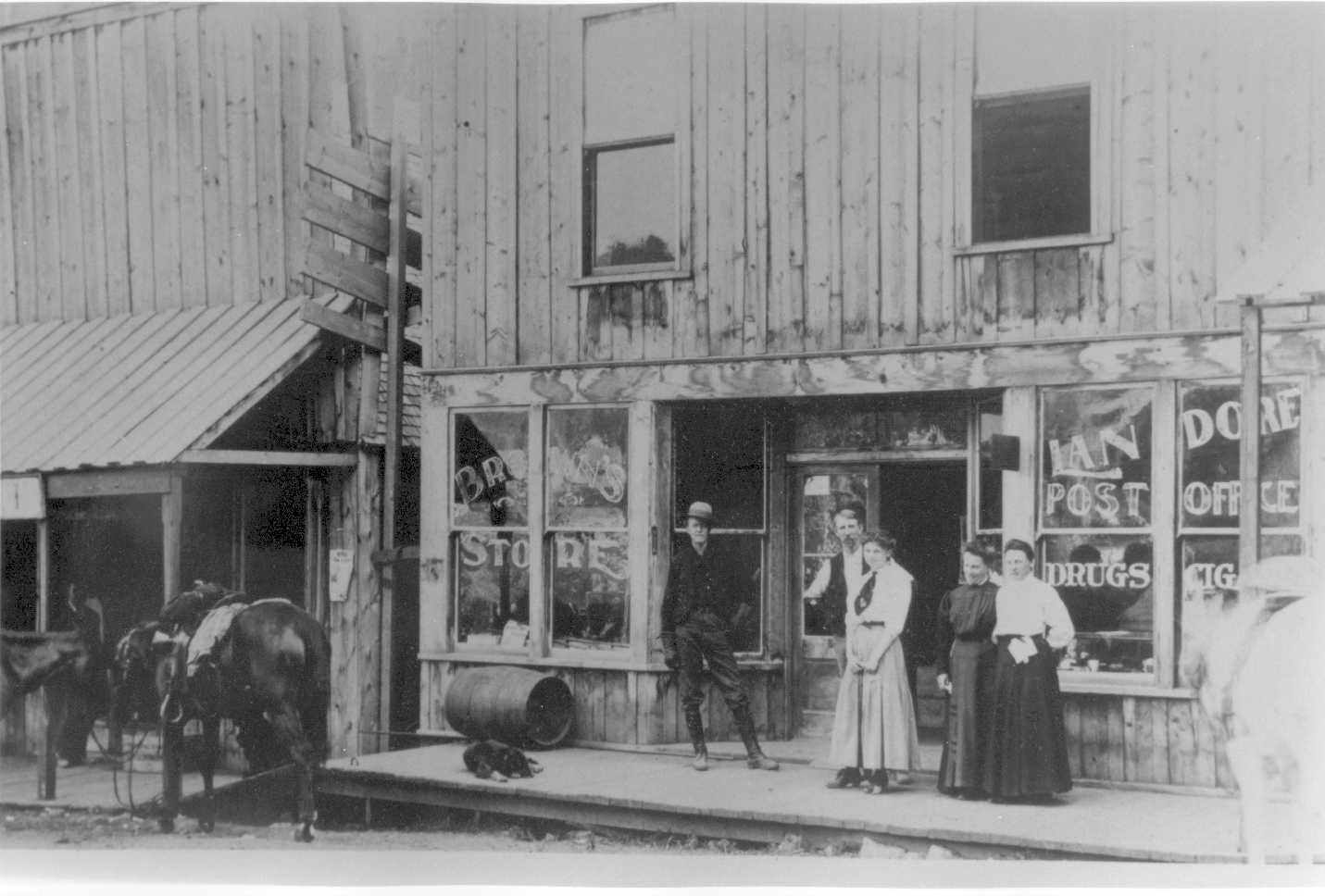
Browns store at Landore, 1908. The people are, in no particular order: William W. Irwin, Dr. Wm Brown, Winifred Brown, Mrs. Edwards, and Mrs. Emma Brown.
100 years ago
October 26, 1923
The Cambridge High School football team played a game against Cascade High School at Cascade. “It is the first game of football ever played in Long Valley; the first game ever played by either of the schools participating and the first game ever played by any of the individuals on either team.” The Cambridge players: Ralph Hinshaw, Paul Suiter, Ellis Peterson, Dallas Queen, Vernon Hudelson, Raymond Mitchell, John Frasier, Joe York, Lester Reed, Thomas Coriell, Henry Winders, John Olmsted, Fred Bain.
A boy was born October 21 to Mr. and Mrs. Earl Winks.
“Mrs. Geo. Childers and Mrs. Claude Childers are over from Wildhorse this week.”
A girl named Eleanor Jane was born to Mr. and Mrs. E. B. Jones on October 19.
75 years ago
October 28, 1948
The Carl Bumgarner place is being remodeled. The kitchen porch and small back bedroom have been removed from the house. “These rooms are to be replaced with a new kitchen, bedroom, bath, furnace and utility rooms and will be one and one half stories in height. Three bedrooms upstairs and a front room and dining room of the original house have already been remodeled.”
A boy named Russell Verne was born to Rev. and Mrs. R. D. Brubaker on October 23 at the Weiser hospital.
49 years ago
October 31, 1974
About 30 men are working 48 hours per week to complete the steel work on the new Whitebird Hill bridge.
Died at a Weiser nursing home: Harley D. Jones, 75, formerly of Cambridge.
25 years ago
October 29, 1998
The Alan Dopf family moved from Payette to Boise.
Dale and Lavonne Howell will celebrate their 50th wedding anniversary on November 8.