I ran across an article in the June 28, 1940 issue of the Adams County Leader that has some interesting information about early mail routes and carriers. It was written by Lee Highley, who was the New Meadows postmaster at the time.
Gold discoveries near Orofino, Florence and Warren in the 1860s brought thousands of fortune seekers through the Weiser River route to those gold fields.
In these isolated gold camps, people yearned for contact with the outside world. Aside from keeping in touch with friends and loved ones, business matters required some type of communication. And then there were legal matters too; claims had to be filed, etc.
The first mail route into Idaho followed the same route that brought the miners—up the Columbia River, and then through Lewiston. Before the first transcontinental rail line was finished in 1869, mail from the eastern U.S. traveled by ship around Cape Horn to the Columbia and on into Idaho. When Boise was established in 1863, mail and freight arrived there from Umatilla Landing on the Columbia River via the old Oregon Trail route over the Blue Mountains. After the transcontinental rail line was built, shipments started coming north from Kelton, Utah. The Kelton route soon replaced the one via the Columbia for any commerce to and from Idaho.
According to Highley, a mail route from Boise to Indian Valley and on north was established in 1874. It came up through Emmett and the Crane Creek area. An 1877 Statesman newspaper said this stretch to Indian Valley covered 75 miles via wagon road. From Indian Valley, mail went to Council, Meadows Valley, Warren, Florence, and finally Mount Idaho (near Grangeville). The Statesman said, “From the point where the Little Salmon trail leaves the mail route to the Main Salmon river at the mouth of the Little Salmon, the distance is 50 miles. Between the last named points the route is difficult, passing over a high and rugged mountain to avoid the deep canyons on the Little Salmon River.” The total distance from Boise to Warren was listed as 175 miles. From Warren to Florence, 50 miles, and from Florence to Mount Idaho, 50 miles.
Highley said the journey from Boise to Warren took seven days. Edgar Hall covered it (Warren to Fort Boise) in 24 hours on his ride to report the outbreak of the Nez Perce War in 1877!
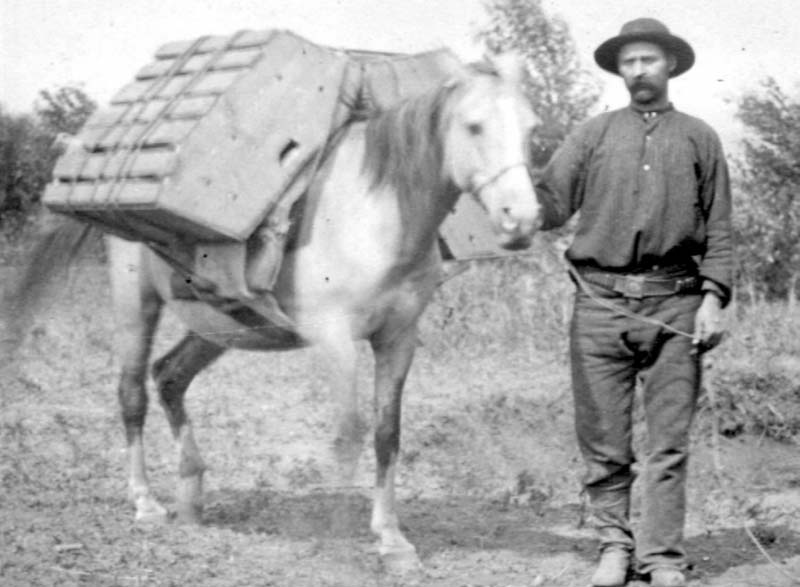
This mail route was contracted to Calvin White and his partner, D.W. Jennings. White and Jennings did not carry the mail themselves, but subcontracted the work to men such as Solon Hall and his sons, Edgar and Abner. Edgar Hall, and Tom Price were two of the best-known mail carriers on the route between Indian Valley and Warren.
One of the most common questions that I’m asked is about how Fort Hall Hill got its name. It’s easy to confuse the name with Fort Hall in southern Idaho, but our Fort Hall Hill has nothing to do with that place. The name came about because there was a cabin at the southern foot of Fort Hall Hill where Solon Hall and his sons would spend the night on their journeys between Indian Valley and Warren. The cabins became known as “forts” for reasons that are not clear, but my bet is that it had to do with people’s sense of humor that was unique to that time period. Because the cabin was used by the Hall family, the cabin at Fort Hall Hill became known as “Fort Hall,” and the hill became known by that name for the location of the “fort.”
There were several cabins along this route, which were spaced about a day’s walking distance apart. The next such cabin to the north was Fort Price (near present-day Tamarack), named after mail carrier, Tom Price. Of course Price Valley has the same name origin. I don’t know where any other mail “forts” were along the mail route, but there had to have been several.
Tommy Clay was another well-known mail carrier on this route for twelve years. His stepson, Ed Osborn also carried mail there for two years. Lee Highley interviewed Ed’s wife and got a couple of good stories about Tommy Clay. One occurred in the late fall of 1875.
Winter snow came early that year, and twelve inches fell one night. Clay was on his way north from Indian Valley on horseback with three pack horses. The pack horses were in the lead as they reached a river crossing at present-day Tamarack. There was a dead horse lying near the crossing, and several wolves were feeding on it. Highley wrote: “At his Clay’s approach they moved away singly and in pairs to the nearby timber. One of their number, however, was more reluctant to depart than the others. He had leaped to the saddle of one of the pack horses, ripped the canvas covering with his claws, pulled out a small square of bacon and sat contentedly but hurriedly eating his dessert course. It was so much better than frozen horse meat that he would not relinquish it but made away through the snow to the timber. He was fortunate in this, that Mr. Clay never carried a gun, but always relied on a trusty blade beaten out from a rasp of steel.”
Food was stocked at cabins along the mail route, especially during the winter. One spring, the weather warmed up quickly and the food at one of the cabins didn’t keep as long as expected. Highley related the tale of one of the mail carriers who had cooked extra food and left it at a mail cabin for his return trip several days later: “Upon reaching the cabin again, he was weary from the load of mail and the travel in soft snow. He ate and fell asleep only to awaken wrought with pain and threatened with ptomaine poisoning. Morning found the worst over and after a fire and coffee he managed to get out on the crust and make away for the next station.”
I read that Ralph Finn knew the location of the Fort Hall cabin, but he didn’t record it or place a marker there, so the exact location has been lost.
100 years ago
May 22, 1925
“An aeroplane passed over town Saturday, bound in a northerly direction.”
The Craddock & Son garage building is going to be remodeled to make room for a complete and modern filling station. The plan calls for a corner entrance and driveway. To do this, the west corner of the building, now occupied as the office and sales room, will be set back 25 feet. The front of the building will be set back also, to provide ample room for driving in and out, and two large pumps of the latest design will be installed in the driveway.
Cambridge High School had 15 graduates.
75 years ago
Missing issue: May 18, 1950
49 years ago
May 20, 1976
Anglo-Bomarc Mines Ltd. of Vancouver, B. C. is doing exploratory work at the Hercules Mine located on Cuddy Mountain four miles north of Highway 71. “First attempts to reach the present mineral zones started as early as 1901 but were stopped by unstable conditions in the drift (tunnel). Attempts have been made since then in 1945, 1965 through 1968, and again in 1970. Since exploration and expansion of the old drift in 1975 and ‘76, progress reports show enough silver, lead, and zinc or to warrant a large mining operation.”
“New Meadows has incorporated their Emergency Medical Technicians and other interested persons into a non-profit service corporation to be known as ‘Meadows Valley Ambulance Service, Inc.’. Articles of incorporation have been approved and an ambulance has been purchased.”
25 years ago
May 18, 2000
The Midvale girls track team won the district track title for the third year in a row.
The Midvale/Cambridge Rangers baseball team won the district championship game and will travel to the state tournament in Lewiston.