
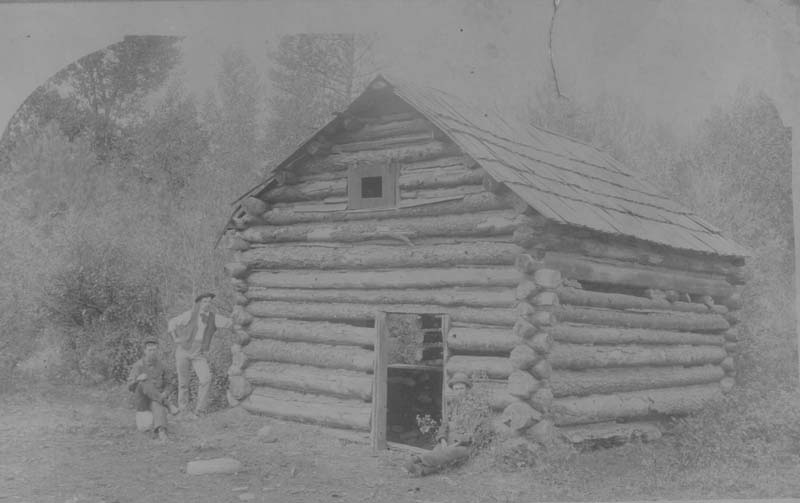
On October 8 I gave a presentation at the New Meadows Depot about Packer John and his cabin near the old town of Meadows. I thought a History Corner on the subject might be of interest.
To set the stage for the story, a little background is in order. What is now Idaho was almost exclusively occupied only by natives until gold was discovered near Orofino in 1860. This brought a flood of fortune seekers to the region. Almost all of them traveled up the Columbia River to what became the town of Lewiston in order to reach the new gold field.
In 1861 gold was discovered at Florence, northeast of present-day Riggins. That brought an even bigger rush of gold seekers. Also, on April 12, the Civil War broke out.
1862 was one of the most important years in Idaho history. Gold was discovered at Warren (between the Salmon River and present-day McCall). Copper was discovered in what became the Seven Devils Mining District. And one of the most productive gold fields in the U.S. was discovered in the Boise Basin, northeast of present-day Boise. Congress passed the Homestead Act that year. Tim Goodale brought the first wagon train to reach the upper Weiser River area. And John Welch, who would become known as “Packer John,” built his cabin.
At this time, almost the only way people used to reach the gold fields was via the Columbia River and Lewiston – a new “town” that consisted mostly of tents. The new gold strike at the Boise Basin was over 250 miles from Lewiston and supplies.
Looking to make money selling supplies to the brand new gold mining Mecca, John Welch, only 20 years old, with an unknown number of hired men took a pack train of supplies from Lewiston to sell in the Boise Basin.
The route the pack train took undoubtedly followed an Indian trail along the ridges west of the Salmon and Little Salmon Rivers. That trail became known as the Boise Trail, Packer John Trail, or a few other names. It became the principal route for fortune seekers to reach the Boise Basin.
This trail was very short-lived, as the supply route from Lewiston was soon changed to a trail over the Blue Mountains from Umatilla Landing on the Columbia. Even this route was superseded after the first transcontinental rail line was built in 1869, and a supply point along the rails at Kelton, Utah ended the need to bring supplies by ship around Cape Horn to the Columbia River.
But in 1862 Lewiston was the closest supply point to the Boise Basin, and Welch would have delivered just about the first supplies to reach the miners there, but nature interfered.
As his pack train reached Meadows Valley and tried to climb over the ridge into Long Valley, the snow was too deep to continue. The crew set work building a shelter in which to store the precious supplies. They had to have selected a spot with adequate timber (possibly Cottonwood) from which to build a log structure. After stashing the supplies in the cabin, the outfit journeyed back to Lewiston for the winter.
As soon as the snow melt allowed in the spring of 1863, John Welch took another pack train south from Lewiston with supplies. Although the record is sketchy, I would assume he delivered the fresh supplies to the Basin first, and then returned for the ones stashed in his cabin. Even by then, few, if any, supply trains had reached the Boise Basin gold camps, demand was off the charts, and Welch probably made a killing selling his goods.
The 18’ X 24’ log storage structure that Welch and his men built became known by a few names, such as the “Mountain House,” “Cottonwood House,” or “Goose Creek Cabin” but was mostly known as Packer John’s Cabin. For a time, it was the only structure between Warren and the Boise Basin, it became a popular stopping point for travelers.
In July of 1863 Idaho became a territory. Lewiston was named the Territorial Capital. At first, Idaho Territory included area outside of the present boundaries, but was soon reduced to the boundaries we know today. Because it was more or less half way between Lewiston and the new population centers in the Boise area, that October, the territory’s Democrats held a convention at Packer John’s Cabin to nominate delegates to Congress.
Republicans held a similar convention there that year. Meanwhile, tens of thousands of men were being slaughtered in the Civil War. Some fled to the West and made Idaho’s political picture “interesting.”
In the summer of 1864 both parties again held conventions at Packer John’s Cabin. That December the capital was moved from Lewiston to Boise.
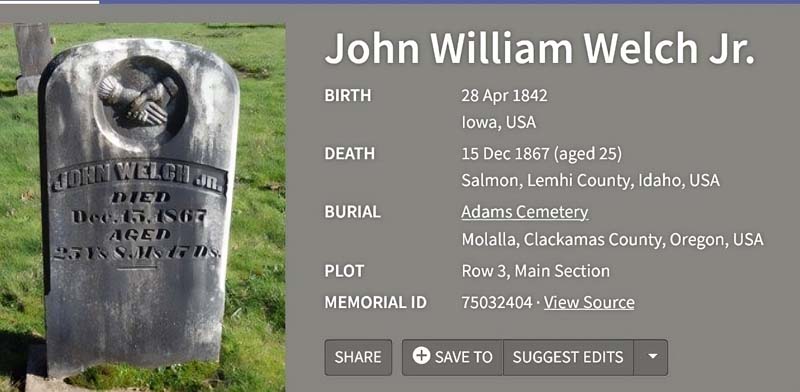
John Welch continued to freight supplies to and from various places. In 1867 he and a companion were traveling from Salmon to Boise with $3,200 in cash and $500 worth of gold dust. (Worth over $78,000 in today’s dollars.) Along the way, four robbers held them up at gunpoint. Welch made the mistake of telling the robbers that he would recognize them if he saw them again, at which point one of the robbers shot Welch in the head.
Packer John Welch was 25 years old when he was murdered. His brother, William, retrieved the body and took it back to Malalla, Oregon (southeast of Portland) for burial.
Next week: Packer John’s Cabin and its replicas.
100 years ago
November 14, 1924
“V. W. Keele has bought 10,000 pounds of dressed poultry in the last week – mostly turkeys – goes to show that a good deal of poultry was raised in this section this year.”
“We have often heard the slang phrase a ‘dog killing time,’ and Marshall Pettit knows what it means. He loaded up his old zulu the last of the week and made away with some of the surplus dogs of the town. There were plenty, too,”
Goodrich – A girl was born to Mr. and Mrs. Luster sic] Thomason November 5.
75 years ago
November 17, 1949
Died at her home in Midvale: Nellie Stewart Hiddleson, 77. Burial at the Hillcrest Cemetery at Weiser.
A daughter was born to Mr. and Mrs. Don Moritz of Grays Creek at the Council hospital on November 14.
A daughter was born to Mr. and Mrs. Hugh Snapp of Midvale at the Council hospital on November 12.
A daughter was born to Mr. and Mrs. Dale Cada on November 7 at the Council hospital.
Fourteen men turned out to work on the Indian Valley community hall.
“The first of December, Star route from Indian Valley to Cambridge will go around the Grays Creek Road bringing daily mail service to quite a number of families not now on the route.”
49 years ago
November 13, 1975
Died at a Caldwell nursing home: Robert Ray Loveland, 79. Born in 1896 in Kansas, he came to Midvale in 1914 and graduated from Midvale high school in 1917. Burial in the East Side Cemetery.
25 years ago
November 11, 1999
Advertisement: Lorton Pharmacy – Harold G. Williams – proprietor/pharmacist.
A group of Washington and Adams County farmers and irrigators are promoting improvements to the Lost Valley reservoir dam. Their plan is to double the 30-foot height of the existing dam, which will nearly triple the storage capacity of the reservoir.