
I left off last week after the first transcontinental line was completed in 1869 and supplies were being freighted to central Idaho from that rail line at Kelton, Utah.
In 1881, as part of the rapidly expanding rail system in the West, the Union Pacific Railway Company started building the Oregon Short Line (O.S.L.) northwest across southern Idaho from the main line at Granger, Wyoming. At the same time, the Oregon Railway & Navigation Company started construction on the opposite end of the O.S.L. from Portland, Oregon. The two construction efforts would meet at Huntington, Oregon to complete that line. The U.P. line progressed across southern Idaho, generally following the old Oregon Trail, bypassing Boise because of the steep grade required to reach the town.
The Oregon Short Line reached Weiser at the very end of 1883, and the first train rolled into Weiser in January of 1884. That November the two construction companies met at Huntington to complete this vital branch of the transcontinental line.
The new rail supply point at Weiser sparked excitement in the region all around it. For Council, the trek to a rail supply point was reduced from weeks or more from Kelton, Utah to a two-day wagon trip each way.
When the O.S.L. reached Weiser, an old story unfolded that illustrates the economic power of railroads and their ability to coerce communities to bend to their will and increase their profits. When the rails arrived, instead of placing the depot in a town, it was standard practice for the railroad company to establish a depot outside the town on land that it had acquired. Because the depot would always become the indispensable center of commerce, any business that didn’t move to it signed it’s own death warrant. It was move to the depot and buy a lot belonging to the railroad company, or die.
When the O.S.L. reached Weiser, it put its depot a mile or two southeast of the town. Even though this location started to draw businesses to it, the company relocated their depot to almost a mile west of Weiser, which began a migration of businesses to lots it had to buy from the railroad. The final nail in the town’s coffin came when a fire wiped it out in 1890. This original section of Weiser was then referred to as “old town.” The practice of killing towns for profit would be repeated, or attempted, in our area several more times over the coming years.
By the 1890s, the lack of transportation for the rich copper ore from the Seven Devils Mining District, plus the vast areas of timber in the Weiser River drainage, became a constant topic in the news. Every year, as dependable as the appearance of spring flowers, promises of a rail line to the mining district and the timbered hills to the north of the O.S.L. appeared in area newspapers. Claims of rail lines to be built north to Lewiston abounded. The idea of building up the Snake River, past the foot of the mining district and on to Lewiston, was touted as a sure thing several times, even though building a railroad through Hells Canyon was a pipe dream as foolish as any ever imagined.
Even though it seems Weiser was the obvious starting point for such a railroad, towns from Emmett to Payette promoted the idea that their community would be the best for such an endeavor.
All during the 1890s, Thomas Bates championed efforts to get this railroad built. In 1894 he hired surveyors to lay out a grade up the Weiser River from Weiser, and announced that construction would start in six weeks. His efforts continued until finally, in April of 1899, the Pacific & Idaho Northern Railway Company actually started construction on a line up the Weiser River, branching from the O.S.L. At Weiser.
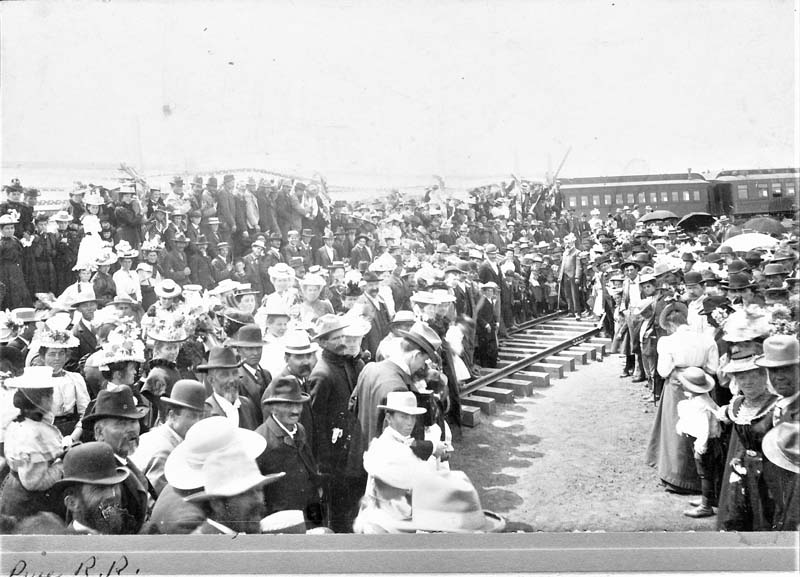
After some distance of grade was built on which to lay ties and rails, the first rail was laid on May 18, 1899. A huge crowd gathered at Weiser to watch Thomas Bates drive a spike made of Seven Devils copper. The crowd cheered, the band played, and long speeches were made proclaiming the wonderful future that would be assured by the railroad.
A few miles from Weiser, the river runs through a narrow canyon between steep hillsides. This canyon had been avoided by the trapping group led by Peter Skene Ogden in 1827 as being too challenging, even for pack animals. Tim Goodale’s 1862 wagon train chose an alternate route over Midvale Hill, which basically became the highway route (with one change) to this day.
The P&IN put 800 Japanese workers to attack this canyon with picks and shovels, as it was too steep to use horse-drawn equipment until a crude path had been hacked from the hillsides. It would take months to create a railroad grade through this canyon. Meanwhile 2,000 more workers were scattered in camps along other parts of the planned route. Huge quantities of hay and grain were needed to feed at least 450 teams of a minimum of 900 horses.
Continued next week.
100 years ago
July 10, 1925
Mentioned: the Clare sawmill “above Vista.”
Many people celebrated 4 July at Starkey and Council.
75 years ago
June 29, 1950
Died: Otto Thomas Marquess, born 1888 in Missouri. He was about 15 years old when his family moved to Cambridge.
A son was born June 25 to Mr. and Mrs. Laverne Linder of Midvale.
Twins, a boy and a girl, were born to Mr. and Mrs. Marvin Ader at Walla Walla.
49 years ago
June 24, 1976
The county crew has paved Fifth Street in Cambridge. “For years the road has been a source of rough rides and clouds of dust. Fifth Street is one of the more heavily traveled through streets in Cambridge and the new service will be a tremendous improvement for the west side of Cambridge.”
25 years ago
June 29, 2000
Died: Vivian Shaw, 57, of Cambridge/Council.
Don and Dorothy Watson are celebrating their 50th wedding anniversary.
Newly-constructed westbound lanes are now open on I-84 from the Oregon border toward Boise.