
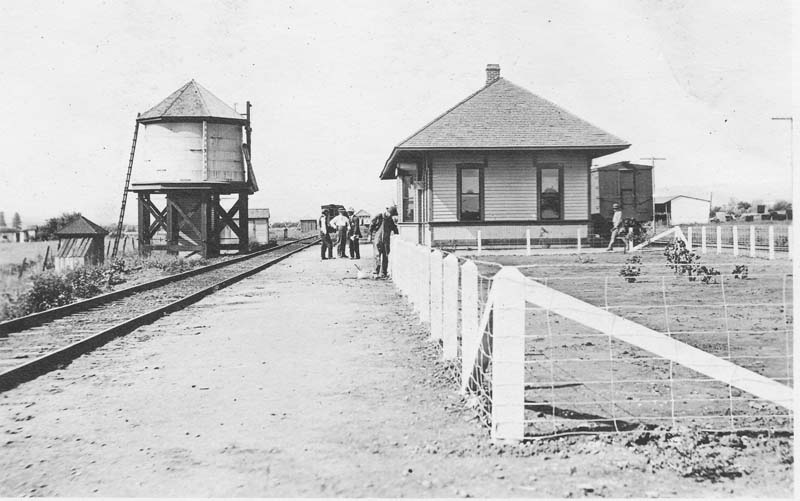
When construction of the P&IN reached Midvale, the company didn’t seem to try its usual trick of replacing the town, but the fate of Salubria was uncertain. The P&IN kept its planned route a secret until the last minute, ultimately building to a new town they named “Cambridge” about a mile from Salubria. The name first proposed for Cambridge was “Lewisville” after Lewis Hall, one of the principal owners of the P&IN. The Postal Department refused the name “Lewisville,” saying one town in Idaho named after a Lewis (Lewiston) was enough. The name “Cambridge” was settled upon in honor of the hometown of Hall’s alma mater, Harvard. The first train pulled into Cambridge on December 29, 1899.
The thriving town of Salubria soon completely disappeared. Today there is almost nothing left to mark the spot, except I think there is still part of a printing press at a fence corner if you look closely enough.
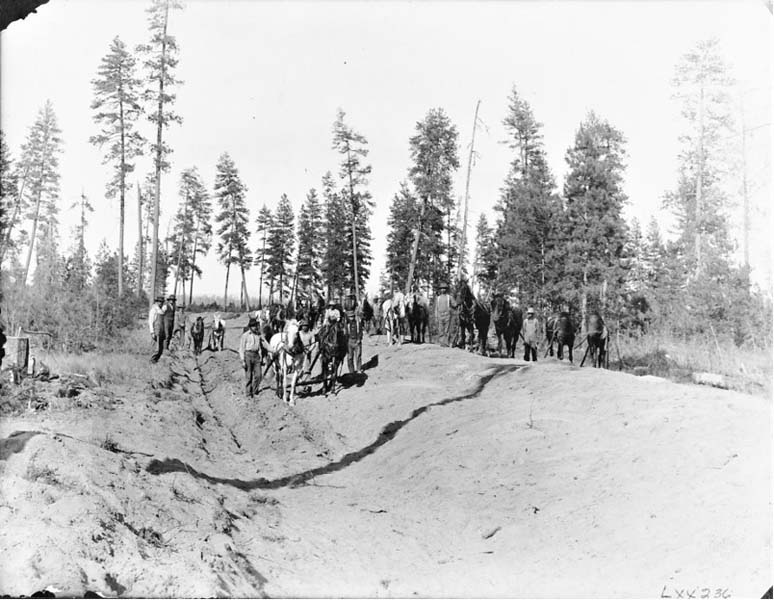
Work on the P&IN apparently stopped for the winter but resumed in April, 1900. Construction up the Weiser River was slow, and the tracks didn’t make it to Council until almost a year later: March 13, 1901. The rails ran to the east side of Council, with the depot about where the Dollar Store is today. Parts of the grade are still visible at the golf course and from there northeast.
Immediately after the rails reached Council, copper ore from the Seven Devils mines began arriving at the depot for transport to a smelter. For many years, pieces of spilled copper ore could be found lying on the ground there.
Initially, the P&IN seemed to make no effort to put the depot outside of Council.
Even before the line reached Council, construction started on sections of railroad grade between Council and the Seven Devils mines. Some grade was created along Hornet Creek and some sections are still visible on the side of White Monument, not too far southeast of the Peacock Mine. Another grade was started up Price Valley, resulting in Railroad Saddle receiving its name. Both of these routes soon died – partly because the mines didn’t produce as expected and partly from the realization that the cost of the line would be unreasonable.
Partly due to politics, and partly from economics, the rails went no farther than Council until 1905. The P&IN decided against building along the foothills on the east side of Council Valley and moved the tracks and the depot to the west side of town before building on north. There were later some disgruntled mutterings among local residents; they claimed that if the line had continued along the foothills at the level of the original Council depot, it would have avoided the need to cross the Weiser River so many times.
When the depot location was planned on the west side of Council, the P&IN at first planned to put it north of the center of town. Local opposition managed to get the depot located near the end of Moser Avenue.
Construction of the line reached what would become Fruitvale by the end of 1905. Some construction continued during a very cold winter, reaching the Stevens Stage Station at the mouth of the East Fork of the Weiser River in February of 1906.
By December 22, 1906 the tracks were completed to a place in the canyon called “Evergreen,” which was a short distance downstream from present-day Evergreen Park. Again construction stopped for several years. People and supplies bound for the Meadows Valley or McCall had to continue north from Evergreen by wagon road.
Construction north from Evergreen started in October 1910. The work on this stretch was being done by crews of “husky Greeks,” and their cooks left an interesting legacy behind. At various locations along the line they built dome-shaped ovens from stones and earth to bake bread. The remains of these ovens are still visible.
Rails reached Meadows Valley in January 1911. Once again the company stopped a mile short of reaching Meadows, the only town in the valley, and created the town of New Meadows. Meadows soon died.
Big plans were made to build on north to Lewiston someday, but they never materialized. The overwhelming challenge of building through the Little Salmon River canyon alone must have discouraged this. Plans to build on to McCall were contemplated but never came to fruition.
When the Idaho Northern Railway arrived in McCall in 1914 it had killed a number of towns along the way. Their new depot at “Cascade” killed Thunder City, Crawford and Van Wyck. Their new town of “Donnelly” killed Roseberry. The depot at Payette Lake was built north of McCall at a place they named “Lakeport,” but outraged citizens with political connections succeeded in having it moved back into town.
My presentation about Mesa Orchards was well attended last Tuesday evening at the News Meadows depot. Recording the live presentation didn’t work out, but I have recorded a version of that presentation and put it on YouTube. It’s 1 ½ hours long. You can find it by searching my name on YouTube.com.
100 years ago
July 17, 1925
On Friday that temperature reached 108 in Cambridge and 112 at Weiser.
Obituary of Margaret Pitzer, 39. Burial in the Cambridge Cemetery.
Died: W. T. Cornett of Indian Valley.
A girl was born to Mr. and Mrs. F. Wikoff on July 11.
A girl was born to Mr. and Mrs. Harry Ludwig of Indian Valley on July 7.
75 years ago
July 6, 1950
A daughter named Mary Christine was born June 29 two Mr. and Mrs. Clare Lorton.
A son was born to Mr. and Mrs. John Stewart on June 30 at the Council hospital.
A son was born to Mr. and Mrs. Glen Howland at the Weiser hospital on July 3.
Died: John Marvin Rasdall, 72, Midvale rancher.
The Idaho Public Utilities Commission has ruled that the “Galloping Goose” running between Weiser and New Meadows will be discontinued, effective August 1. The loss of this service will more adversely affect those patrons residing in the vicinity of Goodrich, and to a greater extent to those living in the vicinity of Fruitvale. “This is a localized situation due to location and snow conditions, but not affecting the general public interest sufficiently to justify denial of this application.”
This issue contained the first part of an article, “Early History of Salubria Valley,” by Ila G. Wilson.
49 years ago
July 1, 1976
“Scott Ritter, 20, youngest son of M. S. and Catherine Ritter, Council, was killed Sunday evening, and Anthony Hale, 23, son of Mrs. Vincent Schwartz, Midvale, received multiple cuts and bruises when the B. L. M. fire truck they were riding in, went off the road about 12 miles south of the Tony Cada ranch on South Crane.”
Mr. and Mrs. Fred Bain celebrated their 50th wedding anniversary.
A son named James Edwin was born June 22 to Mr. and Mrs. Larry Horning at the Caldwell hospital.
25 years ago
July 6, 2000
“The framers are working steady on the new Cambridge High School wing. The roof is almost completed.”
Died: Lloyd Raymond “Ray” Jeffries, 96, of Ontario, formerly of Cambridge and Mesa. Burial in the Indian Valley Cemetery.
Died: Walter Grossen, 89, Indian Valley.