
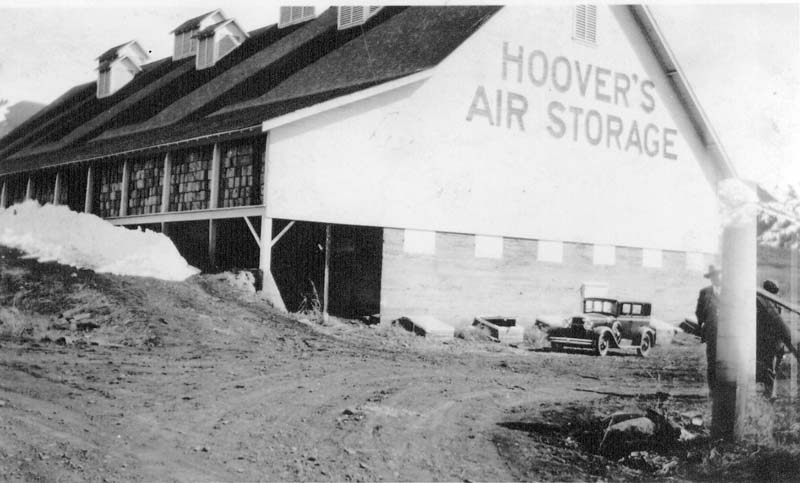
While Mesa Orchards was spending money on improvements during the 1920s, the Orchard District just north of Council also expanded until fruit trees covered almost the entire area between Mill Creek and Orchard Road east of the highway. Men such as William Hoover, Lawson Hill, Addison Missman, Tom Nichols and Frank Scholl were some of its prominent producers. These men, and others, built “packing plants” where apples were sorted, boxed, and then shipped via the railroad.
In the early 1920s a railroad spur was built to service the packing plants in the Orchard area, and the power line was extended to them as well. The rail spur left the main line about where Orchard road now crosses the old railroad grade (Weiser River Trail) and went straight east about to the highway. Addison Missman (for whom Missman road is named) built a big packing plant next to the main rail line and just north of the new spur. Bill Hoover built a second building along the south side of the spur, near the highway, from which to load fruit into railroad cars. Frank Scholl had a similar structure between Hoover’s loading facility and the main railroad
Charles Lappin had an orchard to the north of the Orchard district on Lappin Lane. (Lappin Lane of course is named after him and his family.) Lappin had one of the first commercial orchards in the valley when the “fruit boom” began about 1907. In 1927 he employed 35 workers during the apple harvest.
Frank Galey was another well known fruit man. He had a sizable orchard on Mill Creek.
Lawson Hill’s place was on the south east corner of Mill creek road and Orchard Road, and Bill Spahr’s was just across the road to the north. Mrs. Spahr (Lucy) taught school at the Orchard school for a time, in the 1920s. The old Spahr orchard is the only orchard in that district that has remained more or less intact. The Spahr house (still standing at 2483 Mill Creek Rd.) drew attention as being unusual when it was built in 1935. It was built out of rock, and also sat on a natural rock foundation from which the basement was reportedly created with dynamite.
William Hoover’s packing plant was located on the south east corner where Orchard Road and Missman Road intersect. When it was built in 1923, it was said to be the biggest one in the Council area, second only to Mesa’s. It was such a local landmark that, when movie star Gary Cooper came through Council in 1947, he was given a tour of the plant. By that time, Bill Hoover had died (1931) and his son, John Hoover was running the operation.
It had a concrete floor, contained a grading machine, and could store almost 80 railroad car loads of apples. (The largest cars held 795 boxes and took about a day to load.) When the packing plant was built, it took six railroad car loads of wood shavings to fill the walls for insulation. During the harvest, Hoover employed 40 pickers in 1927, and kept at least 40 more workers busy at the packing plant.
From John Hoover’s daughter, Elinor, about the packinghouse:
“The processing room was on the south side of the building and was lined with windows. The apples were brought in from the orchards by wagon, transported to the processing room and loaded onto a conveyor belt that had round holes in it. Any apple that fell though was a cull and was dumped outside; we fed them to the pigs, made cider and vinegar. Nothing wasted.
“The apples were then dumped into an acid bath, and pushed onto another conveyor belt, spray rinsed and rolled past workers who watched for worm holes or apples that did not pass the standards of color, shape, etc. These apples were then rolled past more workers called ‘ring facers’ who fitted the prettiest apples into a ring to be placed on top of a bushel basket of fruit filled from the conveyor belt. At the end of the line, workers then put lids on the baskets, pasted the label on top that stated they were extra fancy and fancy apples from the Council orchards and grown and packed by William H. Hoover and later, John W. Hoover. The fruit was then either stored or taken to the loading dock, loaded onto wagons, taken to the railroad cars waiting at the Hoover spur about a half mile away. These cars then took the fruit to its final destination.”
More next week.
100 years ago
August 15, 1924
The Weiser State Bank, a new institution, will open its doors in less than a week.
Died from meningitis: Retha, the four-year-old daughter of Mr. and Mrs. Harley Wells of Pine Creek.
75 years ago
August 18, 1949
“Dan R. Lindsay, 56, a lifetime resident of Indian Valley, died at the Council hospital Wednesday night.” He was born at Indian Valley in 1893 where he lived on the same ranch for his entire life.
“A new transmission line and four new substations supplement service to electric users of this area and north of here. The 69,000-volt line, energize last month, it is an extension to New Meadows of the 69,000-volt line built by the company a year ago from Weiser to Cambridge. Substations have been installed at Cambridge, Council, Tamarack and New Meadows. Soon after Idaho Power Company purchased the electric system in the area from West Coast Power Company in 1944, it commenced remodeling and otherwise improving the system. Since taking over the responsibility of supplying electric service to the Midvale-Cambridge-Council area, the Idaho Power Company, in addition to constructing its transmission supply line, has built over 164 miles of rural distribution line to extend service to farmers of the area.”
Died: Sylvester Holmes, 78, retired Midvale rancher.
A daughter named Edith Pearl was born August 9 at the Council hospital to Mr. and Mrs. Mike Dinkel of Tamarack.
“Combines have been rapidly replacing the old grain binder and thresher in this area. This year, according to reports, threshing is being done on four places, the Grover Gibbs, Elmo Edwards, Cecil Kellar and Fred Norton farms. Both methods of harvesting have their virtues, but, from a woman’s point of view, the a task of cooking for from 18 to 25 men during rushing is not an easy task.”
49 years ago
August 21, 1975
Ribbon-cutting ceremonies on Friday officially opened the Mesa Hill North and Mesa Hill South projects on Highway 95. “The Mesa Hill project was officially opened at 1:14 p.m. on Friday, August 15, 1975.”
A daughter named Tammy Joy was born to Rev. and Mrs. Don Strunk at the Weiser hospital on August 18.
“Work resumed Wednesday on Midvale’s new library after recessing for several weeks awaiting the arrival of roof trusses. No date has been set for completion of the project.”
The Road and bridge crew found 32 broken stringers on the bridge over the Weiser River at Midvale. The 4 x 12 bridge stringers are being replaced with 6 x 12s, and the bridge should be opened to traffic Thursday. “Midvale people east of the bridge have had to travel 12 miles to shop at their local stores, as the bridge 6 miles north was the closest route out.”
25 years ago
August 19, 1999
The total proposed bond amount for a new Cambridge High School would be $3 million. The new building would be placed on the old football field west of the current structure.
Died: Effie “Ruth” Taylor Cole, 86, of Payette, formerly of Council. Ruth Cole was born in 1912 near White Bird, Idaho. She married Fred Cole in 1931, and they had five children. Fred died in 1993. Ruth spent 18 years as the telephone operator for the Bear Creek area, from 1960 through 1978, and then Cambridge Telephone installed a modern dial system.