
Apparently back in 1913, when “Mesa Orchards Incorporated” was created, it did not go by the name “Mesa Orchards Company.” This exact name became official in 1923. Mynderse wrote: “Soon after my father’s death, George Donart, with his usual astuteness and wisdom recommended and then took care of the incorporation of the orchards and we were thereafter known as the Mesa Orchards Company.”
Adams County Leader, May 11, 1923: 40 more acres of apple trees were planted at Mesa
The News (Cambridge) September 7, 1923: “The Mesa Orchards have established a local sales department for the convenience of nearby customers and offer the following fruits in the season, Peaches-Pears – Plums-Prunes-Grapes - Apples, starting September 15 and continuing throughout the season. Bring your containers. John Kilgore, Local Sales Mgr.”
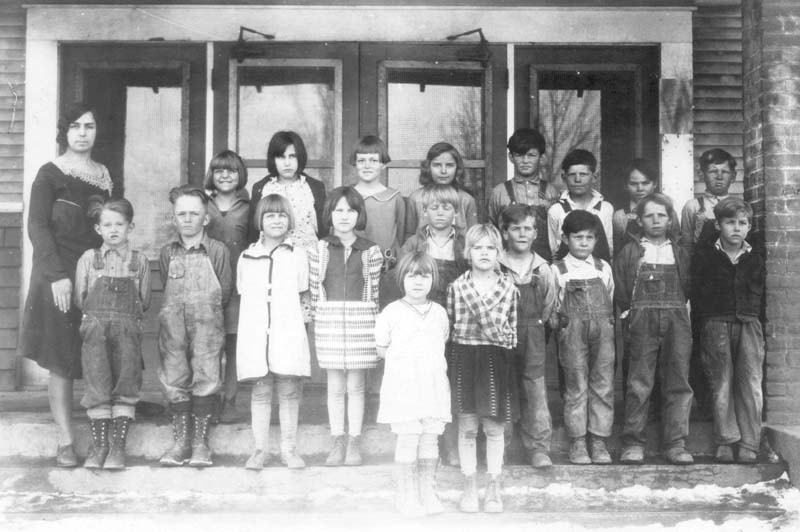
Ruth Brown McFadden wrote about the Mesa School: “I started school at Mesa in September of 1924, and graduated from the 8th grade there in 1932. The Mesa School was rather a large building with two large rooms and a big hall and a full basement underneath. All eight grades went to school there. The first, second, third and fourth grades were in one room, and the firth, sixth, seventh and eighth in the other. In the fall, during apple harvest, there would be a lot of extra kids in each room, as so many people came for the harvest and to work in the packing house and dryer.”
Ruth’s mention of a “dryer” referred to the evaporating plant, which burned down in November 1924. Evaporation or drying removed some water from the apples, resulting in a more shelf-stable product that would also help them last during long distance shipping. After the drying process, apples could also be converted into concentrated forms, such as apple juice concentrate or apple pulp. Evaporation plants were common in the late 19th and early 20th centuries.
Adams County Leader, Sept 18, 1925: Mesa apple output this year is estimated at 275 rail car loads – guessed to be about half of the total Adams County apple production.
Adams County Leader, Fri. Sept 3, 1926: The Mesa Orchard Co. is selling apples, peaches, and pears at “the Little Log House.”
In 1927 Ed Wade became foreman at the Mesa Orchards Company. He served in this capacity until 1935 when he was elected Adams County Sheriff, an office he held until 1943.
A 1929 issue of the Adams County Leader printed what may be a realistic estimation of the Mesa Orchards as, “one of the largest commercial orchards under one head operated anywhere in the northwest.” It listed 1,200 acres growing fruit and 2,500 acres total.
The stock market crash in the fall of 1929, and the global depression that followed all through the 1930s, was a blow from which the local fruit industry never fully recovered. Fruit prices plummeted. Because the fruit market failed to yield an adequate return, trees in the Orchard District were not maintained as well as they had been. The trees were older now, requiring more water, and water had become harder to get. Disease began to spread through the orchards, and many of the trees were destroyed. Only those trees that received adequate water and care survived the depression years. Eventually almost all of the land in the Orchard District was sold off for homes and small farms.
Apparently the Mesa Orchards Company bought many of its supplies from “Reilly Atkinson & Company, Inc.” of Boise. An undated letter from that company to the Van Hoesen brothers, perhaps during the depression, contains revealing details about the company’s financial situation and the massive number of items it used. Parts of the letter read: “You are considerably back on your payments as per our contract for this year. Briefly, our records show - bushel tub baskets - 65,197 - which is approximately eight cars of baskets and you inventory on this item as of last Thursday was approximately 600 dozen, making you short on your payments in the neighborhood of $10,290.00 covering approximately seven cars.” The letter mentioned, “A grand total owing to us by you of $30,439.74 which is entirely too much for you to be owing us at this time of the year Our agreement was that you were to pay for merchandise used and you were to remit to us each week.”
There were four main reasons why the 1930s started a downward slide for fruit growers:
1- Low fruit prices.
2- Cost of spraying. By the 1930s codling moths had apparently developed immunity to lead arsenate, which had been used to control them for many years. It took almost continual spraying during the growing season to keep the worms from taking over an orchard. Not every grower could afford this.
3- New Federal health regulations required the washing of apples with muriatic acid to remove lead arsenate. The cost of washing the apples was the least of the problems caused by this law. Muriatic acid hurt the keeping quality of apples, making refrigerated storage and transport almost a necessity. The average grower only had cellars.
4- The accumulation of lead arsenate made it almost impossible to start new trees on ground where it had been sprayed routinely.
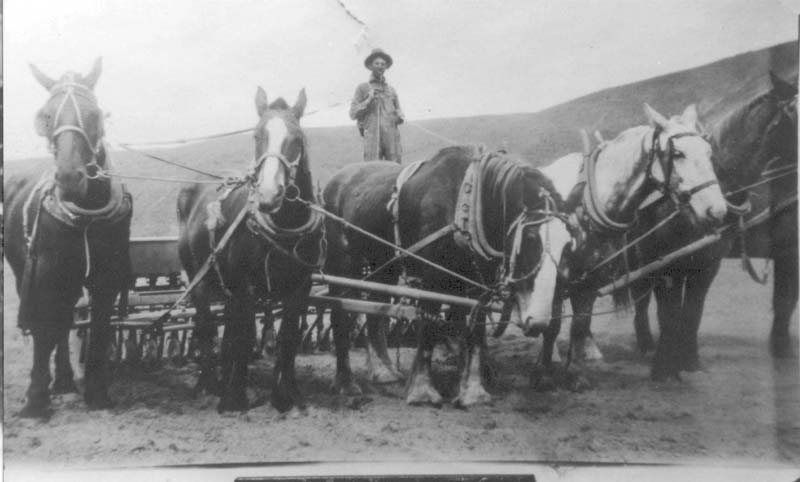
These were not the only problems caused by lead arsenate at Mesa. Thurn Woods remembered how the workhorses used in the orchards would slowly become sicker and sicker from eating the grass that grew between the trees. They would eventually die or have to be put down.
Continued next week.
100 years ago
August 29, 1924
“Mr. and Mrs. Charles Campbell stopped here Monday while in route home from Walla Walla where they had been to attend the marriage of their son, Albert. The bride was a Miss Ruskin and a former teacher in the Council schools the past two years.”
“The Mesa orchards are the scene of great activity these days, and they are working hard to keep ahead of the maturing fruit. They have a large force of workmen, and it is proving a big task to take care of the orders as they come in from the jobbers from all sections of the United States.”
Died: Mrs. Lottie Paradis McInturff who was here from Seattle visiting her son, Burl McInturff of Midvale.
75 years ago
September 1, 1949
Nearly 3,000 people attended the three-day Washington County Fair and Rodeo.
A 33-acre test plot of safflower is being grown by Carl Bumgarner. The project is being promoted by Idaho Power in an effort to find new crop suitable for this area and for a better paying crop to substitute for small grain when other grain prices drop.
49 years ago
Skipped
25 years ago
August 26, 1999
A daughter named Cassie Mae Shelton was born August 21 at the McCall hospital to Steve and Marygrace Shelton of Council.
George Everett Kincaid, 33, of Meridian, formerly of Cambridge, was drowned in the Snake River in Hells Canyon on August 1. His body was found August 17.