
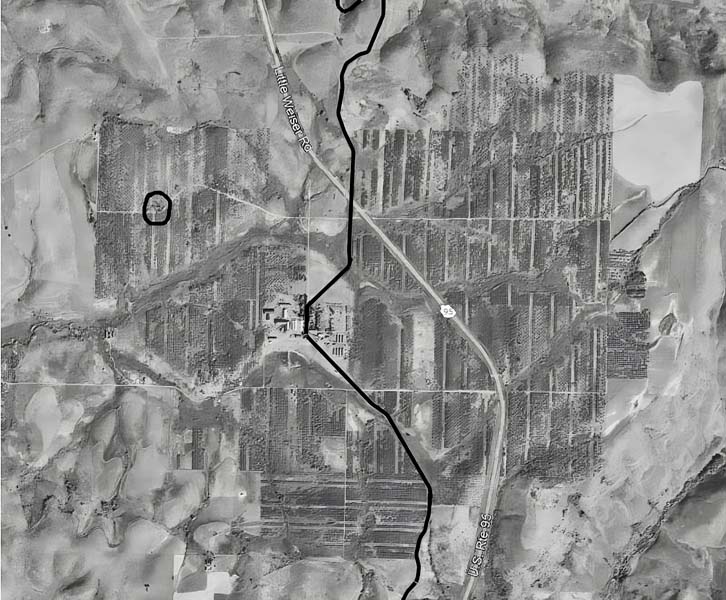
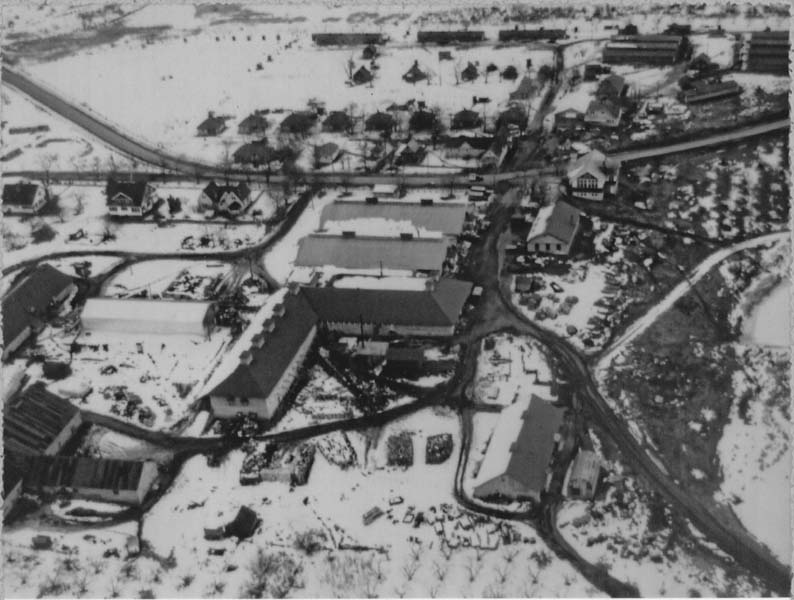
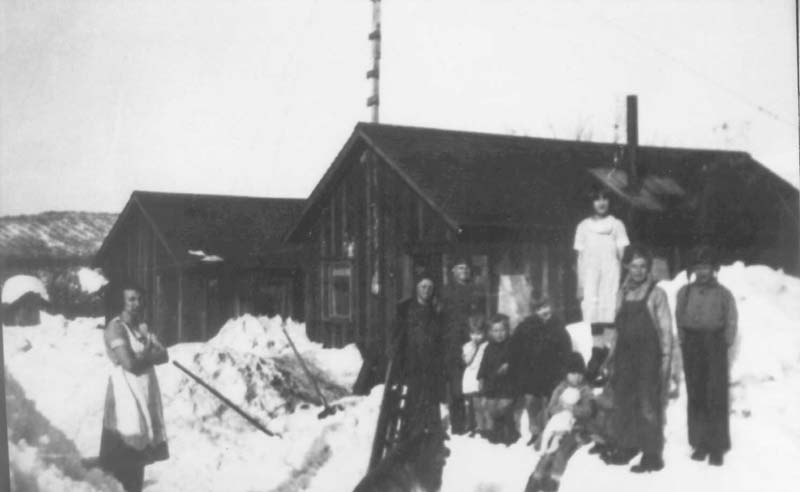

Alvin Shaw (1926 - 2021) lived at Mesa in the 1930s and ‘40s, with his parents, John and Lula, and sisters Geraldine and Fernica. He shared his memories of those days:
“My mother and most of the ladies worked in the packing house. The street that ran north and south behind the office and store had eight bungalows on it. The street that ran east and west along the office and store had the cookhouse and bunkhouse and some single family houses on it for about two blocks to a street that ran north and south. This street had no name but was called ‘Tin Can Alley’.
“I always said the further up this street you went the tougher they got, and I lived in the last house. Down under the hill from Johnny Denboars house sat the company horse barns where they kept the horses in corrals. They used these horses to pull wagons and slips to get the fruit to roads where the fruit was loaded on open cab Model T Ford trucks and hauled to the large cellars where the fruit was stored and eventually processed for shipment to markets.
“Across the highway from the store were three big dirt and timbered cellars where they stored the fruit. Behind the cellars was a packing house where they packed the fruit and got it ready to ship to the markets. Behind the packing house sat an apple drying house. I believe they shipped out dried apples some too.
“They had a big cable tram that ran from the packing house to the railroad where they had a storage and shipping building. When I was about seven or eight years old, two of my uncles and some other men put me in one of the gondolas, between the baskets of apples, at the packing house and off to the railroad siding I went. Was not bad going down, but coming back to the packing house the gondola was empty. Quite a ride for a young boy. I could not have fallen out as I had such a grip on the strapping on the floor of the gondola.
“My dad, John, walked the flume at times and checked for leaks. He packed a roll of cotton rope soaked in creosote that he pushed in leaks to stop them. Then he would go back to irrigating the orchards until harvest then he worked in the cellars and packing house.”
Alvin’s description of his father plugging flume leaks mentioned one of the methods for this, but another method was to dump sawdust into the flume. The sawdust would travel down the flume and wooden pipes and get stuck in the cracks and crevices where the water was leaking. It would soon swell up and help close the leaks.
Ralph Longfellow shared a memory about this: “When I was 15. The Orchard was hiring that summer so I got a job there. One morning the foreman called me over and said he had a special job for me. He walked me over to dump truck that looked like it had survived action in WWII. He told me, ‘I need you to take this load of sawdust to the dam up the Middle Fork and dump it in the water’.”
Ralph Shared another memory: “One day we labeled applesauce. A semi-truck from Safeway arrived with the labels for the cans. My job was to check the cans as they came out of the labeling machine for dents. If they were dented, they were pulled out and set aside. I was about mid-afternoon when we were stopped to change labels. The new labels were for ‘Choice’ applesauce. The guy driving the forklift that was bringing the cases of unlabeled cans to the labeler asked, ‘Where do I get the Choice Applesauce?’ The foreman replied ‘The same place where you got the other.’ Later that summer when I was in a Safeway store in Weiser, I checked the applesauce prices. The Choice was 3 cents more per can.”
Alvin Shaw listed a number of people who lived at Mesa that he remembered. For those who remember them or are related to them, I’ll make a quick list here:
In the big homes, one of the families was the Daggetts, with children Nancy, Vernon, Bob and Lynda Mae. Sam and Reba Gentry and children, Ruth & Paul. The Happy Evans family, with children Evelyn and Max. Next to them lived Perry and Alice Kilborn and children, Ronald, Yvonne, Vernice and Pearl. Next them lived Albert and Audrey Kilborn and children. The Franklin family, with children John and Agnes. Two Gray families: Charley, Opal and children, Bob and Glenna – Bill Gray and family. The Kecklers: Gus and Bertha, and children Louis, Donald and Marie. The Bill Browns and children John, Aleck, Ruth, Bob and I believe Marie. The Bellmore family, the Jacobs family, the Ballard family, Red Rice family. The Morris families, Harlan and Hazel and children; Buhl Morris and wife and children.
Some of the single men that lived and worked there: “Soup” Bentley, Clarence, Dillon, Marvin “Ching” Kilborn, Arnold Shaw. Ted and Chet Shaw, Harold and Cecil Houston. The McFaddens, Floyd, Clarence, Raymond and Royal and their dad.
More next week.
100 years ago
September 12, 1924
“The Dixie school started last Monday with an enrollment of seven in the ninth grade, which is being added for the first time this year.”
Married at the Council Congregational Church by Rev. Gordon: Miss Daisy Hancock, daughter of Mr. and Mrs. James Hancock of Indian Valley, and Ralph Longfellow, son of Mr. and Mrs. R. M. Longfellow, south of Cambridge.
Married at the Washington Hotel in Weiser: Ben Howland, son of Mrs. Laura Howland of Salubria and Beulah C. Smith, daughter of Mr. and Mrs. Marion Smith of Salubria.
“A good many Midvale people attended the big Ku Klux Klan celebration which was held in Boise Monday.”
75 years ago
September 15, 1949
“The Rush Creek school started last Monday with 19 pupils in attendance.”
Midvale schools opened last Tuesday with an enrollment of 78 in the high school and 127 in the grade school. “The high school shop building is being used for first and second grades for a few days until the building, formerly the Dixie school, is ready for occupancy. Attendance units are: Keithley Creek, where Mrs. Leona Williams is teacher; South Crane, Barbara Brewster; and North Crane, Donna Norton, teacher. The opening date for North Crane was postponed until September 19 because of the delay in moving the Sweet Home school to a more convenient location. The building was moved Thursday by Scheloske Bros. of Weiser.”
49 years ago
September 11, 1975
The mutilation of cattle is spreading to new areas in Idaho, and, in addition to Adams County, has now spread to Washington County and Malheur County in Oregon.
25 years ago
September 9, 1999
“On August 4, 1999, Forest Supervisor Dave Alexander signed the Record of Decision for the Grade-Dukes timber sale, in the Cuddy Mountain Roadless Area, approximately 12 miles west of Council in Washington County.”
Died: Nora Leora Fuchs Hart at Grandview, Idaho. She was born in 1945 and Council and went to school in Midvale.
Died: Katherine L. Jeager Secoy, 83, of Cambridge. Burial in the Salubria Cemetery.
Property owners adjacent to rail banked railroad rights-of-way are often concerned with loss of privacy, trespass, potential for increased crime, and possible liability in the event a trail user is injured on adjacent private property. Rural counties are often concerned with the cost of search and rescue efforts and increased law enforcement.