
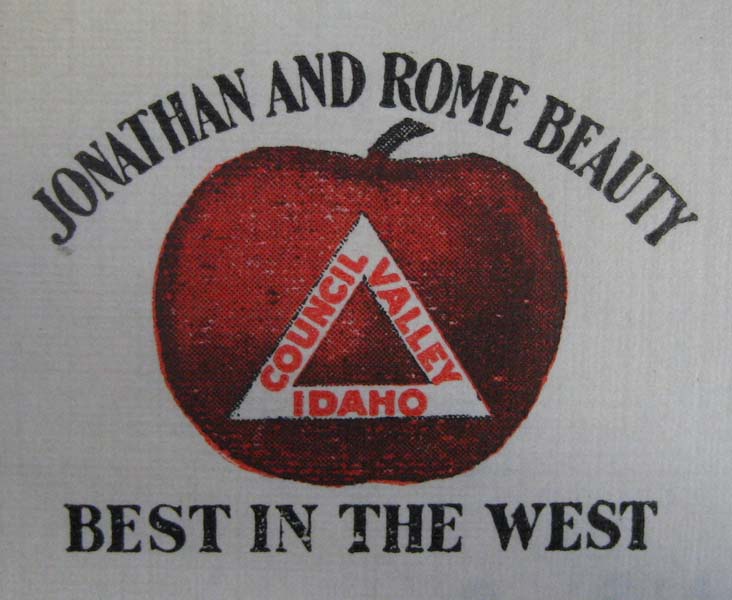
By about 1909, orchards were the rage here, and it seemed that everyone was jumping onto the band wagon. Local business men came up with a logo depicting a red apple accompanied by the slogan “The Home of the Big Red Apple” which was placed on envelopes, banners and other promotional material.
The local fruit growing craze in the Council area was part of a trend in the entire Northwest. The Mesa project was only one of many similar efforts. The Northern Pacific Railroad helped promote the industry, as much of the fruit growing area was within their service area – from Montana to Washington. In their 1910 promotional booklet, “The King of The Land of Fortune,” the king they were talking about was the apple. They said, “We know that orchard in the East and Middle West have for some reason been growing less and less productive. In respect to the care and attention given to orchard, and particularly the apple orchards, the orchardist of the Northwest excels.” The railroad company continued, saying that 50 years ago, “not more than one-tenth as many apples were raised for commercial purposes in the United States as are raised today.”
Promotional material raved about the profits to be made by fruit growing. The desire of investors and homesteaders to get in on this type of money-making opportunity produced a multitude of land schemes. A popular practice of promoters was to buy land cheap, plant fruit trees, then sell tracts at high prices to people from the east who had idealistic visions of a homestead in the great Western outdoors. Thousands of acres were exploited in this manner, and it had a negative influence on fruit prices at times, even though the land involved was often not suitable for growing fruit.
It isn’t exactly clear how the first investments by the Weiser Land & Water Company were financed, but it seemed to involve the National Land Reclamation Company and the sale of $300,000 worth of bonds that were due to mature on January 1, 1912. These bonds, and the mess they created, would haunt Mesa managers for decades.
The company sold ten-acre parcels to individual investors at $500 per acre. (The equivalent of about $13,000 in today’s dollars – so $130,000 for 10 acres.) For that price, the company would plant fruit trees, care for them for five years, plus pay 3% interest on the buyer’s investment. Their promotional material stated: “On this tract are planted apple trees of the finest variety to the number of about eighty to the acre, making 800 trees on each 10-acre tract.” After five years, the owner could operate independently, or the company would continue to do the work for 10% of the net profit from the land. The company would also build a house for the buyer at what it cost the company for “materials, labor, and supervision.”
The editor of the Council Leader newspaper championed the cause by bragging, “Council Valley possesses a peculiar climatic condition which worms cannot become climated to.” He also claimed, “An apple failure on account of frost is something that has never been known of here.”
In the spring of 1909, about 20,500 young fruit trees were shipped to the Council Valley to be planted. The Forest Service even joined in the frenzy by designating the Stevens Ranger Station near the East Fork of the Weiser River as an experiment station where various fruit trees were to be grown to determine which varieties were best adapted for the local climate.
Also in 1909 a new townsite was established about six miles north of Council. In keeping with the local trend of the day it was called “Fruitvale”, and most of the streets were named after apple varieties. There was also a division of Weiser named Fruitvale at the time.
The Weiser Valley Land & Water Company had an office in Boise and an “Eastern office” in Chicago. Judah P. Gray was the General Manager of the orchards at the outset (and until 1919).
J.J. Allison’s cousin and Vice President of a Chicago bank, Oberlin M. Carter, came west from Chicago to join in the fruit excitement. He was one of the partners who established the first orchards at Mesa and also owned shares in the Council Valley Orchards. His brother, Dr. I. Stanton Carter, was a successful dentist in Chicago and came to practice in Council. He also invested in the Mesa project and was involved, to some extent in its operations. He was the first manager of the Mesa store.
Other officers in the company were C.K. Macey (General Manager June 1910) and C.E. Miesse (pronounced mee’ see).
According to Clyde Rush, peach trees were planted as fillers between the slower-growing apple trees, and were to be removed after the apple trees began full fruit bearing.
Continued next week.
100 years ago
May 23, 1924
Married: Hugh Beggs and Miss Grace Downs.
A girl was born to Mr. and Mrs. Roy Alderson on May 21.
Married: Elton Lewis, son of Mr. and Mrs. George Lewis of Cambridge, and Miss Levine Sargeant who has taught at Midvale High School for the past two years.
A boy was born to Mr. and Mrs. Herbert Ader on May 20.
Between 500 and 600 people attended a Ku Klux Klan lecture at Midvale Sunday afternoon.
“The people of Midvale, who had retired for the night, were awakened from their slumbers about 9:30 o’clock Tuesday night, May 20, by the loud roar of dynamite, or some other high explosive, and upon careful investigation beheld in the street near the post office a large blazing cross, which illuminated the street for several hundred yards. This is the second demonstration of the fiery cross in Midvale, and vicinity. There is much talk that this denotes that the now famous Ku Klux Klan has perfected an organization here, and it is said that the burning cross denotes that the organization has reached a strength of 100 or more. The good citizens of Midvale herald this as a new era of law enforcement, as it is a well-known fact that the Ku Klux Klan takes a very firm stand for law and order. On the other hand, the fiery cross strikes terror into the hearts of the evildoers and lawbreakers. There is much room for reform here, and it is hoped that the benefits from this organization will be lasting, and that it will spread to the uttermost parts of the country.”
75 years ago
May 26, 1949
The Cambridge High School Bulldogs will compete at Pocatello for the Southern Idaho Regional Baseball Championship. Pitcher Eddie Ludwig struck out 16 batters in a recent game. Other team members in a front-page photo were Don Murphy, Tom Coriell, Kenneth Mink, Walter Ford (manager), Walter Smith (coach), Richard Higgins, Lawrence Johnson, Darrell Jones, Gordon Allison, Jimmy Ludwig, Harold Ford, Donnie Westfall and Norman Hansen. An Idaho Statesman photographer took the picture and photographed other Cambridge citizens. Those photos appeared in Sunday’s Statesman.
Another Statesman photo appeared on page 4 with the caption: “Eddie Ludwig, star pitcher for the Cambridge High School baseball team hasn’t lost a game this season. The attention of major-league scouts has been attracted by the 17-year-old’s ability and record, but he has another year in school before he can sign on the dotted line.”
Died: Robert Emery Linder of Midvale. Born in Missouri in 1870, he traveled by covered wagon to Colorado with his parents, and then went on to Middle Valley in 1875.
Twin daughters were born to Mr. and Mrs. Harold Johnson of Indian Valley.
Twins, a girl and the boy, were born to Mr. and Mrs. Elmer Carpenter on May 19 at the Weiser hospital.
A daughter was born on May 22 to Mr. and Mrs. Ernest Howland at the Ontario hospital.
49 years ago
No issue
25 years ago
No issue.