
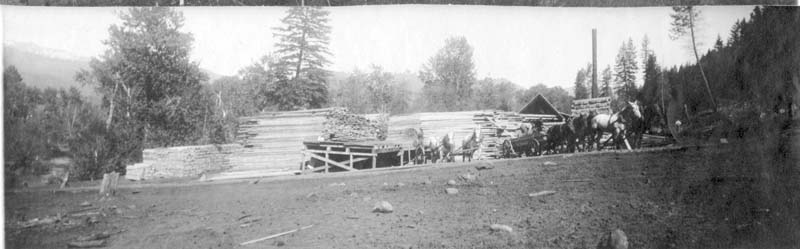
In establishing orchards on their mesa south of Council, the Weiser Valley Land & Water Company (operating the Council Mesa Orchards Company) faced one huge problem: how to provide the absolutely essential irrigation water for the fruit trees. They had an ambitious plan to get water to the mesa from the Middle Fork of the Weiser River, just north and east of the mesa, but all those water rights had been taken.
The company devised a plan to build a dam to create a reservoir on Lost Creek (a tributary of the West Fork of the Weiser River 25 miles to the north) and sell water rights to farmers downstream. They planned to buy, or trade for, water rights on the Middle Fork. How they would get that water up to the mesa would become an entire story in itself.
J.J. Allison filed maps and field notes for The Weiser Valley Land & Water Company with the U.S. Land Office in Boise on December 23, 1908 in an application for a right of way over the public domain for a reservoir.
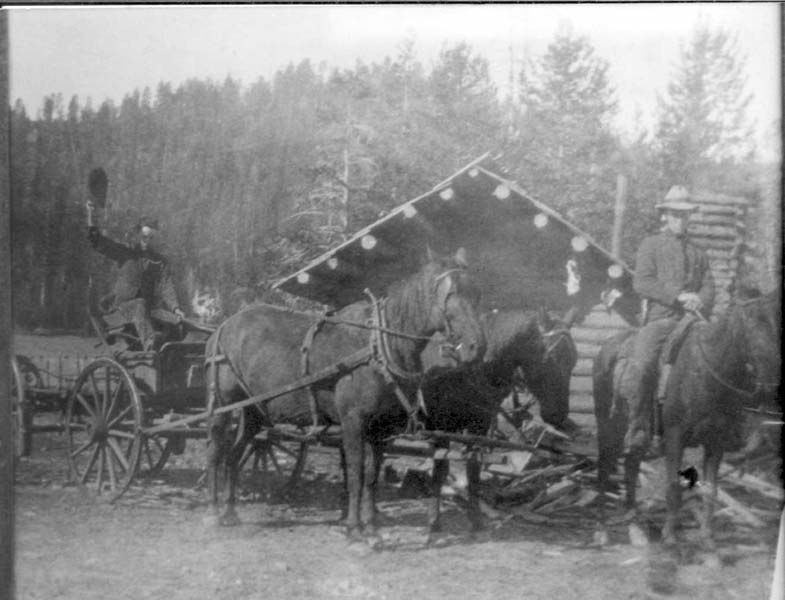
The dam was to be built across Lost Creek where the creek ran from a broad valley and entered a narrow canyon. The obstacle to their plan was that two brothers, Frank and Colonel Ryan, had established homesteads and built cabins in that broad valley.
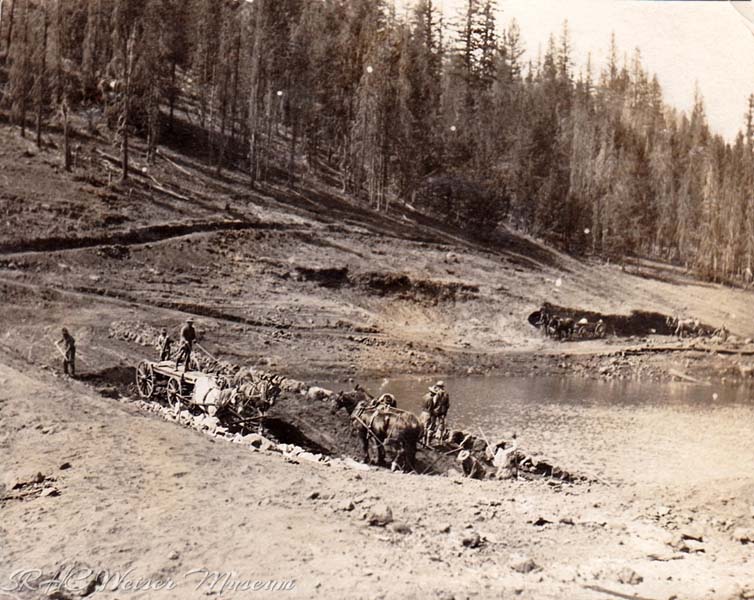
A court case ensued, in which the Weiser Valley Land & Water Company argued that the best use of the land would be for a reservoir instead of homesteads. While the dispute was making its way trough the courts, the company started building a dam in September. It took not much more than a month to complete. The $50,000 cost in 1909 would be about $1,716,109 in 2024 dollars. The result was what is known today as the Lost Valley Reservoir, also known as Lost Lake.
Allison’s right of way application was approved by the Department of Interior on November 8, 1909. By that time, the dam may already have been completed or was nearly done.
A Portland newspaper said the dam “was completed in November, as was also the tunnel which is 8 X 10 feet in the clear, and 250 feet long, and which will be used to carry water from the reservoir around the dam into the Weiser river to supply the main Weiser river with an amount of water equal to the water taken from the middle fork for the 4,000 acre Council Mesa Orchard. The water for the great orchard will be conducted from the Middle Fork to the mesa through a flume seven miles long. A seven mile ditch is being dug 12 feet wide at the bottom with an average depth of six feet. This ditch will be lined with lumber, thus preventing all seepage, and it will also be the means of supplying the mesa with pure water for drinking and domestic purposes.”
Although the newspaper exaggerated some aspects of the story, it was mostly correct.
The court case with the Ryan brothers over their homestead claims was settled in 1910. Ironically, the Ryans (who had both studied law) agreed that the highest and best use of the land was as a reservoir site. They established that they should be paid for their homesteads on the basis of this value, and were paid $16,000 for the two homesteads – over half a million in 2024 dollars.
Frank Ryan went on to become a well known Weiser attorney.
In September of 1909 two men joined the Weiser Valley Land & Water Company: C.E. Miesse (pronounced Mee’-see) of Chicago, as president, and C.K. Macey as general manager. Macey lived in Boise, but at some point before 1912 he moved to Mesa. By 1914 he wold be the State Horticulture Inspector and headquartered back in Boise.
On October 5, 1909 – The State Engineer of the State of Idaho issued a permit to J.J. Allison for 70 cubic feet of water per second from the Middle Fork.
By the end of 1909 Council Valley fruit had won several more top prizes at the Horticultural Congress in Council Bluffs. The Mesa Company had ordered 80,000 nursery trees to set out the following spring, was building a sawmill on the Middle Fork to cut lumber for the flumes, and had 100 men employed digging ditches. Those ditches were to be completed by May of 1910 at a cost of $300,000. It didn’t quite work out that way.
Next week: 1910 brings crisis and change to Mesa.
100 years ago
May 30, 1924
Married: Harry Dale Adams, son of Mr. and Mrs. A. Adams of Rush Creek, and Myrtle Delilah Parke, daughter of Mr. and Mrs. S. T. Parke of Cambridge.
A boy was born to Mr. and Mrs. Ed Hart of Mesa on May 24.
75 years ago
June 2, 1949
Married: Mrs. Esther Houston of Brownlee to Charles Smith of Weiser.
Married: Mrs. Kathleen Brown and Billie Alison.
A boy was born May 31 to Mr. and Mrs. James Edmison at the Weiser hospital.
49 years ago
June 5, 1975
Died: Melvin R. Crossley, 61, Cambridge. Two local survivors are sons Ferrel and Clifford Crossley, both of Goodrich.
Died: Benjamin R. Fairchild, 88, of New Plymouth, at an Ontario nursing home. Born in 1887, he moved to Midvale in 1917.
Married: Miss Marcia Dale, daughter of Mr. and Mrs. Wesley Dale of Midvale, to Dwain Peret.
25 years ago
June 3, 1999
Aaron Collins is the new pastor at the Midvale Church the of Christ.
Obituary of Mildred Harrington, 90, of Council. Born in 1909, she was the oldest of five children. In 1911, when Mildred was only 18 months old, she moved to Council with her parents and baby sister. In 1928 she married Kenneth Harrington and the couple ranched for 51 years on Hornet Creek.
Obituary of Clifford W. Keele. He was born in Midvale in 1923 to Valdes Keele and Ruth Edson Keele.