
In 1910 the orchard project at Mesa started the year with the outward appearance that everything was going great.
In February, a Portland newspaper reported on the orchards: “The 1430 acres to be set to fruit trees this spring are divided as follows: C.L. Waterbury & Co. of New York City, 1,000 acres; Kerper & Kellogg, New Jersey, 100 acres; Huston & Schroff of Pittsburgh, 160 acres; Whitney James of Chicago, 50 acres; F.E. Weymouth of Boise, 80 acres; R.P. Bliss of Boise, 40 acres.” Some of the growers “expect to grow vast quantities of potatoes between the trees the first five years.”
The reported acres constantly varied from one report to another, even within the official records and reports of the company, which makes it difficult to know just how many acres were being managed by the Weiser Valley Land & Water Company / Council Mesa Orchards, and how many were growing trees. The company also owned land near Cambridge, Midvale and Weiser.
On the 1st day of February, 1910, the company entered into a contract with the Orchards Water Company for the construction of an irrigation system. That contract mentioned the “townsite of Mesa.” Just what was in the townsite is unclear. The contract also involved borrowing money to buy more land, “and for the general uses of the Company in the further development of its business.”
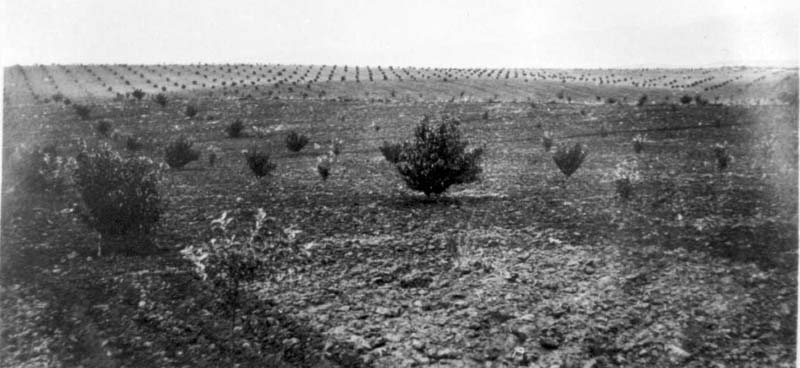
That year, somewhere between 72,000 and 113,000 trees were reportedly planted at Mesa. These numbers should be taken with a grain of salt, as, like the acreage reports, reported tree numbers varied widely.
Since the irrigation system was yet to be completed, water was hauled to individual young trees in barrels on wagons. You can imagine what an enormous and tedious task this was.
The May 5, 1910 Weiser American newspaper reported that the Weiser Valley Land & Water Co. owned 6,000 acres. This figure apparently included land near Cambridge/Midvale and Weiser. The paper said Charles E. Miesse was president of the company, and C.K. Macey was general manager. How J.P. Gray fit into the situation isn’t clear, as he was the general manager of the orchards during most (if not all) of the early years of the enterprise. Adding to the confusion, a legal document from May 1910 lists the General Manager of the company as Charles F. Hatfield.
The letterhead above correspondence written by C. K. Macey, on June 18, 1910 listed the other officers of the company: Elias Nelson, Horticulturalist; C.E. Miesse, President; Prof. J. J. Allison, Vice President; Fred Brown, Secretary; C.F. Hatfield, Treasurer.
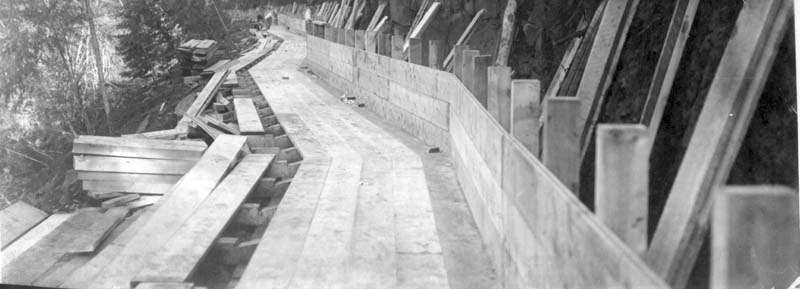
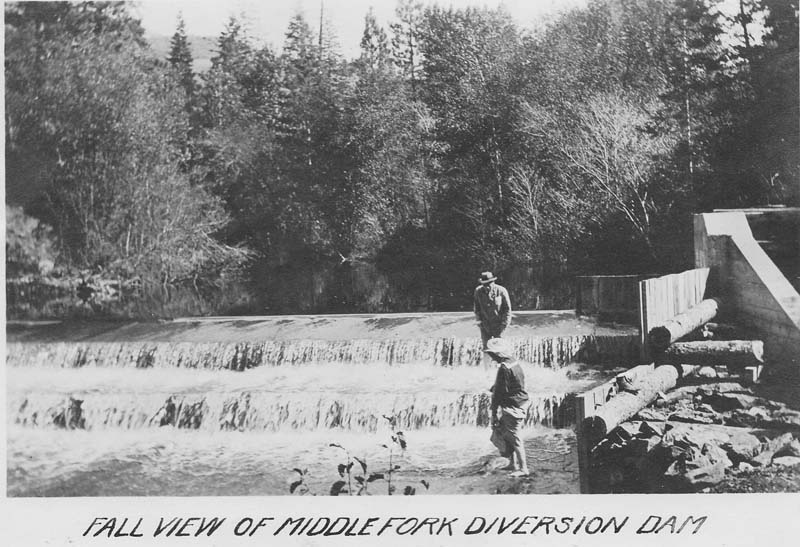
In his letter, Macey said, “The flume will be finished Wednesday or Thursday next, and we will have everything ready by then for irrigating the north part of the orchards which are under the open ditch.” He referred to several carloads of irrigation pipe that arrived, and about the ditches in which the pipe will be laid: “It will take four or five days yet to complete these ditches, and the pipe can be laid at the rate of at least half a mile a day when they start on it.” (The Council newspaper said the ditches cost $300,000.) This Company has a permit for all of the waters at the headwaters of the Weiser River, and a permit to divert into the same basin the head waters of the Little Salmon River. We have further filed on another reservoir site, this giving us all of the reservoir sites in the Weiser Valley.”
Macey and the investors were concerned about the fact that their tens of thousands of young trees had not been watered, aside from some water hauled in wagons. But, Macey said, “I have trampled all over the lands the last few days, and find the trees holding their own in good shape. We had quite a shower Thursday afternoon, which freshened everything up considerably.”
His optimism proved to be misguided. All or most of the young trees died from lack of water. And although their public persona gave no hint of it, the company was headed for financial trouble. The company was spending money like a drunken sailor.
Macey’s letter contained details of $217,626.71 in expenses incurred by the company. A dollar back then would buy what about $23 would buy today, making that total over $5 million in today’s dollars.
Some of the major expenses were: Slick Bros. Construction of Boise – $5,691.37 for ditch line; Caldwell Nursery - $2,536.46 for trees and plants; Allison & Gates of Council - $2,968 for clearing land; Payette Lumber & Mfg. Co. of Payette - $1,109.87 for “Log Scale, Saw Mill”; $1,156.95 for freight, lumber, ditch line, etc.; Seattle Coast Pipe Co., Seattle, Wash. $3,862.55 for “Stave Pipe to Ditch Line”; Boise City National Bank $2,273.60 for mortgage interest. At least 35 men were employed at the sawmill or acquiring logs for it. At least that many were being paid for labor at the orchard plots. Investments in ditch work was a major part of the budget.
In this same letter, Macey mentions, almost as a side note: “The condemnation suit will be tried next week and we have to be prepared to pay whatever amount is awarded, which will probably require about $5,000.00.” Just what that lawsuit was about is a mystery, but this amount would soon be insignificant compared to the iceberg the company ship was about to hit.
Next week: New owners fight to save the ship.
100 years ago
June 6, 1924
Died: Thomas James Stephenson. Born in 1855 in Canada, he spent 41 years in the Upper Country. Burial in the Cambridge Cemetery.
A class of 11 students graduated from Midvale High School this year.
The editor describing a drive to Northern Idaho on the North and South Highway along the Little Salmon River: “The highway, while only finished in the difficult parts, is passable, and the little town of Riggins is a fine place.”
Died May 5: C. R. Johnson, age about 67, at the home of his son, Loren Johnson, near Cambridge.
75 years ago
June 9, 1949
A girl was born to Mr. and Mrs. Glen Howland on June 7 at the Weiser hospital.
Reorganization of the school districts was approved in the June 6 election. “While this is not official, it is understood that the new school district will be identified as Joint Class ‘B’ School District No. 442.”
Married at Council on June 3: Midvale girl Alma Merk, daughter of Mr. and Mrs. Russell Merk of Midvale and Dick Fisk of Fruitvale.
Married: Melvin Norton, daughter of Mr. and Mrs. Fred Norton, to Morgan McKay, Jr. of Kellogg.
Married at Weiser: Mrs. Belle Evans and Allen Seid.
49 years ago
June 12, 1975
A son named Roy William was born to Mr. and Mrs. Ross Gedeborg of Midvale on May 29 at Council.
A new Idaho law requires drivers to have proof of liability insurance when registering or transferring plates and registration on vehicles.
A benefit auction and dance were held at the Upper Dale school house Saturday to benefit Myron Mink.
25 years ago
June 10, 1999
Kermit and Joanna Wiggins are celebrating 50 years as owners and operators of the Cambridge Telephone Company.