
The same unsigned letter from Cortland, NY that I ended with last week described the Mesa situation at the end of 1910:
“The new owners were compelled practically to begin all over again, only they planned a larger development on different lines – discontinuing the plan of getting rich quick by unloading the proposition upon some one else for a profit. They acquired additional land until they owned about 4,000 acres in all and laid out and installed an extensive and expensive underground water system and started in, in good faith, to make the orchards the best in the country.”
Some of the investors in the enterprise propped it up with close to half a million dollars of their own money. David W. Van Hoesen wrote: “I have spent nearly $100,000 of my own money upon this orchard proposition for which I have of course been compelled to take securities that are junior to the bonds.”
The board members of the Weiser Valley Land and Water Company met in the company’s office in Boise on November 26, 1910 and decided to issue $600,000 in corporate “Refunding Bonds” at 6% interest. Sales of the bonds began on Jan 3, 1911. The first bonds were to mature (the point at which principal is required to be repaid to the purchaser, along with 6% interest) would be January 1, 1914, with more maturing on the first day of 1915, 1916 & 1917.
With the massive investment and new debt, the orchard enterprise was able to complete the irrigation system. The flume, which was somewhere between 6 and 7 miles long, measured about 5’ wide by 3’ deep, with a 1.5” thick lining made of “Oregon fir.” There were initially two siphons to cross canyons, which were 3’ diameter wooden pipes, terminating on each end at a concrete structure joined to the open flume.
Since most or all of the new trees had died from lack of water, thousands of new trees were planted in 1911.
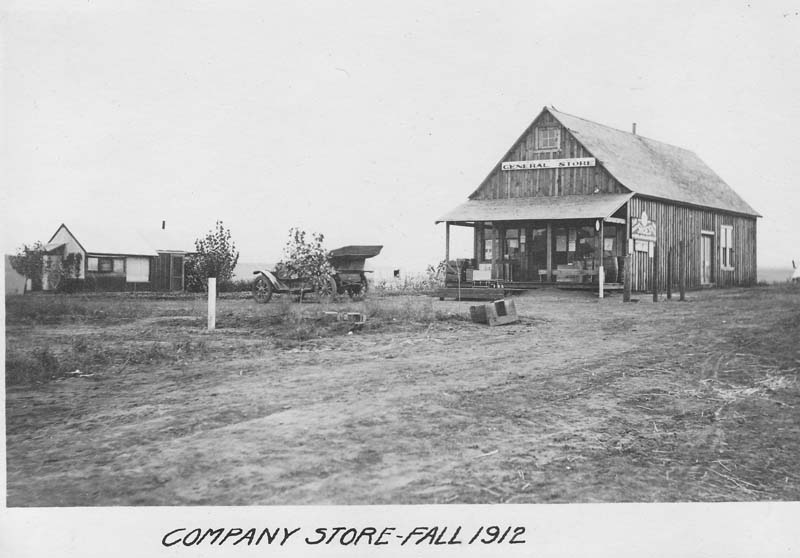
The Weiser Valley Land & Water Company seems to have established a store at Mesa in 1911, with dentist I. Stanton Carter as manager. In 1912 the “Middle Fork” post office was closed and mail was routed through a new post office established at “Mesa,” which was located in the company store. The first postmaster was Edward Hart. I think the next postmaster was J.P. Gray, who seems to have held that position, and also managed the store, until 1919. Subsequent store managers, after Gray, were Harry Mills, Gordon Reynolds, and then Sam Gentry.
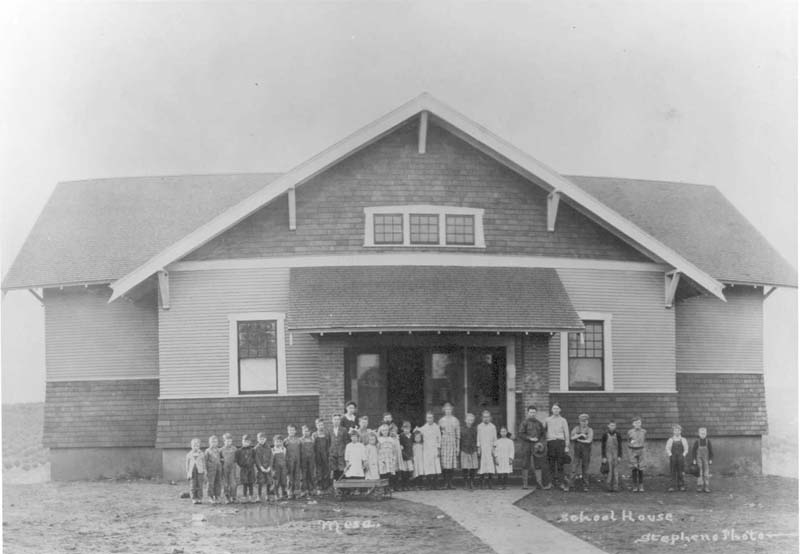
Mesa School District, No. 1, was organized in July, 1911, and the company built a temporary school. It had an average attendance of 9 students during its 8-month term. In the summer of 1912, one of the more expensive school houses in Adams County at the time was built at Mesa at a cost of about $5,000 (about $155,000 in 2024 dollars). It had two classrooms, each with a teacher teaching 4 grades.
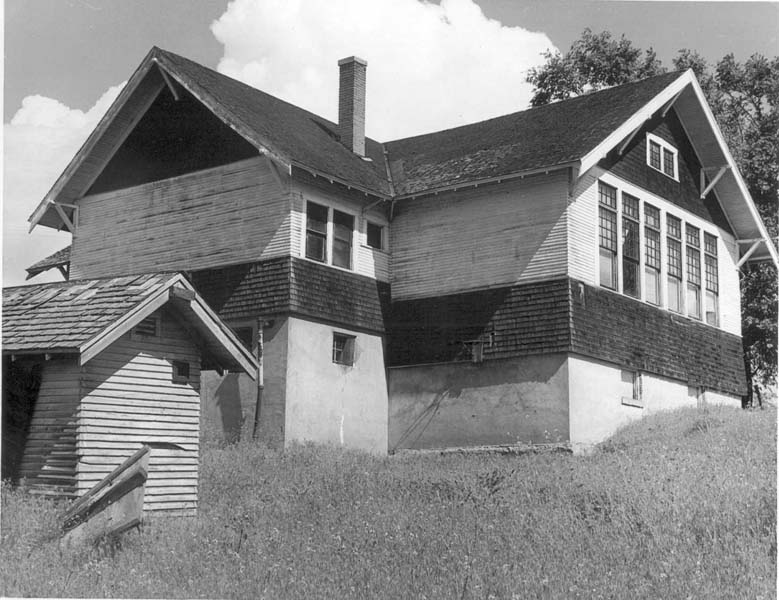
Ruth Brown McFadden wrote about the Mesa School: “Each room had big windows on one side. There were double doors in front, and as you came in there was a door on both sides; one side opened into a small storage room, and the other one went down stairs into a two-room apartment where the teachers could live. There were three or four steps that went up into the hallway. Both rooms had two doors each. At the end of the hallway there was a door going down to the basement where they kept the coal and wood, and a door going outside to the toilets – one for the boys and one for the girls. On each side of the door going downstairs was a small room.”
Continued next week.
The Fruit Industry and Mesa – Part 6
The same unsigned letter from Cortland, NY that I ended with last week described the Mesa situation at the end of 1910:
“The new owners were compelled practically to begin all over again, only they planned a larger development on different lines – discontinuing the plan of getting rich quick by unloading the proposition upon some one else for a profit. They acquired additional land until they owned about 4,000 acres in all and laid out and installed an extensive and expensive underground water system and started in, in good faith, to make the orchards the best in the country.”
Some of the investors in the enterprise propped it up with close to half a million dollars of their own money. David W. Van Hoesen wrote: “I have spent nearly $100,000 of my own money upon this orchard proposition for which I have of course been compelled to take securities that are junior to the bonds.”
The board members of the Weiser Valley Land and Water Company met in the company’s office in Boise on November 26, 1910 and decided to issue $600,000 in corporate “Refunding Bonds” at 6% interest. Sales of the bonds began on Jan 3, 1911. The first bonds were to mature (the point at which principal is required to be repaid to the purchaser, along with 6% interest) would be January 1, 1914, with more maturing on the first day of 1915, 1916 & 1917.
With the massive investment and new debt, the orchard enterprise was able to complete the irrigation system. The flume, which was somewhere between 6 and 7 miles long, measured about 5’ wide by 3’ deep, with a 1.5” thick lining made of “Oregon fir.” There were initially two siphons to cross canyons, which were 3’ diameter wooden pipes, terminating on each end at a concrete structure joined to the open flume.
Since most or all of the new trees had died from lack of water, thousands of new trees were planted in 1911.
The Weiser Valley Land & Water Company seems to have established a store at Mesa in 1911, with dentist I. Stanton Carter as manager. In 1912 the “Middle Fork” post office was closed and mail was routed through a new post office established at “Mesa,” which was located in the company store. The first postmaster was Edward Hart. I think the next postmaster was J.P. Gray, who seems to have held that position, and also managed the store, until 1919. Subsequent store managers, after Gray, were Harry Mills, Gordon Reynolds, and then Sam Gentry.
Mesa School District, No. 1, was organized in July, 1911, and the company built a temporary school. It had an average attendance of 9 students during its 8-month term. In the summer of 1912, one of the more expensive school houses in Adams County at the time was built at Mesa at a cost of about $5,000 (about $155,000 in 2024 dollars). It had two classrooms, each with a teacher teaching 4 grades.
Ruth Brown McFadden wrote about the Mesa School: “Each room had big windows on one side. There were double doors in front, and as you came in there was a door on both sides; one side opened into a small storage room, and the other one went down stairs into a two-room apartment where the teachers could live. There were three or four steps that went up into the hallway. Both rooms had two doors each. At the end of the hallway there was a door going down to the basement where they kept the coal and wood, and a door going outside to the toilets – one for the boys and one for the girls. On each side of the door going downstairs was a small room.”
Continued next week.
100 years ago
June 20, 1924
A girl named Laveta Arline was born to Mr. and Mrs. Charles Cox on June 5.
Married at Weiser: James Collins and Miss May Jones (daughter of Mrs. Rose Jones of Cambridge), both of Cambridge.
Died at Riverside, California: Minnie Seid Fletcher, formerly of Midvale. She was born in Iowa in 1875 and came to Idaho in 1898 with her parents, Mr. and Mrs. W. F. Seid.
“The P. & I. N. says the following about their new motor placed in the commission last week: ‘In addition to our daily passenger trains we believe we now operate the finest railroad gas car in the U. S. A new, specially built, model with a capacity of 33 passengers, mahogany finish, lavatory, deep comfortable seats upholstered in genuine Spanish leather.’ “
Passenger rates on the P. & I. N. Railway: from Weiser to Midvale, $.96; to Cambridge $1.23; to Council, $1.80; to Starkey $2.10; to Tamarack, $2.46; to New Meadows, $2.70.
75 years ago
June 23, 1949
The Holworth Nixon family, living 21 miles west of Cambridge, abandoned their home for safer living quarters, due to the threat of a landslide. “By the end of last week fences had moved out of line as much as 8 feet, a piece of ground 20 feet wide and nearly a quarter mile long had sunk in various depths up to 10 feet, other cracks appeared on the east and west sides of the acreage that measured up to 2 feet wide and 6 feet deep.”
Four cases of polio were diagnosed in the area in the past few days.
“Mr. and Mrs. L. D. Nixon are awaiting word of the arrival of the body of their son, 1st Lieut. James Nixon, which is being sent home from New Guinea for burial here. He died there September 20, 1943. Funeral services and interment will be held at Rosedale Cemetery near Payette.”
49 years ago
June 26, 1975
Alan and Sue Dopf are taking over the Record-Reporter, and Beth and Stu Dopf are retiring. Stu began working at the Record-Reporter in 1936 and purchased the business in 1937.
Dolores Francis died in California June 17, and she was buried in the Indian Valley Cemetery on Saturday.
Becky Shaw and Ronnie Smith will be married on June 28 at the Indian Valley Community Church.
“A former Cambridge youth, Tony Draper, 15, son of Mr. and Mrs. Ron Draper, was swept away and is presumed drowned June 19 in the swift waters of the Snake River. The Draper family lived in Cambridge about 10 years ago while Mr. Draper was depot agent here.”
A girl named Monica was born June 19 to Mr. and Mrs. Jim Nixon at the Weiser hospital.
Swimming lessons will be given at Starkey Hot Springs.
The Mink Land and Livestock Company has purchased the Della Riggin ranch east of town.
Died: Beryl Edgar Ferguson, 71 of Cambridge. Born in Wyoming in 1903, he moved to Cambridge in 1939 where he farmed.
25 years ago
June 24, 1999
Died: Charles A. Neill, Jr, 83, formerly of Midvale. He graduated from Midvale high school in 1933.
Died at the Council Community Care Center: Naoma Miles Wilson. Born in 1926 in Utah, she and her husband, Malvin, moved to Council in 1956.
Letter to the editor says a video shown on Public Television “has the one underlying purpose to recruit innocent children to engage in homosexual behavior.”