
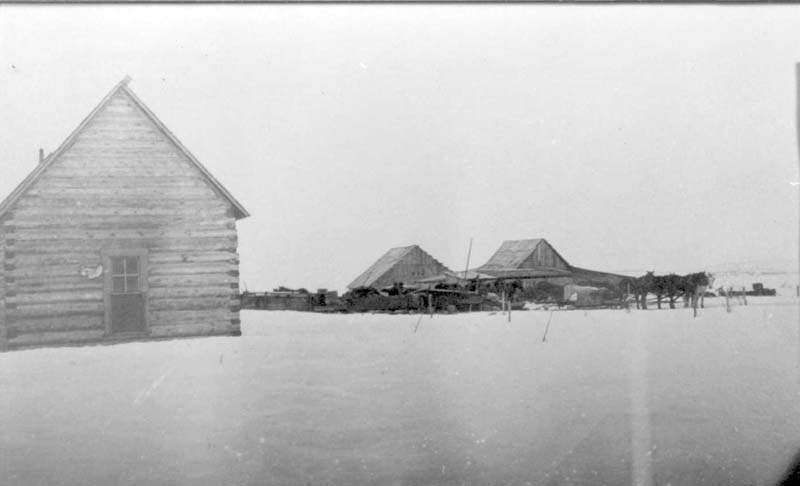
During the summer of 1912, Reverend Stover of the Council Congregational Church held services at Mesa every Sunday.
By the fall of 1912, it was estimated that there were 3,000 acres of orchard within a twelve and a half mile radius of Council, which included Mesa.
A document dated November 15, 1912 lists the land that had been purchased by the Weiser Valley Land & Water Company: Council Mesa – 3,160 acres; Bacon Gulch – 240 acres; Midvale – 433 acres; Middle Fork – 160 acres (timber land); total – 3,993 acres. It said 1,389 acres had been planted to fruit trees, 1,222 acres of which had been sold to investors or on-site growers.
At this time, the orchards had no problems with insect pests. Chris Hildenbrand offered $100 to a group of visitors if they could find a single worm in his big orchard.
The orchards may not have had insect pests, but “blight,” a contagious disease that killed trees, was present and very much feared. A state fruit inspector made regular examinations of local orchards, and outbreaks of this affliction were taken very seriously. Several local orchard men were actually arrested and tried in court for not destroying their infected trees after the inspector had ordered them to do so.
1913
The Weiser Valley Land & Water Company seems to have formed a subsidiary company called “The Mesa Orchards Incorporated” in 1913. The first indication that I’ve found of this in the available documents comes in a September 1913 statement of financial condition and organization of both companies.
Of the Mesa Orchards Company, the statement said, “This is a subsidiary corporation, organized as an operating company, for the purpose of conducting the company’s store and other mercantile business and of erecting and operating canning and evaporating establishments and of managing the Company Orchard, etc., etc.”
The company started using a letterhead inscribed with “The Mesa Orchards (Incorporated),” along with a red apple logo bearing a big capital “M” on which was printed, “Mesa Fruit – Best in the West.”
The same September 1913 document mentioned above contained the following: “Many prominent and prosperous business men and farmers located at different places, principally in the states on New York, Ohio, Illinois, Iowa and Kansas have bought our orchards either as an investment or for a future home. Several purchasers have already built homes and settled upon the Mesa and many more will do so when the 5-year development period has expired. The Company does not encourage home making at present, because it desires, as far as possible, to keep the orchards in on large tract during the development period so as to insure uniformity of care and cultivation. Settlers mean intertillage and varying methods of pruning and cultivation – which is not compatible with the Company’s purpose to make this the largest and best orchard in the United States.”
Although J.P. Gray was involved with the Mesa project from the start, he may not have actually moved to Mesa from New York until 1912. In his memoirs, Menderse Van Hoesen said: “My father influenced J.P. Gray, a close friend and business associate, to become a partner with him in the project and to go to Idaho to take over the management of the orchard development.”
A professionally printed report dated December 1, 1913 said: “We re pleased that it is time to transmit to you our third annual report as it cannot help but bring to your notice that the time is not far distant when you will be in charge of your own property and receiving a fine income from it as well as being numbered among the fruit growers of Idaho. In accordance with the plan outlined in the last annual report, we did not plant any additional acreage this year but devoted our time entirely to the care of the trees already planted.
“During this season, as well as last, our working camp and the families located on the Mesa have been supplied from our small garden patches with all the vegetables of every kind that could be used, including sweet potatoes, tomatoes, sweet corn, water melons, cantaloupes, pumpkins, etc., all of which yield very abundantly and have been pronounced by the many guests we have entertained as being of the finest quality they ever tasted.”
“ We have also had an abundance of small fruits, including strawberries, blackberries, dewberries, currants, gooseberries, etc.
“Our fruit is also by no means limited to apples, peaches and pears, as we can successfully raise both sweet and sour cherries, plums, apricots, nectarines and prunes. We are also raising grapes very successfully, both of the American and Euopean varieties, including Flame Tokays, Muscats and Malagas, and produced bunches of Tokays this season from two-year old vines that weighed three and four pounds. Of the American varieties, the Concord grapes do especially well here, and from a few two-year-old vines we picked over a ton, the larger part of which we sold at four cents a pound wholesale.”
Continued next week.
I will be giving a talk and slide presentation at the New Meadows depot on Tuesday evening, July 9, starting at 7:00 p.m. about the Pacific & Idaho Northern Railway and how it affected life in our area.
100 years ago
July 4, 1924
“A celebration by the K. K. K. will be held at New Meadows, we are informed, July 4th.”
Died: Mrs. Elizabeth L. Hall at the home of a daughter at Whitebird. She was one of the very earliest pioneers of the Salubria area.
Work was completed on the 8-inch concrete pipeline to supply the southeast part of Cambridge with irrigation water.
75 years ago
July 7, 1949
Three more cases of polio were discovered in the Midvale area in the past week.
A daughter named Gwendolyn was born at the Council hospital June 29 to Mr. and Mrs. Roy Ingles of Midvale.
Married on June 7: Melba Norton, daughter of Mr. and Mrs. Fred Norton of Cambridge and Morgan McKay of Kellogg, Idaho.
Most area gardens were frostbitten on Thursday when temperatures dropped to 29 degrees.
A petition has been submitted to the Washington County commissioners proposing a cemetery at the southeast corner of the southwest quarter of the southwest quarter of Section 36, Township 14 N, R 2 W.
49 years ago
July 10, 1975
The water tank of the Cambridge municipal water system has been completely drained on hot days in past years. For that reason the City Council has ordered water meters installed at all outlets.
Indian Valley – “The Fourth of July has passed, and on Council Mountain we can still see several patches of snow, in spite of the 95 degrees temperatures the past few days.”
Appearing at the Snake River Stampede: Roy Rogers, Dale Evans, The Sons of the Pioneers.
25 years ago
July 8, 1999
“Starting this month, Idaho gas stations offering only self-service are required to assist people with disabilities fuel their vehicles.”
Died: Paul D. Towell, 91 of Joseph, Oregon, formerly of Midvale. He was born at Midvale in 1907, the son of Frank and Rosanelly (Hicks) Towell.
Died: Ema Kerner Braun, 86 of Cambridge.
Died: Marvin Hugh Snapp, Sr., 72, of Boise. He was born in Midvale in 1926 to John and Nelly Turnbaugh Snapp. He graduated from Midvale High School in 1944.
Died: Ronald P. Horn, 40, of Payette, formerly of Cambridge.
Died: Anne Milne Howland, 88, of Billings, Montana, formerly of Cambridge.