
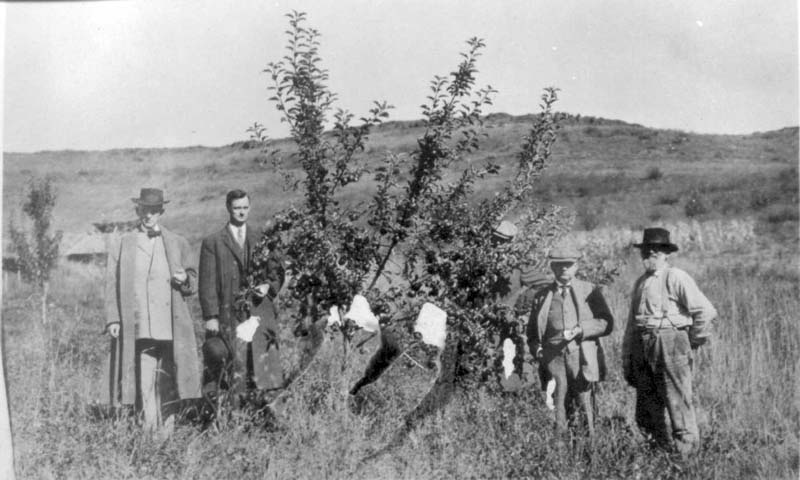
Mesa Orchards started 1914 with optimism, at least on the surface. A letter from New York (recipient unknown) dated January 3, 1914 said:
“The whole project is today one of the best in the Northwest and the orchards are making good in every way and are really becoming famous. The planted land is now selling readily for $600 per acre and the problem is to get it planted fast enough.”
On June 8, 1914 an unusual cold snap hit central and southern Idaho. Temperatures dipped to 20 degrees in some places. Only two areas – Council Valley and Mesa, along with the “Emmett Bench” – escaped severe crop damage. This helped build a sense that Mesa would always be free of the threat of frost.
Although Mesa had yet to deal with was insect pests, many other orchards were already spraying their trees. Mesa would not be spared for long.
Some time after WWI started in 1914, David W. Van Hoesen wrote and undated letter that seemed to have been addressed to Mesa investors. He started on a positive note, commenting that the orchards, “been cared for and developed in the best possible manner and are making good in every way.”
But he continued:
“In the meantime, however, the bonds and coupons have been coming due with startling regularity. Every one connected with the Company has done his level best to meet them and prevent a default. The past three years have probably been the worst this country has ever experienced in a financial way and nearly every kind of development has been checked and most Western enterprises have been forced to declare a moratorium. Notwithstanding those conditions, this company has always before managed to pay its interest promptly and during the past three years has reduced the principal of its bonded-debt from $600,000 to $337,000.
“The Company’s plan was to plant and sell land enough so that the payments therefrom would take care of the bonds as they became due. That plan has worked exceedingly well so far; and if the Company could have planted and sold less than 1,000 acres more of its land the payments thereon would have met the bonds as they matured. The extraordinary conditions during the past year – the tight money, poor business and finally the War and the near panic resulting therefrom – rendered it absolutely impossible to get anyone interested in any way in a Western enterprise. The Company was not able to get the money to plant and develop any additional land and was indeed fortunate to be able to care for what had already been planted.
“The Company, therefore, is in the positions of having plenty of good assets but no money.”
Van Hoesen claimed the land at Mesa, “has been conservatively estimated by those who have seen it to be worth more than twice the whole amount of bonds outstanding; but it is not cash and cannot be converted into cash quickly.”
At one point in the letter from which all this comes, Van Hoesen said, “Personally, I regret very much that the default could not have been avoided. If I had had or could have obtained the necessary money myself I would gladly have paid off the bonds.”
I can find no other references to what he meant about a “default” or its repercussions. Regardless, the company somehow survived.
1915
Just how many of the Mesa Orchards Company plans for 1915 came to fruition is not clear, but an outline for that year showed plans to spend $10,000 on “new store buildings and lodge about May 1st.”
It said 2,500 acres of orchard land was partially cleared and 1,400 was planted to trees. 1,000 acres had been sold to investors at $500 per acre, and the trees would soon be at full fruit-bearing age. The company owned 433 acres of farm land and 320 acres of timber land.
In March of 1915 David Van Hoesen sent a letter to all the purchasers of acreage at Mesa, stating: “The Company has cared for your orchard in accordance with its contract up to this time but is unable to continue doing so because of financial difficulties.” He offered to “take care of your orchard tract during 1915 – pruning, cultivation and irrigation it” and pay the taxes, for $30 per acre, “payable in advance, in addition to whatever fruit crop there may be.”
Owners of over 1,100 acres took Van Hoesen up on this offer, and J.P. Gray managed the work. Some other acreage owners did their own work.
In 1915, Mesa and Indian Valley were connected directly to the Weiser-Council telephone line. That same year, transcontinental connections were completed that gave Idaho nationwide service.
In the fall of 1915 Mesa Orchards reached a vital milestone. The trees finally began to yield fruit. A report by George M. Bull to the Colonial Trust & Savings Bank, October 2, 1915 stated: “This year the peach trees were bearing a very material crop, and the apple trees were just entering bearing. Next year there will be a very material apple and peach crop to be placed on the market.”
Continued next week.
I just put a ten-minute video on YouTube, using movie footage from Dr. Thurston and the Van Hoesen family, showing operations at Mesa in the 1930s and ‘40s, including the tramway in operation. You can find a link at the Council Valley Museum Facebook page, or search for my name on YouTube, or type the direct URL: https://youtu.be/5bSPLww3OCI.
100 years ago
July 11, 1924
The first rain since February fell Saturday night, but the precipitation was very little.
“The section foreman of the P. and I. N. Railroad between Midvale and Weiser lost his left arm and suffered other serious injuries last Friday. The speed car on which he with his crew were riding was hit by the freight train.”
“The Clare sawmill at Vista, Idaho has closed for the time being.”
Two houses and the Church of Christ at Midvale were destroyed by fire in the early hours of Monday morning.
Died: Mrs. May Burger of Indian Valley. She was born in New York to William and Sarah Coriell and came to Indian Valley in 1883. She married Joseph Burger, one of the very early settlers here, in 1886.
Died: Elizabeth Lorraine McDowell-Cole-Hall. She was born in Iowa in 1848, began teaching school at the age of 16 and crossed the plains with her parents with a Quaker wagon train, reaching Boise in 1865. In 1866 she married Daniel Cole and three years later they moved to the Salubria Valley. He died in 1902. She married George Hall in 1923.
75 years ago
July 14, 1949
Married: Shirley Morris, daughter of Mr. and Mrs. Nate Morris of Indian Valley, and Leo Toney, son of Mr. and Mrs. Fred Toney of east of Cambridge.
Married: Patricia Carlson, only daughter of Mrs. Florence Carlson of Council, and Donald C. Whiteman, younger son of Dr. and Mrs. R. T. Whiteman of Cambridge.
A daughter named Irene Marie was born July 9 at the Weiser hospital to Mr. and Mrs. Roy Van Fossen.
49 years ago
July 17, 1975
A week of very hot weather was followed by a severe lightning storm, torrents of rain and extreme wind on Saturday evening. Buildings and trees were blown down. Hail and near tornado velocity winds swept a swath across the area. Power poles were snapped, sprinkler pipes were twisted and broken. Gardens, cornfields, grain crops and some hay fields were devastated.
Died: Richard Lee Herriott, 62, of Midvale.
Died: Houston D. Preston, 52, formerly of Midvale, in Washington.
Indian Valley – “Hazel Johnson is home after going to Boise for the removal of a tooth filling that had lodged in her lung while she was having a tooth pulled.”
25 years ago
July 15, 1999
Ray and Ina Potter celebrated their 65th wedding anniversary.
A daughter named Lynsey Nicole was born June 27 at the Weiser hospital to Steve and Angie Bumgarner.
Married: Dr. Mary Elizabeth Barinaga, daughter of John and Christine Barinaga of Cambridge, and Douglas Rigby of Challis, Idaho.