
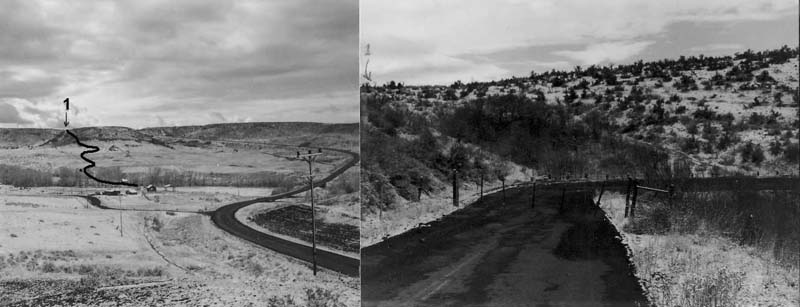
It’s hard to imagine what the Council Valley looked like when the Winkler family arrived in 1878. There were no roads. There were a few wagon tracks, or wagon trails where wagons had traveled enough to call them that, but they were not roads. There may have been few short stretches of fence to pen livestock or keep animals out of a garden. There were vast areas where none of the above, nor a building of any kind, was visible.
Accounts mention the Winklers clearing brush. Much of their land was composed of the bottom land from the east side of the Weiser River to the small creek beside which they built a house and out buildings. It was, and still is, some of the best farm ground in the valley. In 1878 much of it was undoubtedly covered with a thick growth of cottonwood trees and thorn brush. No doubt years were spent reducing this overgrowth.
Two decades later, a mention in the Weiser Signal said that four years after the Winklers arrived (1882) there were only 4 women living the the Council Valley: Mrs. Winkler, Mrs. Moser, Mrs. Kesler and Mrs. Robert White. How accurate this was is hard to say, but George M. Winkler’s wife, Elizabeth Harp Winkler (by then age 20) was surely living here.
As more settlers arrived in the valley, a road through it developed. As I wrote before, the road from Indian Valley over Mesa Hill followed the same established by the Moser family in 1876. After crossing the Middle Fork of the Weiser River (which, of course, would have been a ford before a bridge was eventually built) the road may have passed over the low hills just north of the river something like the present highway does.
However a map drawn by Patsy Phipps Bethel shows the road approaching the valley along side the river – somewhat like the railroad would years later. So, from that Middle Fork ford, the original road may have gone down the north side of the Middle Fork to near its mouth. Like the railroad later would, Patsy’s map shows it angling northeast toward the present highway and the old Mesa Siding.
Regardless of how it reached the valley, the road turned north and skirted the low, east-facing hills west of where the present highway enters the valley near Cottonwood Creek.
After going north along the foot of the low hills, it forded Cottonwood Creek and continued to a point just west of the house at present day 1725 Highway 95 (just across the highway and just north of the Cottonwood Road turnoff).
From there it went east to about where the present highway runs and turned north to where Council would soon become a town. Old photos show it coming into Council almost exactly as the highway did before the bypass (Michigan Avenue). The route here was the approximate route of an Indian trail through the valley. At a point just west of the present town square park, that trail branched, with one branch turning west to go up Hornet Creek.
The other branch turned east before continuing north, skirting the east side of the little hill north of downtown, somewhat like present day Galena Street does. The wagon road through the valley took the approximate route of Galena Street. North of town, my bet is that, the old wagon road probably turned west near the present Kesler Cemetery and then turned north to wander across the hills near the Winkler Cemetery. The route north from there is lost to history, but by the time it reached the George Winkler place (2301 Hwy 95), it passed just east of their house.
In the fall of 1885 the county commissioners had a bridge built across the Middle Fork. The following May the commissioners traveled to Council to evaluate the site for building a bridge across the Weiser River near the mouth of Hornet Creek. The Signal said the mud was axle deep most of the way from Cottonwood Creek to Council and “almost a constant mud hole” from there to George Winkler’s place “4 miles north of Council.” The commissioners decided to put a new bridge across the Weiser river above the mouth of Hornet Creek “at the same site of the old bridge.” I’ve tried to find when the first bridge was built there, but haven’t been able to yet.
Letticia Winkler was known as “Aunt Lettie” to many local folks. She became the closest thing to a doctor in the earliest days of settlement. She had brought herbs with her from the South, planting them when she arrived here. She was a midwife and traveled to the homes of those for which she helped, often staying for more than a week.
Letticia only lived in the valley for about 13 years. She died at the age of 62 in May of 1891.
Continued next week.
100 years ago
November 9, 1923
Married: Glenn H. Johnson and Miss Ruby Shannon, both of Cambridge.
“The post office at Goodrich, Idaho will be discontinued after the 15th of this month and mail heretofore going to that place will come to the Cambridge office.”
75 years ago
November 11, 1948
Married at Midvale: Miss Oretha Snapp, daughter of Mr. and Mrs. John Snapp, and David Deakins, son of Mr. and Mrs. Charles Deakins of the Oregon Side.
Died at Caldwell: John James Marsh, 77, formerly of Cambridge.
A girl named Marilyn Jean was born to Mr. and Mrs. Bert Wilson of Midvale at the Weiser hospital on November 6.
Grays Creek – Don Moritz and Esther Reimer were married at Winnemucca, Nevada.
Died at the Council hospital: Frank W. Maupin, 66, a resident of Idaho since 1908. He had owned and operated the Mann Creek store from 1939 until a few months ago.
Died at Nampa: Mrs. Mary A. Smith, 85, a pioneer resident of Cambridge.
49 years ago
November 14, 1974
Married in Boise on October 11: Miss Pauline Faye Cada, daughter of Mr. and Mrs. Tony Cada, and Fred J. Nye of Malta, Idaho.
25 years ago
November 12, 1998
Richard and Connie Paul are the new pastors for the community Baptist Church at Midvale.
In a letter to the editor about Y2K: “The nightmare is already beginning to unfold as predicted. The rush to get out of the city and into the country is now accelerated and led by the computer programmers themselves. Many government workers I personally know are quietly preparing. Even the wealthy are crating the mansion on the Hill for self-sufficiency out in the sagebrush.”
Died: George Stikney of Washington, formerly of Cambridge in the 1930s.